Albert Brooks has occupied many roles in the entertainment industry – he’s the familiar voice behind one of Pixar’s finest films, as well as being a regular guest on some of the greatest shows in history. He has also proven himself to be exceptional leading man material, as well as a scene-stealing character actor who can play any role, whether heroic or villainous. It’s difficult not to appreciate him since he is one of the industry’s most interesting individuals. Therefore, I recently decided to undergo something of a challenge by looking at another role he has taken on over the course of his career, albeit one that is not nearly as celebrated as his work in front of the camera. Over the years, Brooks has directed several memorable films, each one of them a comedic gem in one way or another. They’re not necessarily perfect films, but they’re all interesting in their way, which has made the previous few months of exploring the few instances where he stepped behind the camera so entertaining. As an actor, he is extremely recognizable and cherished, especially considering his comedic persona has been used brilliantly by many directors over the years. Yet, he is consistently undervalued as a director, so much so that he has failed to attain much long-lasting acclaim, despite having made several fantastic films that can rival any other comedies from their respective years. This conversation aims to rectify this and provide the necessary discourse for Brooks’ status as one of the industry’s finest voices, which is made so abundantly clear throughout his wonderful work.
When it comes to looking at his career as a director, Brooks may not be the most versatile – each one of his films is made along the same lines, always focusing on a main character based on Brooks or his neuroses in some way (obviously being played by him), normally taking place in or orbiting around the film industry. He’s played actors, writers and directors, which is likely drawn from his own experiences. However, this is one case where it is more likely that we can acknowledge him for adhering to the well-worn adage of “write what you know”, since Brooks knows the industry in and out, as evidenced by the small set of fascinating films he made throughout his directorial career. He wasn’t a natural-born filmmaker is perhaps the most polite (and accurate) way to excuse his decision to make films that exist in a very particular wheelhouse. All of them are broad comedies centred on middle-aged men with some degree of psychological instability that makes them act out in erratic ways. Mercifully, we have films like Broadcast News that act as a litmus test for whether one will be able to appreciate what he is doing since his directorial efforts certainly see his peculiar charms operating on all cylinders. There’s very little difference between his on-screen persona and the one he presents off-screen (at least in terms of an offbeat sense of self-deprecating humour – one would hope that Brooks is not as deranged as most of his characters), making each one of his films a labour of love. None of the movies he directed is bad in any way, it’s just those towards the bottom of the list are slightly less original or more focused on a concept that Brooks is not as comfortable exploring as he would be otherwise – but it all comes to create a fascinating set of films that remain as funny today as they did when they were originally made.
It’s easy to just view his work as Brooks crafting vehicles for his gifts as an actor, but there is something much deeper to the process he undergoes when making these films, which comes through in each film, almost as if Brooks is taking a single stock character, which was very closely aligned to his personality (even playing himself in one instance), and building on this general group of individuals that he mastered. Looking at them individually may make us think they’re just simple comedies built around Brooks’ comic persona, but bundling them together brings out a new level of discourse around his gifts as a storyteller. He implicitly knows what makes us laugh, and even when he was always playing it relatively safe, there was a subversive quality to his films – as we’ll see, he’s covered topics as wide-ranging as love and marriage, motherhood, the media, cross-cultural relations, creativity and even the great inevitability of death. It almost seems as if Brooks chooses a particular theme and then crafts a film around it, which ultimately leads to each one of his projects being focused on one particular idea, from which it refuses to budge until it makes some profoundly bold statements, which is exactly why his work is so successful since he brings the same level of hysterical comedy to each film and its unique thematic content.
As with previous editions of this series, the concept is simple – over time, I have watched and reviewed all of his directorial ventures in film, which are ranked and discussed below. There was one exception here – it was decided that one project would be ineligible. The Famous Comedians School, the obscure short film that Brooks directed very early on in his career, while fascinating in its way, is more of a brief experimentation in outright silliness than it is a fully-formed film, and at only eight minutes in length, it was deemed to be an unfair entry into a discussion on the rest of the films that make up this list. I do encourage anyone curious enough to seek it out to do so because it certainly does have its charms. Brooks has not ventured into directing for television (despite having quite a notable presence on it over time), so there isn’t any need to remark on television being excluded.
Without any further ado, here is a ranked list of the films the wonderful Albert Brooks has directed, accompanied by a brief discussion, with the links to the full reviews included in the title for more elaborate thoughts and ramblings on his small but unforgettable body of directorial work.

Unfortunately, when it comes to ranking someone’s films, there is always one that has to occupy the last position. Unlike in previous editions, where there was a very clear and deserving candidate for the bottom placement, Brooks never made a necessarily bad film, but rather one or two that had significant flaws that kept it away from achieving something special. Looking for Comedy in the Muslim World is not a bad film, but rather one that needs a lot more work. Its heart is in the right place, especially in how Brooks is expanding on the idea of the world being united by the common experience of laughter – the ideas are just slightly underdeveloped, and it takes far too long to get to a point of complete coherence, spending too much time on the build-up, only to have the conclusion be anticlimactic and bitterly disappointing. It has some wonderful jokes in it, and Brooks is as charming as ever – it just needed to be developed more than it was, since it flirts with being great, it just fails to reach the point. It is disappointing that this is the final film Brooks directed to date since he has shown himself to still have many fantastic ideas and a vivacity that would make his younger colleagues jealous, and to end his directorial journey with a relatively underwhelming film is unfortunate, but certainly not the disaster it could have been.

If his last film was his worst, his first would be just above it – and by no means is Real Life a poor film, but like Looking for Comedy in the Muslim World, it simply finds many of its ideas lacking, some of the humour being underbaked and in dire need of more precise execution. Brooks receives credit for being ambitious enough to make this film, especially several decades before the advent of reality television, which places cameras in the intimate spaces of individuals and allows audiences unfettered access to their personal lives. The film simply just loses steam – it has many fantastic jokes scattered throughout it, but these are strung together with a narrative that doesn’t serve them nearly as well as it should, and it becomes almost exhausting to see the same ideas repeated throughout. Undeniably, Brooks was working from a place of deep ambition with the creation of this film, and his audacity does not go unnoticed, since Real Life has made memorable moments. These are just slightly too few and far between to register in the way they should have, especially when the premise of the film is incredibly promising, which is half the task when it comes to producing comedy.

Few of Brooks’ films have polarized audiences more than The Muse, which is yet again another fond send-up of the film industry, this time taken from the perspective of a down-on-his-luck screenwriter who used to be able to rest on his laurels from previous successes, but soon comes to the stark realization that one cannot coast on previous achievements for long, since they need to become outdated in an industry that prides itself on the efficient use of its artists. Brooks takes a few steps back and allows his two co-stars to have the spotlight – Andie MacDowell is as charming as ever as the main character’s long-suffering wife who realizes her dreams are worth pursuing, even if it means goes against her husband’s wishes, and Sharon Stone (who is undeniably the film’s main attraction) is allowed to lean into the eccentricities she was usually asked to suppress in her bigger roles, and she proves that not only is she incredibly funny, but that she can command the screen with nothing but her iconic presence and broad set of talents. Some view it as a minor work, others see it as brilliant – except Stone’s magnificent performance, I tend towards seeing The Muse as a more middle-of-the-road effort that is very entertaining, but not on the same level as some of his more notable works.
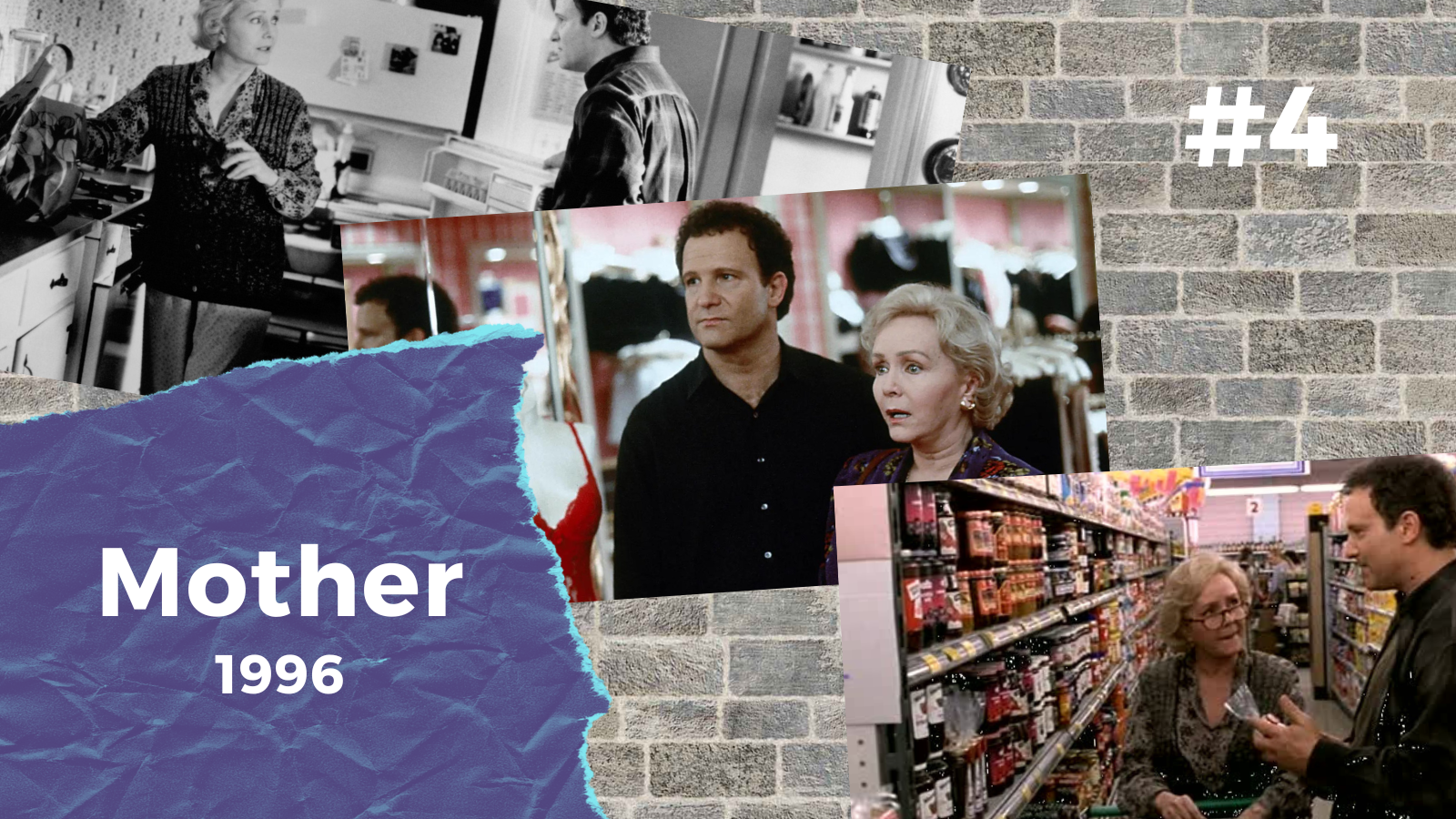
Brooks’ best decision as a filmmaker has been to showcase his talents as an actor, but also acknowledge that an actor is only as good as the people with whom they are sharing the screen. In this regard, you cannot get a co-star more charismatic and iconic than Debbie Reynolds, who plays the titular role in the director’s hilarious and endearing Mother, a film that focuses (much like we can glean from just a glance) on the relationship between a wayward son and his domineering mother. It’s a very traditional film (and one of the many entries into the sub-genre of comedies that orbit around the supposedly hilarious strained relationship between family members), but it has that sense of enchantment that we can often appreciate when it comes to these upbeat films that may not have particularly serious discussions but feel rooted in reality in a way that keeps us engaged. Whether we buy into the underlying message or simply want to see the convergence of two great comedic icons, Mother is a film that represents some of Brooks’ very best work as a writer and director.

There is more comedic ambition in a single frame of Lost in America than there is in entire television series that have been made on similar subjects, and even more hilarity than anyone could ever hope to include in a singular work, let alone one that barely runs 90 minutes. Never before has the idea of a road trip across the United States seemed as chaotic and off-the-wall as it did under Brooks’ masterful direction – and while this may not be my choice for the peak of his work as a director, it might be my favourite film he has made, at least in terms of how Brooks navigates a kind of comedy that is uncomfortable but never unbearable, with the oscillation between awkwardness and humour being a firm foundation for one of the most delightfully chaotic comedies of the 1980s. The film was even inspired by my recent endeavour to undertake my tour of the United States, which was done through comedy films set in each of the states, which was titled Laughs in America, in tribute to this offbeat comedy. Hilariously irreverent and always compelling, there is very little doubt that what Brooks achieved with this relatively simple comedy is one of his finest achievements.

If there is one aspect of Brooks’ career that we cannot call into question, he tends to never do anything half-heartedly, and when he sets out to explore a particular concept, it is always going to be consistent and thorough in its investigation. He had quite a task ahead of him in Modern Romance, which is a very simple film that tackles one of the most complex but universal themes in art: love. Like everything else he has done, the film is filled to the brim with the expected levels of awkward humour, sharp dialogue and memorable performances, including from Brooks himself. This was the moment that Brooks truly came into his own as a director, and with his unforgettable style of taking a relatively straightforward idea and developing it into a complex series of moments, each one well-constructed and meaningful along with being outrageously funny, he makes some profound statements on the nature of love, something that everyone has experienced in some form, but yet still struggles to define beyond the general perceptions we have all acclimated ourselves to believe to be fact when in reality it is all conjecture, something this hilarious film emphasizes more than even the most serious, complex examinations of the same topic.

Was there any other choice for the top spot on this list? Defending Your Life is a film that has essentially defined Brooks, which is quite an achievement considering he has made a career from being unclassifiable – but once we look deeper, we realize how this is the coalescence of everything that he finds compelling and fascinating as an artist. The reason to consider this his best directorial effort is not only because it is a magnificent and brilliant film in its own right, but also because it contains absolutely every element we appreciate in his work, both as an actor and director. While we can look at performances like Broadcast News and Drive as his best performances, nothing has encapsulated the experience of seeing Brooks on screen as this film – every neurosis, insecurity and paranoid thought that has come to be so definitive of the Brooks archetype is represented in this film. It’s not only his best directorial effort, it’s also his best performance (perhaps in a dead-heat with Broadcast News, another film that brought out the best in him as an actor), and has certainly stood the test of time better than many comedies. Infused with layers of Powell and Pressburger, just coupled with Brooks’ eccentric style and a range of very promising ideas, it’s a masterpiece of various genres, and a truly terrific endeavour that will unquestionably be viewed as not only his personal best but a truly important comedy that only gets better as time goes on.
As time goes on, it becomes increasingly clear that Brooks may not step behind the camera again as a director. He has been enjoying living as a slightly reclusive comedy legend, emerging only when it is required or he receives an offer that he cannot ignore (such as in the upcoming Ella McCay, the first film James L. Brooks has directed in over a decade, and a reunion between the pair), which is more than deserved based on his body of work. Regardless, the legacy he has left behind as a writer, director and actor has yet to be matched, and he remains one of the most singularly visionary comedic minds of his generation, amassing legions of supporters from both within the comedy industry and outside of it, with everyone from the most well-established virtuosos of contemporary humour to casual viewers being incredibly influenced by Brooks and his outstanding approach to humour. These seven films tend to differ in terms of plot (and this isn’t even touching on the inventive short films he made over the years, as well as his acting work, both of which could be entire discussions on their own), but they share an inventiveness and originality that is impossible to overlook. Brooks has remained one of the most essential voices in comedy for half a century, and his work is indicative of someone whose dedication to his craft, both that of storytelling and making audiences laugh hysterically, is a job he took very seriously. His work has stood the test of time and is as funny today as it was decades ago, consolidating him into the history books as one of the most important comedic minds of his generation, and someone whose incredible work has never felt more compelling than it does today, a rare feat for someone who simply set out to make films that were entertaining and compelling, both of which were achieved in abundance.
 The Postmodern Pelican