
There’s a sub-genre of comedy that was wildly popular throughout the 1980s, but has seemingly either been mangled to the point of being beyond recognition, or disappeared entirely. These films were based on a simple premise – either an individual or group of people set off for a day out in some major city or tourist location, and find themselves coming across a range of unexpected events that present them with some challenges that set off their survival instincts. The “one crazy day/night” trope is one that has been utilized in a range of ways, but was at its peak during this period – and mentioning this is a good way to start a discussion on The Dream Team, the beloved comedy directed by Howard Zieff, which tells the story of four patients at a mental health facility that are rewarded with the opportunity to go on an outing, attending a baseball game, under the supervision of their psychiatrist, who believes a change of scenery will do these individuals a world of good, only to find himself attacked by a group of malicious criminals, leaving his patients to their own devices, and forcing them to venture onto the mean streets of New York City, where they not only have to try and make their way to safety in spite of being clearly unfit to take care of themselves, but also being pursued as escaped mental patients who pose a danger to society. It’s an interesting concept that is relatively well-executed, even if it doesn’t reach its full potential in terms of offering us the off-the-wall absurdity that would likely have ensued in a later version of this story. The Dream Team is a film many cherish, and while it is easy to find fault in its particular brand of humour, it’s still a very entertaining one, and its promise, while limited, is not without merit all on its own, which has allowed it be a really terrific entry into a genre constantly undergoing a lot of categorical shift.
The Dream Team is not a particularly original or innovative work – it’s a broad comedy that hits all the required beats and delivers exactly what it promises. This isn’t to disparage the film – there’s always value in a film that gives the viewer exactly what we expect, especially when it is aiming to be an entertaining comedy, rather than a redefinition of an entire genre, which is often what is required of films with a slightly more complex subject at its core. This is not One Flew Over the Cuckoo’s Nest in how it looks at the trials and tribulations of residents of a psychiatric facility, but it is also not a flippant and unengaging comedy that draws its humour from the low-hanging fruit. Instead, it’s a well-made and endearing film that has a lot of potential, some of which may never be met, but at least exists close enough to fool us into thinking this is a very effective work. The structure is one that has been proven to be reliable in countless instances – a group of odd-ducks who don’t quite fit together are placed in close proximity and encounter various obstacles that prove that not only are they able to work as a team, but there is always the potential for friendship after all, which is proposed as being nearly impossible (but which any logical viewer will instantly recognize as merely a ploy designed to create some suspense, even if it is the most blatantly obvious resolution imaginable). Yet, it’s not so much a case of determining how original a work is, and more about seeing how the director handles more conventional material, which is where The Dream Team really works, because while it doesn’t offer much, what it does give us is something a lot more meaningful in terms of comedy that is not necessarily innovative, but rather reliable enough to capture our interest.
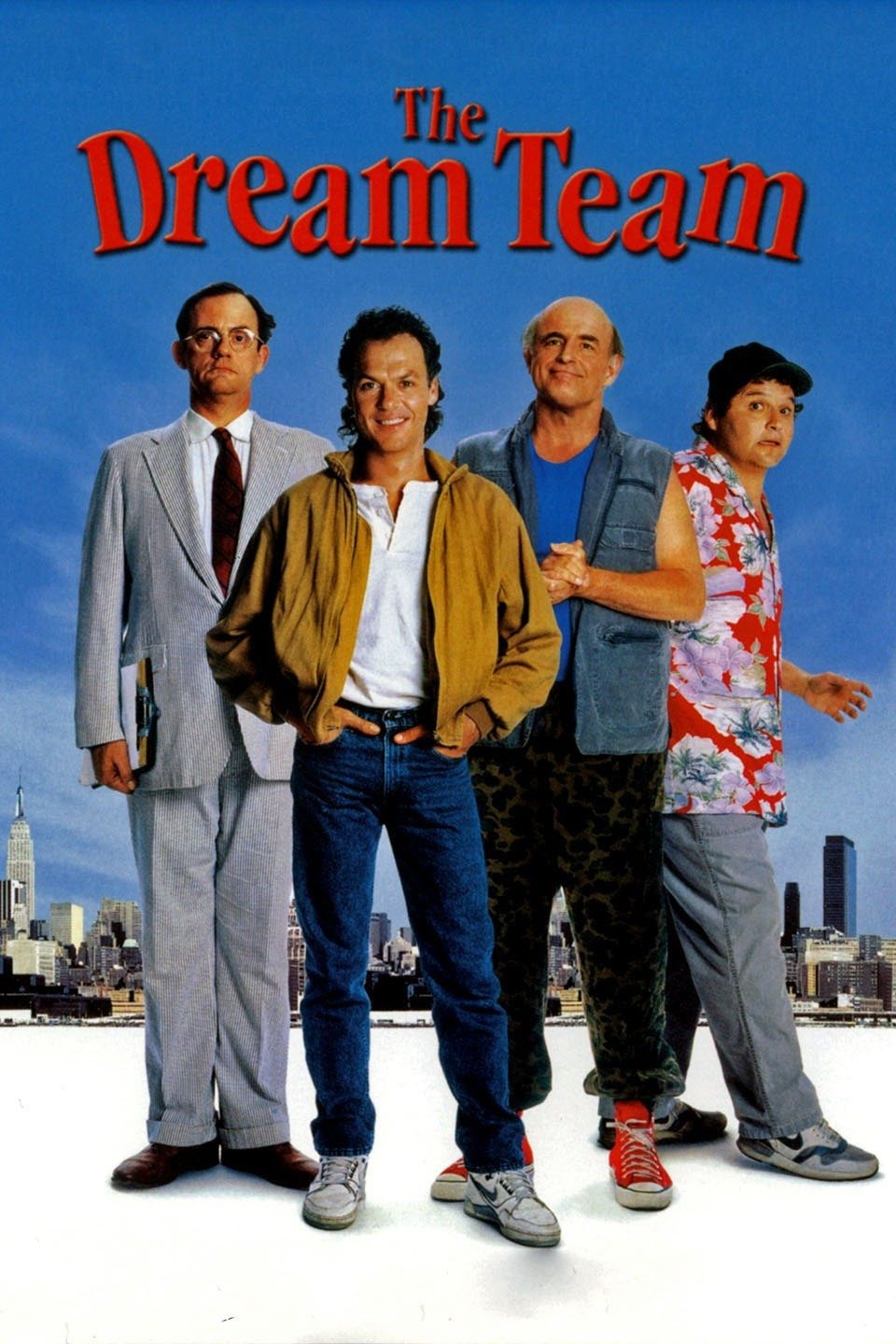
It would be truly staggering had Zieff chosen to make a film called The Dream Team and not bothered to cast actors that could live up to the title. The cast of the film is quite good, even if none of the actors are necessarily doing anything against type – but this is part of what makes the film work, since it makes sure that the right people are chosen to play the roles, rather than taking a risk and casting actors that may have been slightly more unexpected, but perhaps weren’t able to deliver what the story required. Michael Keaton (the de facto lead of the film) is the wise-cracking protagonist with a chip on his shoulder and a sinister streak that allows him to always get his way, while Christopher Lloyd is the cerebral, pernickety intellectual with bizarre obsessions, and Peter Boyle is the sarcastic older character who literally believes he is the second coming of Jesus Christ, all three of them being very entertaining. Stephen Furst rounds out the quartet as the more reserved character who rarely speaks, but serves as the heart of the film (and essentially the catalyst of the chaos that propels the entire story). Nothing particularly revolutionary is being done here, but these are some very solid performances from a great cast who implicitly understand the assignment from beginning to end. It’s a true ensemble effort, and therefore no one stands out any more than their co-stars, meaning that essentially everyone is firing on all cylinders and delivering absolutely stellar performances that are a lot better when viewed in context rather than individually, which is part of the widespread appeal of such a film.
Ultimately, there’s not a lot that can be done about the minor flaws, and it is up to the viewer to determine whether our experience will be enriched by the merits, or soiled by the shortcomings, which is often the case with these very broad comedies. For example, while the performances (as we’ve mentioned) are uniformly strong, the character development is sidelined in favour of the more off-the-wall, zany tone which persists throughout the film. Zieff, as interesting as a filmmaker he may be (particularly as the person who helmed the somewhat revolutionary Private Benjamin, which gave allowed for a cultural reassessment of the wonderful Goldie Hawn) is not the strongest director when it comes to more complex storytelling, and the script itself doesn’t warrant any particularly special mention when it comes to how it writes the characters. Instead, it employs the tried-and-tested method of writing jokes that fit the archetypes, and ensuring they’re given to actors who can handle the material. It’s important to note that the reason The Dream Team works is precisely because it knows its limitations, which was a common quality of this kind of comedy from the era, which didn’t need to convince audiences that it was going against the grain, but instead offering us something valuable as a comedy, rather than a social commentary. The moment we separate this film and its story from the need to assert importance onto every subject is when we can truly just surrender to the entertaining madness that makes The Dream Team so entertaining, since searching for deeper meaning may be a good way of approaching comedies with a satirical edge, but not always the most reliable, as we can see throughout this film, which is much more endearing if we just allow it to progress organically.
The concept of four supposedly insane mental patients being set loose in New York City is certainly a product of its time (and one that isn’t likely in the contemporary era, since we’ve started to look at mental health with a lot more respect, avoiding the “othering” we saw in films such as this), and it can be seen as extremely dated in a number of ways. However, as we’ve seen on countless occasions, choosing to view a comedy from previous decades through a contemporary lens is an immediate method of destroying all goodwill, especially when it comes to something slightly broader, since there is rarely anything all that valuable in these films outside of the ability to provoke laughter, which certainly should not be underestimated, especially not when it comes to something that aims to entertain more than it exists to stir thought. Not particularly complex, but entertaining in a way that feels genuinely endearing, The Dream Team is a charming film, one with a lot of potential, and an even more significant amount of heart. It may not offer us much, but if we’re in search of a film centred on a group of deranged individuals making their way through New York City and encountering many opportunities for mischief, then this film is certainly a worthwhile way to spend a couple of hours. It’s not revolutionary or all that subversive, but it has that genuine charm we often find in comedies from this period, and for that reason alone, there’s a lot of value in this film, which is a lot smarter than perhaps it ought to have been, while never promising us anything out of the ordinary.
 The Postmodern Pelican