
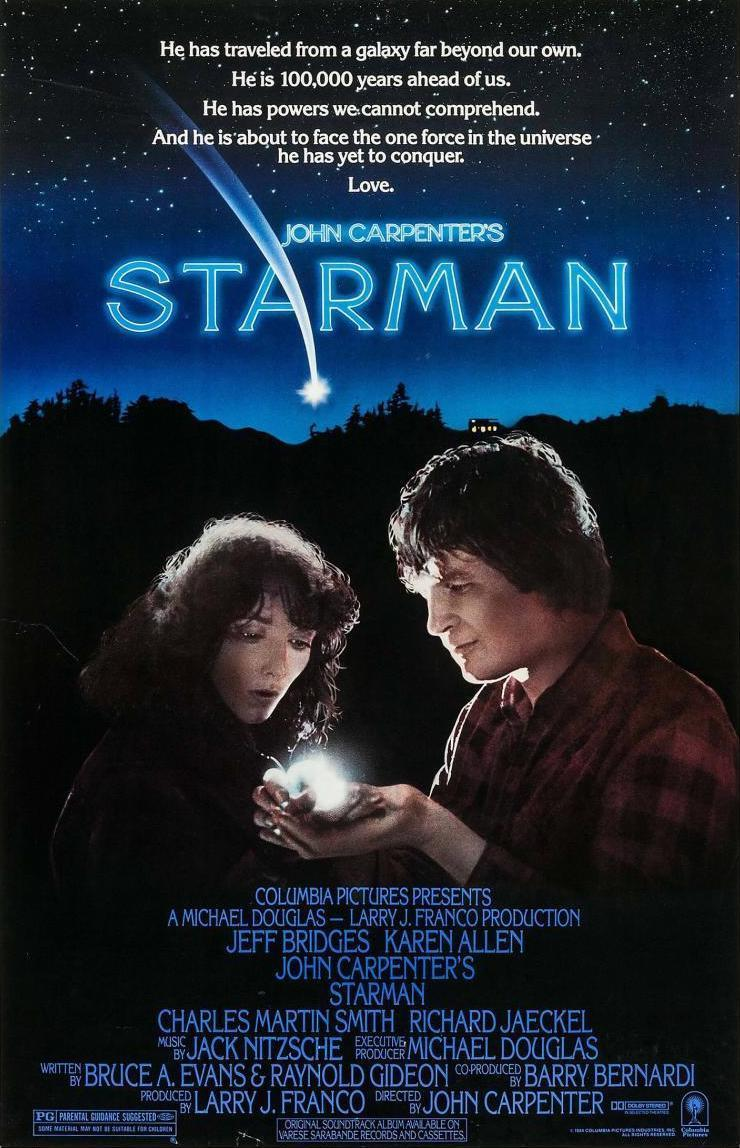
The early 1980s saw a massive shift in the science fiction genre – they were no longer restricted to the realm of the B-movie, and could exist as a legitimate art form unto themselves, instead of being seen as niche genre work. This is very likely the result of the laborious effort put in by directors like Steven Spielberg, whose Close Encounters of the Third Kind and E.T. The Extraterrestrial are considered gold standards of the genre, and remain beloved to this day, not to mention the expansive universes created by the likes of George Lucas and Gene Roddenberry (who is perhaps most responsible for science fiction growing beyond the limits of the drive-in movie theatre), all of which drew audiences of all ages to see which new worlds would be discovered over the course of a couple of hours. This movement opened the door for many great directors to try their hand at some speculative fiction, which includes John Carpenter, who is undeniably one of the most important masters of genre cinema has ever encountered – and he contributed to the growing body of science fiction. By the time he became attached to directing Starman (which had run through multiple directors before he was brought on to launch production), he had already taken a gamble on science fiction in terms of the deliriously bleak and darkly comical Dark Star, so he was not a complete stranger to the genre. However, Starman offered something else entirely, being the kind of sentimental, warm film that were targetted at a global audience, rather than being aligned to the more niche viewership that was more adherent to Carpenter’s work at the time. It’s an entertaining film, albeit one that feels minor – but when looking at a film produced by someone with such an iconic career, even a very good film is going to be rendered as relatively minor in comparison.
Starman is not Carpenter’s best work, but it is one that has many very interesting ideas. Considering he was only helming the film, rather than being involved in the writing process (having been hired quite late into the pre-production schedule after several potential directors departed), we can easily understand why it doesn’t feel like it has his special touch, since conceptually, the film is slightly inconsistent and needed a much more thorough and insightful sense of direction in terms of the story to be fully realized. The cynical view is that Starman was an attempt to replicate the success of films like E.T., which blended the idea of extraterrestrial beings peacefully visiting us, only to unintentionally provoke governmental paranoia, which is offset by the visitor’s growing relationship (or in this case budding romance) with a human who learns of the universe’s hidden secrets in the process of befriending this otherworldly being. If we look at it from this view, it is obvious that this will be seen as a pale imitator, a film that doesn’t bear much originality outside of a few spellbinding moments. However, if we prioritize these particular sequences where the film seems to be at its most unique, we can see that Starman is a much better film than some of its detractors give it credit for. It is a quintessential 1980s science fiction film, with the same level of special effects that we’d expect from that era – and while some may see it as rudimentary, the reality is that this is what gives a film like this its charm, and coupled with Carpenter’s very distinct style of drawing together various ideas, it becomes quite an effective and meaningful piece of cinema all on its own.
One of the more commonly appreciated aspects of Starman are the performances, particularly the one given by Jeff Bridges. Perhaps one doesn’t look at the actor and see him as a likely contender to play a mysterious being from another planet, but this was entirely the point – his broad-shouldered masculinity and All-American charm makes him the perfect contender for the film’s subversive approach to defining the titular character. For once, we see an extraterrestrial that isn’t some bizarre creature that doesn’t bear any resemblance to anything even vaguely human – and this is explained in the film in the form of the alien taking on the form of an ordinary human in order to achieve a particular goal. He may not look like an alien, but Bridges certainly does manage to characterize The Starman as such – not a transformative role in terms of physicality but rather behaviour, he is grappling with a very narrow boundary between insightful character construction and outright parody, and while the film does sometimes struggle to find the space to fully showcase how deep his performance goes, Bridges puts in the work and manages to find the humanity in a character that is about as far from it as possible. Karen Allen does her best to match him, but she doesn’t quite hit the necessary stride, often struggling in both characterizing the role of a young widow grieving the death of her husband as well as coming to terms with the fact that an alien has shapeshifted into him, and meeting the impossibly high standard that Bridges sets when playing the titular character. The two don’t have much chemistry, and they sometimes feel like they’re in entirely different films – but Bridges’ performance is strong enough to compensate for both, even at its most subtle.
What is quite important to remember is that Carpenter’s work didn’t always need to have a much deeper meaning – some of them simply existed for the sake of entertaining viewers, and Starman is one such film. The direction horror and science fiction have taken in recent years has tainted our ability to simply enjoy some of these films, especially those produced outside of the franchises, since “experimental science fiction” and “elevated horror” are buzzwords thrown around without even a moment’s caution – so its only natural to want to assert deeper meaning on a film like this, when in reality, it exists as a very simple work all on its own, without any need to have the most serious or sobering discussions. However, it doesn’t help that Starman is quite a serious film – with the exception of a few lighter moments (almost all of which come on behalf of Bridges’ performance), the film is unfortunately quite dour, and one has to wonder whether it may have been more effective had Carpenter leaned into the humour slightly more, which is precisely where Dark Star found its best ideas. It’s difficult to find a clear reason as to why this film had to be serious, since the subject matter was not nearly grave enough to warrant it (unless the writers were intent on emphasizing the idea of government corruption, which would be the most absurd approach of them all) – and tonally, we find ourselves slightly bewildered, especially since a more upbeat atmosphere would have helped justify the fact that the film was supposedly constructed as a buddy road trip story which eventually flourishes into a romance. Perhaps another viewing is necessary to grasp the reason behind some of these decisions, but as a whole, Starman feels like a slightly missed opportunity to make something brilliant, instead settling for merely decent for most of the time – but it’s on those in which it touches excellence that we should instead focus our attention, since its where the film is much more intriguing.
Starman is far from a perfect film, but it is an adequate one for a number of reasons. Designed to be a charming and entertaining film that had a good message, but was not dictated by some deeper narrative to the point that it felt disproportionate, the film has a very peculiar way of exploring the world in which it takes place. Not enough time is spent establishing the background (since the film starts almost in media res, forcing us to quickly adapt to the story, rather than being eased into it, which isn’t a particularly strong choice), and it sometimes feels disjointed in the way that a slightly more conventional film may have been able to rectify with a few stronger narrative decisions. However, there’s a lot of rugged charm, and while it is clear that it’s aiming for the same portion of the culture that was so enamoured with other heartwarming, thrilling science fiction dramas, its a relatively minor work in terms of both the genre and the director’s own career, but not in a way that feels like it is a waste of time. Starman is a decently-constructed, well-told science fiction film that does unfortunately allow its incessant need to shoehorn in a romance subplot take over the more interesting elements, but at least offers us a degree of worthwhile entertainment, which is a lot more than can be said about a lot of similar films, which may also focus too much on the spectacle than the substance, but don’t have the compelling ideas that Carpenter brings to this story. It’s not a disappointment, but rather a film that should be measured by the value of the sum of its parts, rather than what it was aiming to be, which may have been ideal, but was sadly slightly out of the reach of the film.
 The Postmodern Pelican