
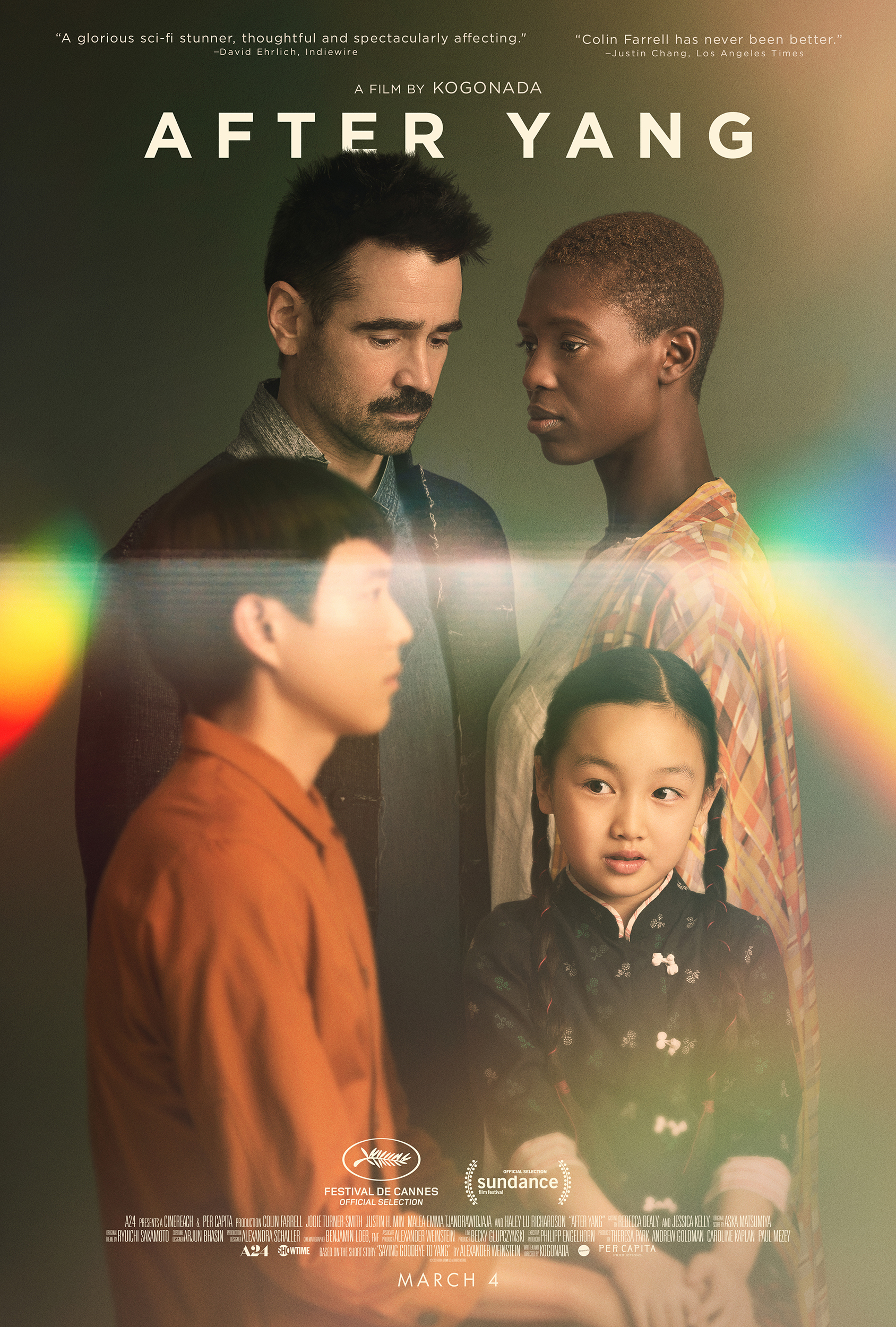
One of the great joys of engaging with modern cinema is that we are given the chance to both relish in the work of the established masters, as well as find new talent that emerges, usually as a result of a wider set of stories being told by more diverse voices. One such example is the case of Kogonada, the pseudonymous Korean-American filmmaker whose passion for cinema extended from a fruitful career making film essays that celebrate the art of cinema in all of its forms (usually paying tribute to his artistic heroes and influences), to becoming one of the most promising young directors working today. Despite having only been involved in three productions so far, his talent is evident, as the two feature films he has made carry almost earth-shattering significance, not necessarily in terms of their form, but rather what they represent. After Yang, which is based on the short story “Saying Goodbye to Yang” by Alexander Weinstein, is one of the most impactful films of the past year, a daring and provocative blend of science fiction and existential drama that once again proves that Kogonada, without any sense of hyperbole, represents the future of cinema, in a way that not too many young filmmakers can be described as embodying. Kogonada’s approach to film (whether as a devotee of the past masters, or as someone who makes it himself) has always been to find the underlying poetry, whether it is in a single frame, an interaction between two characters, or a piece of dialogue – and all of it contains a multitude of meaning that feels beautifully curated by a director whose forthright appreciation for the art form is only comparable to his immense compassion towards the human condition, allowing After Yang to be yet another chapter in what is clearly en route to becoming one of the most interesting directorial careers in contemporary cinema.
As with his previous film, the masterful Columbus (which remains one of the best films of the past decade), Kogonada is centring the ideas inherent to After Yang on the concept of architecture. The main difference being that in the previous film, this was much more literal, with the urban landscapes of a small town in Indiana being used to show the budding romance between two strangers, while here, the idea is more focused on the internal architecture of these characters. In both films, the director is allowing the smallest details to manifest organically, rather than forcing a particular narrative on the viewer. We are carefully guided into this world, which is home to characters that are very familiar to us – not necessarily as individuals with unique traits and characteristics, but rather for what they represent. From one of the first scenes, where we are introduced to the main players (in one of the most unforgettable opening sequences of the past few years), we can immediately tell that After Yang is a film that is prioritizing how it explores the lives of these people, whether they’re the protagonists of the story, or those that are supplementary to their individual narratives, existing on the periphery, but yet being fully-formed in their own right, so much that the film could have just as heavily have shifted its attention to any of them and still be incredibly beautiful. Few narrative films have been able to evoke the concept of sonder more than After Yang – the beautiful but intimidating realization that every person has their own complex, varied lives composed of countless details – and we don’t often find works of art dedicated to openly remarking on the fact that we are all part of an endless series of stories, ours just one of the billions that have existed over the course of our collective history, which is a truly stunning thought, and one that Kogonada uses as the foundation for this stunning film.
The humanity of After Yang is complex and challenging in how it questions some very deep ideas, but it is so beautifully conveyed by the cast, who dedicate their time to bringing these characters to life. Colin Farrell continues to define himself as one of our greatest actors, playing a man whose comfortable life is slowly pulled apart when he realizes how temporary everything is, and how becoming complacent, as tempting as it may be, can only present someone with several obstacles once confronted with the nature of reality. Jodie Turner-Smith is stoic and statuesque as the voice of reason, the person in the film whose ability to see beyond the immediate moment makes her the heart of the film, and the catalyst behind some of the most significant statements made throughout the story. The performances may seem like they aren’t particularly daring, since they’re far more subdued than we’d expect, with a complete lack of hysterics or over-the-top techniques that might be expected. However, they fit into the film as a whole, since everything about After Yang (and Kogonada’s style in general) is more propelled by a kind of nuanced subtlety, where the true power of a single moment is contained not in what we see, but rather what is implied. It’s a beautifully poetic character study that never needs to raise itself too far outside of this state of simmering complexity to makes its points clear. The actors deserve praise, since it is often just as difficult to embrace this kind of subtle, measured performance as it is to go over-the-top, but they commit entirely to these characters, aiding us in the journey into this film, which feels all the more authentic as a result of their incredible performances.
Speculative fiction is sometimes a challenging genre (I’m hesitant to use the term science fiction, since that implies a level of detachment from reality, which is the antithesis of what we see throughout After Yang), since it is one of the few genres where artists are not only allowed to engage in wild flights of fancy, but actively encourages to do so, which can lead to some truly riveting works, but also some that can become needlessly complex. After Yang is a carefully-constructed film, one set in a version of the future that seems far more plausible than most, and which touches on themes that are extremely close to discussions that we’ve been having for centuries. At a cursory glance, it doesn’t even feel like Kogonada is aiming to make a science fiction film in the first place, since the film is so incredibly simple and direct in how it explores certain ideas, which ground it within a recognizable reality. However, the focus here isn’t on technological innovation or the immense progress our species is going to make in the future – it’s more focused on the natural progression of our consciousness, and how we deal with some of life’s most intimidating questions. After Yang is working from a text that stirs up a considerable amount of thought on the subject of existence in relation to the idea of artificial intelligence (undeniably the most distinct subject in the history of science fiction, second perhaps only to the idea of exploring distant galaxies – but even in this case, our fascination lies with trying to discover whether there are other forms of life beyond our own), and some of its commentary is incredibly interesting and leaves space for a considerable amount of discussion about the future. Yet, the purpose of the film is primarily to be a beautiful meditation on life – technological advancement is intriguing, but not as much as the human element that comes along with it, which is the area in which this film is ultimately the most compelling. After all, what is the purpose of immense advancements in technology if it isn’t done to improve the lives of the people who use them?
What is quite remarkable about After Yang in terms of the narrative and the concepts that sit at its foundation is how the story is incredibly simple, but the ideas it explores are far more complex. This small, intimate character study somehow becomes a poignant and moving exercise in humanity, plumbing the emotional depths of existence and trying to find some kind of answer to the question of what it means to be alive, which is something that has provoked philosophers and artists for as long as we have been sentient. Like many others who have endeavoured to answer this question, Kogonada doesn’t find a resolution – however, one can argue he wasn’t even searching for it in the first place, instead provoking some poignant ideas and handing it over to the viewer, who will take whatever resonates with us and build on it through our own individual engagement with the material. Not even the smartest and most perceptive individuals understand the nature of life, so After Yang does its best to present some of its biggest questions in a form that is compact but powerful, which is precisely how Kogonada finds the nuance in an otherwise very simple story. The most philosophically-profound narratives are those that are far more humble, normally created by those who know that aren’t going to solve every mystery that have been asked for as long as we’ve been sentient, but rather that through engaging with the most fundamental ideas, we can find so much meaning that is not solely available to the elite existentialists who dedicate their lives to answering these questions, but accessible to anyone with the ability to look beyond our direct surroundings, and ponder the beautiful mysteries that have been following us around since our conception.
There comes a point in all of our lives when we are confronted with one of the most brutal realities known to us – the subject of impermanence. The realization that, regardless of how rock-steady our lives may seem, that comfort cannot last forever, and that much like everything, it will come to an end. Whether our own lives, or those of our loved ones, we were not constructed to last forever. For some, this may cause something of an existential crisis, while others will see it as a beautiful progression of the natural world, a recycling of resources and ideas that exist in one form for only a short span of time before taking on another meaning as time goes on. Whether we believe in an afterlife, or if we simply view the gradual decomposition as renewal, there is comfort in knowing that life has meaning, even after our physical form has ceased to exist. These ideas form the foundation for After Yang, which is so precise in how it asks these questions, but makes it very clear that the answers are out of its reach, an intentional choice that gives the film a depth of meaning. Pulling apart the layers of this film is a beautiful experience – it takes its time, being measured and paced in a way that may be mistaken as slow, but actually is done to give us the chance to ruminate on these themes alongside these characters – and it becomes a wonderfully complex glimpse into the subject of humanity, filtered through the perspective of a group of characters, both real and artificial, and their individual journeys. It’s a film filled to the brim with the kind of carefully-curated imagery that make for a truly special experience, and while it may take some time to fully understand its scope, After Yang is an incredible film that draws the viewer in and confronts us with some harsh truths, all of which lead to a stunning and evocative series of moments that stir thought and make us look at the world around us in a very different but somehow more compassionate way.
 The Postmodern Pelican