
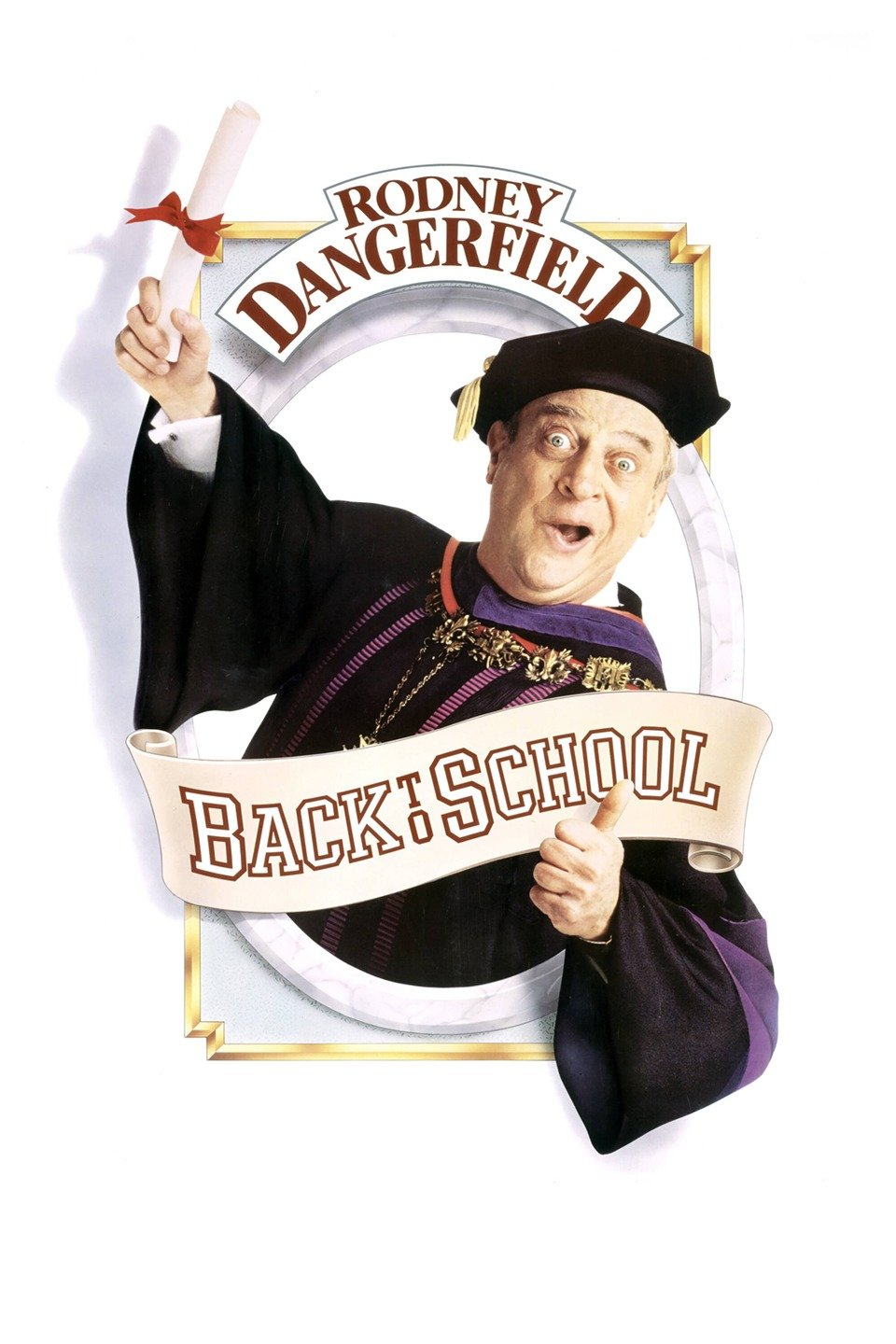
There are two categories of films that feature comedians in the central role – the first are vehicles made to showcase their talents, essentially working as a means to further monetize their popularity. The second are films that see the comedian playing against type, either taking on a more dramatic role, or one that isn’t entirely aligned with what makes them popular. In the 1980s, there were several attempts at placing Rodney Dangerfield, one of the most cherished and iconic comedic minds of his generation, at the forefront. Many of them are associated with the former category, essentially taking the comedian’s common persona of the lovable, collar-tugging everyman who is always ready to deliver a cry of “I don’t get no respect”, and transposing him into a fictional world, where he is basically playing a version of himself. For some viewers, this is lazy filmmaking, since everything orbits around Dangerfield and his unique characteristics, and thus the film is serving the actor, not the other way around. However, there are many that consider this to be Dangerfield’s peak as an actor – perhaps he was funnier in Caddyshack (his retorts in that film continue to crack me up, regardless of how many times I revisit it, which is surprisingly often), or more interesting in films like Natural Born Killers or Little Nicky, which cast him in small but substantial roles that allowed him to actively riff on a version of his persona, but with different effect. Yet, few films have managed to take this beloved comedian and perfectly encapsulate exactly why he held the reputation that he did more than this one, while still being a decent, entertaining effort in its own right.
One of the most surprising aspects of Back to School is how subdued it is – having seen some of Dangerfield’s other cinematic vehicles, one would be inclined to expect a mile-a-minute pace with absurd characters and ridiculous situations, since this was very much par for the course when it came to his comedic stylings. It may be quite disorienting to see how simple the film actually is – it doesn’t lack the over-the-top charm that made Dangerfield’s films so entertaining, but it goes about it in a very different way, keeping it all quite straightforward, and drawing humour from some unexpectedly ordinary situations. This approach isn’t one that necessarily warrants much discussion, and it could simply indicate that the creative minds behind the film were aiming to introduce Dangerfield to a wider audience, not restricting it to those that were already on the comedian’s wavelength – after all, despite being incredibly popular, Dangerfield had his own share of detractors, especially in those that found his persona grating or inauthentic (despite his off-character moments indicating that his real-life characteristics are heavily mirrored in his comedic persona). Ultimately, the best way to describe Back to School is as a film designed for both devotees of the comedian, and for those previously unversed in his work, but willing to experience it for the first time, in a format that contains many of his most significant qualities, but in a way that is ultimately a lot more accessible, rather than the jarring and peculiar stand-up comedy that many have as their introduction to his work.
So much discussion is centred around trying to explain how Back to School is built on Dangerfield’s reputation and popularity, it neglects the fact that he is actually giving quite a decent performance, one that is a lot more complex than we’d imagine based on a cursory glance. Undeniably, he’s not stretching himself too far beyond what he was known to do, and nothing about the film suggested that he was expected to. Yet, it’s difficult to not be entirely charmed by what he is doing here – he’s taking his familiar quirks, and adapting them to be more reflective of the film that surrounds him. If anyone was responsible for Back to School being an uninspired vehicle, Dangerfield would be the least complicit, since he is actually putting in the work, within the boundaries of keeping with the tone of the film. He’s unexpectedly fantastic, and manages to elevate a relatively paltry screenplay (which was put together by a staggering four writers, among the Harold Ramis, who we have to believe is responsible for some of the more inspired aspects of the story). It also helps that Dangerfield is surrounded by strong actors – Keith Gordon is wonderful as his son, as is a very young Robert Downey, Jr., in an early supporting role that shows that he was a scene-stealer from the start. Respected actors like Sally Kellerman and Ned Beatty lend the film more credibility, and there is even a small but memorable role by the delightful and equally-iconic Sam Kinison, someone who is always a welcome presence, since it reminds us of his lightning-in-a-bottle brilliance that is sorely missed – and everyone ultimate comes together under the firm belief that what they’re making may not be great, but its certainly extremely entertaining, which does count for something.
Ultimately, there’s not much to be said about Back to School, outside of the fact that, when we look at it in context, there really isn’t anything particularly revolutionary about the film. The premise is simple and predictable, with the story of a middle-aged businessman returning to college not being entirely original. It also doesn’t help that everything about the film is filtered through being a Dangerfield vehicle – he doesn’t extend himself too much, and is essentially playing himself, just under a different name, and with a slightly different set of intentions. However, where Back to School has shortcomings, it also has an abundance of flaws – there are some genuinely hilarious moments (and surprisingly not all of them come from the protagonist – there’s a wide range of supporting characters who are just as funny), and the premise, while simple, is one that we invest in, to the point where the extremely predictable ending is still riveting, even when we know exactly how the film is going to end. It’s not a complex film, nor is it a groundbreaking one – but it has a lot of charm, and an abundance of heartful humour that help sustain it, drawing out some unexpected complexity from a story that never intended to be all that unique, but rather to highlight its lovable star. Anything that happens alongside it is really only supplementary, which is even more reason to experience this film firsthand, especially since it becomes increasingly clear that there are some genuine surprises lurking just out of view.
 The Postmodern Pelican