
Moral ambiguity has always been the most notable quality when it comes to looking at how Todd Solondz makes his films, with the director himself even remarking on his tendency to go for more perverse stories, especially those that touch on issues much deeper than simply dark comedy. This has always been the case, as we can see in even his earliest work, which contains the same vitriolic sense of humour that we’ve come to associate with the director. Welcome to the Dollhouse is his first official feature-length film (after a few years of purely independent filmmaking, mainly working in short-format storytelling), and it’s not difficult to see that he brought many of the same sensibilities from his time helping define the underground arthouse industry. Filled to the brim with the caustic humour that has categorized him as one of our most polarizing cinematic geniuses, and told with the kind of fervent, deeply bizarre narrative detail that has come to be his trademark, Welcome to the Dollhouse is a truly memorable film, and an important part of cinema history, due to its precise and scathing nature when it comes to the subject of how far social satire can be taken before it becomes exploitative. There are many imitators (including of this very film, which is arguably his most influential in terms of the countless homages and tributes made by those who consider themselves disciples of the director), but there is a level of detail in Welcome to the Dollhouse that feels so authentic and real, and makes it a work of unimpeachable genius, albeit one that is certainly an acquired taste.
Welcome to the Dollhouse is a very effective litmus test to determine whether someone is capable of leaping onto the director’s peculiar wavelength, since it has all of his distinct quirks, but in a form that is slightly more accessible. Over the course of his career, Solondz would push the boundaries of the craft, each film becoming more acidic and darkly comical, playing to the director’s perverse sense of humour. However, unlike many filmmakers that have supposedly mistaken his stark dark comedies as an excuse to mindlessly court controversy, there is method to the madness, which we can easily find throughout his films, which are much more nuanced than their reputation would have you believe. As his first feature-length film, Solondz was working through several ideas, all of which are filtered through the story of Dawn Wiener, a socially-awkward teenager who finds herself adrift in a world that not only confuses her, but is filled with people who are actively hostile to anyone who is different. It’s a recurring theme in the director’s work, and as his entry into the world of larger-scale filmmaking, it’s an audacious debut, and one of the more interesting uses of the renaissance that was emerging around this time in independent cinema – more abstract ideas were finding their homes with boutique studios, which were able to market them to audiences growing weary of the mainstream. Yet, even considering that this film had a likely viewership that would appreciate its peculiarities, its immense success and status as a cult film still seems bizarre, since there are few films that are capable of critiquing society in a way that seems so sardonic, and can manage to still be adored. Yet, Welcome to the Dollhouse undercuts all of this through its bizarre and deranged brilliance.
Welcome to the Dollhouse is a masterpiece of discomfort, the kind of artwork that feels less like a piece of entertainment, being more akin to a deliberate provocation, in terms of both form and content. Throughout the film, Solondz is not trying to give us comfort, but rather inviting us to take a journey with him into this unremarkable New Jersey suburb, which is home to characters that are rendered as nothing short of grotesque. Unlike another provocative filmmaker to which Solondz is often considered an heir, the remarkable John Waters, we are not led to feel any sense of fondness towards most of these characters – where Waters celebrates and embraces the freaks of society, Solondz openly gawks at them, putting them in a position where it feels like we are voyeurs into their world, rather than parts of it. Solondz certainly does not hesitate to show his own disdain for society and its conventions – he doesn’t aim to capture the human condition, he is actively trying to deconstruct it beyond recognition, while still holding some degree of familiarity. It can be a daunting experience to see how the director is constantly trying to provoke us into accepting his invitation to laugh at these people and marvel at their oddities – but there comes a point when we realize that what he is representing is not some abstract otherworld, but rather our own, and that he is reflecting a form of reality that may seem misproportioned under his guidance, but is still drawn from a very clear reality. Ultimately, his freakshow is not one in which physical traits are ogled, but rather society itself, which he views as being the most disturbing deformity of them all, which forms the basis for his unconventional coming-of-age comedy, which is equal parts hilarious and disquieting, depending on where one stands when it comes to understanding the intentions and execution of this story.
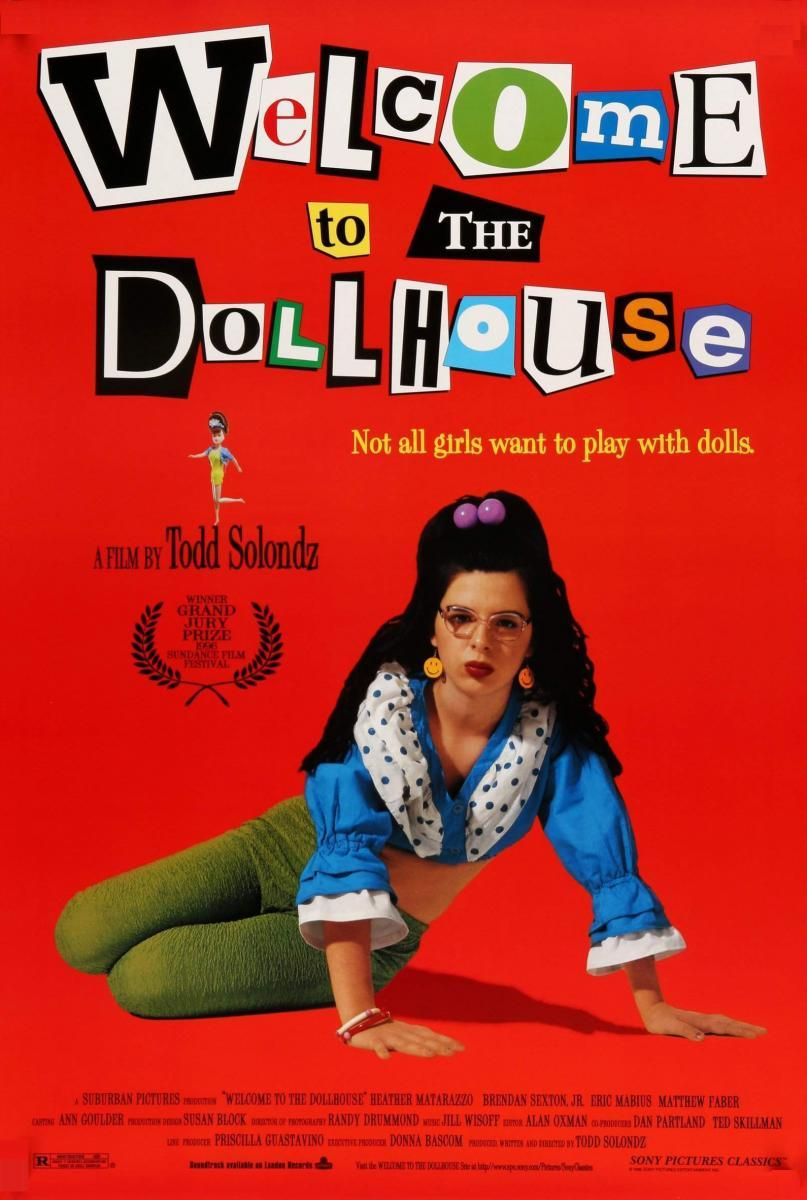
Yet, despite the overt cynicism that underpins the story, Welcome to the Dollhouse is surprisingly affecting, at least in terms of how it portrays the main character. Dawn Wiener is a fascinating protagonist, precisely because she is simultaneously relatable but also undeniably unique – and as much as Solondz may be cynical about the world that surrounds her, he is extremely compassionate in how he frames her journey. A large part of the success comes in the form of Heather Matarazzo, whose performance is nothing short of a revelation. One of the rare instances of an age-appropriate actor being cast in a coming-of-age film (since most at the time skewed towards casting slightly older actors), Matarazzo commands the screen in a way that feels a lot more authentic. Considering the director’s tendency towards creating films that exist at the perfect intersection between social realism and unhinged absurdism, it’s hardly surprising that the central character would be someone whose worldview is defined by feelings of being an outsider. There’s a lot of work done in constructing Dawn as more than just a pale imitation of what the director believes a teenage girl in the 1990s would be (although one of his greatest qualities as a writer is his ability to create meaningful characters, even if they’re as far removed from his identity as one can possibly be), and working closely with Matarazzo allows Solondz the freedom to build a film that simultaneously showcases her talents, while also giving her a role that would go on to define her. Matarazzo deserves a lot of credit for not only turning in a great performance, but being willing enough to trust the director in his vision, since many of her contemporaries may have seen how unflattering and challenging this role was, and avoided it, whereas she embraces it, defining the film and almost single-handedly bringing the more complex human emotions to Solondz’s unsettling and discomfiting set of ideas.
By the time we reach the final moments of Welcome to the Dollhouse, we are essentially at a loss as to what to think. This is a film that is caught somewhere between bleak cynicism and blatant compassion, a series of uncomfortable moments rendered as unconventionally endearing by a filmmaker who finds the beauty in the most unorthodox of situations. Ultimately, you need to have a fondness for the absurd in order to fully appreciate what the director is doing here, since he wastes very little time in establishing that his version of the world is one driven by a nightmarish kind of cynicism, albeit one that never feels implausible. It’s a very dark film, and there are moments where we aren’t sure whether to laugh or feel repulsed, since some of the subject matter goes beyond the limits of decency, and crosses over into the territory where we start to wonder whether Solondz has any understanding of morality at all. However, this is the entire purpose of the film, and we carefully watch as the director addresses a range of complex issues, one idea at a time. Welcome to the Dollhouse is certainly a difficult film, but once we find our stride and start to understand the extent to which the director is willing to go to demonstrate his perspective, it becomes absolutely fascinating, with the blend of grotesque humour and heartfelt coming-of-age comedy making for a tremendously entertaining, and endlessly thought-provoking, series of ideas. Beautifully constructed and made with sincere dedication (to the point where, even at his most morally questionable, we can’t help but feel admiration for Solondz and his perspective), Welcome to the Dollhouse is a truly exceptional film, albeit not one for the faint of heart.
 The Postmodern Pelican