
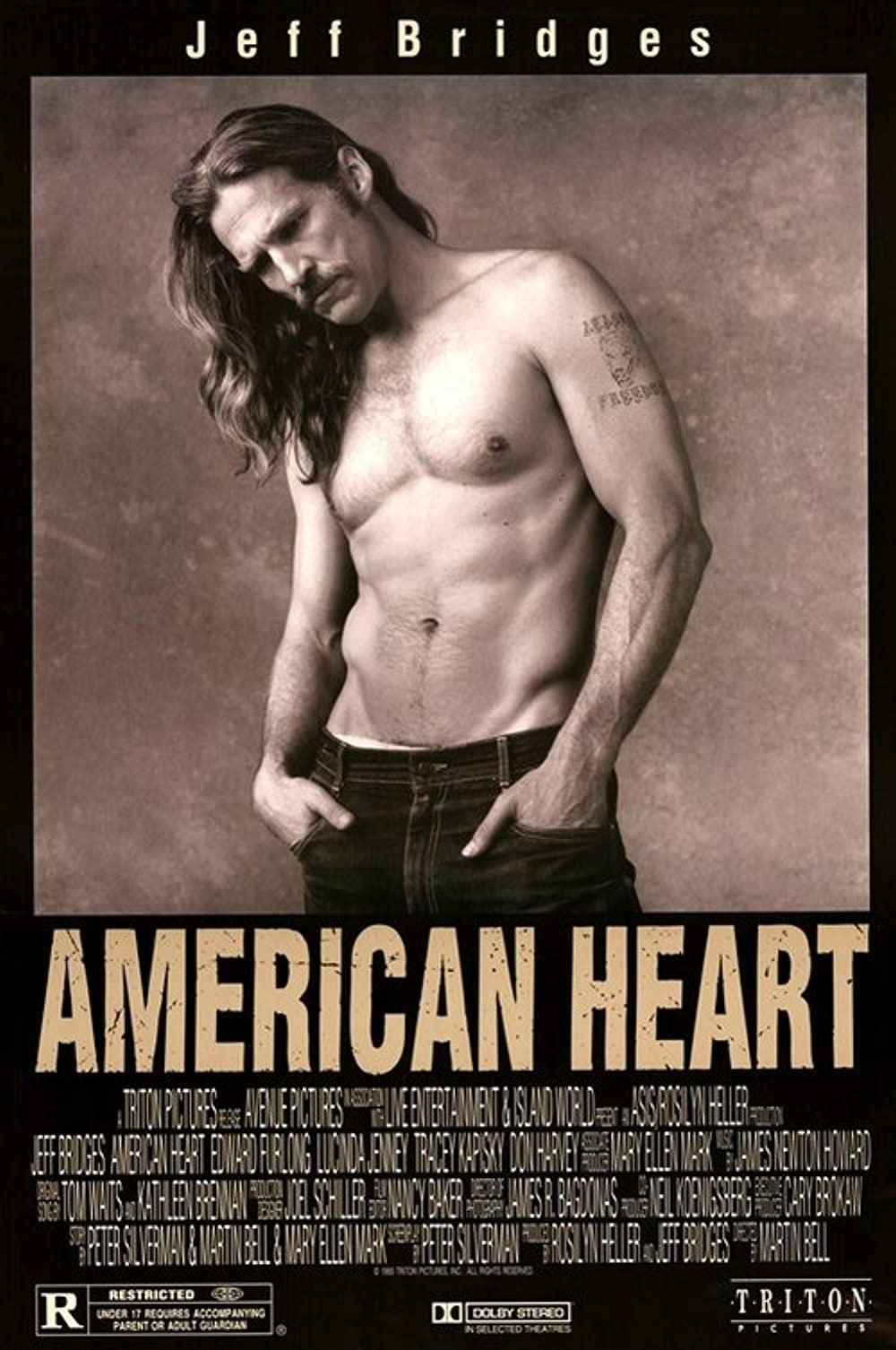
There are so many layers to American Heart, that one can easily spend nearly the entire film trying to find the right entry-point into the world director Martin Bell presents us with. However, the most logical approach would simply be to drop anchor anywhere in the film, and allow yourself to just be immersed in this peculiar and off-beat version of America, as carefully constructed by screenwriters Peter Silverman and Mary Ellen Mark (in collaboration with the director), who tells the fascinating story of a recently-released convict trying to make a life for himself as a free man, only to be confronted by his teenage son, who demands that he act like a father after his time in prison, especially since he is now the only person he has left in the world, putting him in a position where he has no choice but to take on some responsibility as a parent. Together, father and son set off on a powerful journey through the challenging world, one that is both physical and metaphysical, coming to learn more about one another in the process of discovering their own identity amongst the other working-class citizens of their small Seattle suburb. American Heart is the kind of film that feels like it exists on the periphery from the mainstream – beloved by those who have seen it, but almost entirely obscure to those who may not have come across it, or had their interests piqued by the promise of a powerful story about two lonely individuals who find each other, working through the awkwardness and hostility to find common ground, and learning about the harsh realities that neither one of them were all that aware of in the first place. It’s a poetic and beautiful story of human connections, one that is well-written and expertly directed, adding to an era of independent filmmaking where smaller stories emerged and proved to be just as viable as a more conventional premise.
The title of the film has two meanings – the first is a reference to a publication designed to connect prisoners with those on the outside through facilitating correspondence, much of which ends up turning into strong relationships that transcend the prison walls, and occasionally manage to enter into the outside world should the prisoner be released – the magazine is directly mentioned at a crucial moment of the film, and suggests that this was one of the main ideas that propelled the film. However, the second meaning is the one that is far more interesting – considering the people involved in the creation of this film were Bell, who has mostly worked as a documentary filmmaker, and Mark, whose career has mainly been as a photographer, they are both artists with an inherent interest in capturing the human condition, specifically those that relate to the lives of ordinary people in contemporary America. This is evident from the first frame of the film – we are thrown directly into a squalid washroom, where we meet one of our protagonists at a very inopportune moment as he is about to be released from prison. Throughout the following two hours, we accompany him on a journey through the outside world as he navigates life as a free man, which he learns is not all that it is made out to be, especially with the stigma of being a former prisoner following someone around forever. The filmmakers are not invested in telling the story of a man who was misunderstood or falsely accused – they hold him accountable, but in such a way that his plight reveals insights into life on the outside, which is often excruciatingly difficult for those who have spent considerable parts of their lives behind bars. It’s almost as if they have to regain the ability to exist in a world that has become almost unrecognizable – and yet, despite all the challenges, deep within their chests beats the same American heart as when they went in, which is what the filmmakers seem so intent on exploring with this film.
American Heart has a very small following, but it is almost undeniable that what has allowed the film to remain at least somewhat relevant has to do with the work being done by Jeff Bridges. Undeniably one of our greatest living actors (and someone who has been doing some exceptional work for over half a century), the reason he has remained so interesting is his ability to reinvent himself, taking on roles that constantly challenge him as an artist. American Heart features some of his best work – playing the recently-released convict thrown into the world and forced to find a way to not only become a functioning member of society, but also make ends meet for himself and his son, Bridges is about as close to a revelation as a veteran actor can be. There is not a hint of artificiality in his performance, with his quiet rebellion against the status quo that he is instructed to follow making this such a stunning portrayal. A lesser actor would have likely resorted to overplaying the character – after all, Jack is not someone who necessarily lends himself to subtletly, but yet Bridges finds the nuance in a relatively broad character, which only makes for a more invigorating and poignant film, since everything about American Heart is built on these characters. It also helps that Bridges has exceptional chemistry with Edward Furlong, who matches his co-star by bringing to life this insecure but intriguing young man who also just wants to lead a normal life, but finds himself the victim of a range of obstacles that stand in his way. For a film that centres so strongly on the performances of the two leads, American Heart is an absolute marvel, solely on how it manages to bring out a career-best performance in an actor who has been so prolific and diverse in the projects he pursues, which is far from an easy task to accomplish, but which is done with seemingly very little difficulty here.
The incredible performances given by Bridges and Furlong ultimately lead us to the most important concept that underpins this film, namely that American Heart is, above everything else, the quietly resilient story of a father and his son getting to know one another after years of separation. The broader concepts relating to the broken promises of capitalism and the consequences of the penal system are interesting, but what really captivates us is how Bell weaves together all these concept, but in a way that they all ultimately lead back to the most universal theme, that of the relationship between a parent and their child, which forms the foundation of the film, and allows us to understand the perspective being offered by the story. The film hearkens back to the earlier days of New Hollywood (as well as the European films that occurred in its vicinity), where the story of two wayward individuals, drawn together by either fate or circumstance, proved to be the central thrust for many films. As a result, American Heart does not need to overcomplicate anything, and can merely exist as a carefully-constructed story of two people going in search of some deeper meaning to their lives, only to be confronted with challenges that force them to find common ground, which becomes less of a problem the more they find they are similar. It is always helpful to tack on a familial element, but this film takes it even further, making this idea the central drive of the film, and the primary reason it is such a remarkable success, with every intricate detail speaking to the discussion around unconventional families, as well as the importance of forging meaningful connections with the people who guide us through this film – or in the case of this particular story, those whom we have to guide ourselves, which makes for a profoundly moving piece of cinema.
American Heart is the kind of film that can easily pass by without us noticing – despite having been made over thirty years ago, it is not particularly well-known. However, the elements that do make it familiar to a small but vital group of supporters are its greatest successes, and which make it one of the most unheralded masterpieces of the early period of the modern independent film movement, which was defined by stories such as these. Anchored by a mighty performance from the formidable Jeff Bridges, who is turning in some of his best work, and put together by a director who had a clear passion for this material, particularly in how the film investigates certain issues, it is difficult to not find the value in this incredible narrative. Even if we put aside the fact that it is a striking examination of the socio-cultural divide in a post-Cold War America, we can find an abundance of value in how it emphasizes the relationship between a father and his son, which is the emotional heart of the film, and the element that makes it such an endearing and captivating work. A vivid and unconventionally beautiful journey into the heart of American life, the film is a masterful array of images that work together in tandem to create something special. Regardless of what one gleans from the film (since it is one of those stories that lends itself to multiple opinions, particularly in how the main characters are defined), American Heart is a minor miracle of a film, a well-crafted drama about important issues that provokes thought and stirs emotions, all of which are neatly resolved and given the proper conclusion by the end, leaving us in a state of awe, having experienced a truly powerful, poignant story that may not have a happy ending, but certainly does enough with its premise to earn our respect, which is more than enough for a film so clearly intent on giving us insights into what it is like for a sadly enormous number of people in the modern world, who find themselves confronted with insurmountable obstacles on a nearly daily basis, a few of which we find reflected in this truly affecting work of social realism.
 The Postmodern Pelican