
Despite being one of the most celebrated filmmakers of his generation, to the point where he is considered a pioneer of an entire nation’s cinematic culture, Yasujirō Ozu has had a few films produced that are more obscure than others, regardless of the efforts many have put into preserving and distributing his work. For someone as prolific as the esteemed director, it only makes sense that some of his films would be more difficult to find – and outside of his early silent films, some of which are considered officially lost, there is one that is seen as a proverbial Holy Grail in Ozu’s filmography, the wonderful The Munekata Sisters (Japanese: 宗方姉妹), which is not too obscure to be entirely unavailable, but the lack of proper releases by any major or boutique studio in recent years (after concerted efforts to remaster and redistribute Ozu’s work) has made it slightly more difficult to find. However, not all hope is lost, since there have been older releases that have made the film available, and even in a subpar release, the director’s incredible work remains unmatched. As one of his darkest and most melodramatic excursions, The Munekata Sisters is a remarkable change of pace for a director who always seemed rather set in his ways when it came to his methods of storytelling – and throughout this film, Ozu is consistently drawing on a new set of themes that were made available to him through momentarily working for another studio (before promptly returning back to Shochiku), and thus changing some of his stylistic techniques to match with some brand new ideas that weren’t common in his earlier work, which results in a profoundly different experience, but one that is worth every moment of our time.
Some consider The Munekata Sisters to be amongst Ozu’s best work, while others see it as some of his weakest – however, what is almost universally agreed upon is that the film is a fascinating experiment, the impact of which varies depending on the individual viewer. It’s not difficult to determine why this is considered such an outlier in the director’s prolific career – it is far darker than nearly anything he made (including Tokyo Twilight, or any of the later films he made that dealt directly with death and other very serious issues, some of them even including iconography that hints at the very bleak meaning behind these stories), and it also has a more pointed tone than what we are used to seeing from Ozu, one that almost seems to abandon the more easygoing simplicity that Ozu was more known to produce. Yet, it manages to work well, since the director is still very much working within the confine of what he knew to be within his wheelhouse – this is a quintessential story we would expect from Ozu, just in a slightly different form. There is always merit in a seasoned veteran deciding to temporarily alter their pace and try something new, and while in this case it resulted in the film becoming very close to entirely obscure, The Munekata Sisters still has many fascinating ideas that keep it afloat, much more than if it was simply the novelty that many have marketed it as being, with the claim that this is “Ozu’s darkest and most bleak film” being a curious but ultimately irrelevant opinion, since there are an endless array of moments when we are entirely aware that this is just as much a work of the director’s endless imagination as any of his more notable and celebrated films.
The best way to look at The Munekata Sisters is not as Ozu suddenly changing direction and producing something radically different, but rather the director taking some unfamiliar elements, whether it be in terms of genre conventions or small tonal details, and applying it to the kind of stories he would normally tell. Ozu is still very much present in every frame of this film, it just becomes a matter of balancing what is familiar with the aspects that are new and exciting, which is often where the film develops some of its most interesting ideas. Working with Shintoho (who were often the studio behind the works of some of Ozu’s most ferocious peers, such as Mikio Naruse and Akira Kurosawa, both of whom worked with the studio at different points) clearly allowed Ozu the freedom to experiment, especially since they were often cited as the studio that would be willing to take a few risks in the stories they told. This wasn’t an open invitation for Ozu to suddenly abandon the strong reputation he had carefully harnessed over the years, but rather the chance to experiment – and as arguably his most melodramatic film, both in terms of the story and the tone, The Munekata Sisters is a fascinating document of a time and place, as filtered through a slightly darker lens that what Ozu was used to. There are many bleaker moments in this film than perhaps any of the director’s previous or subsequent work – perhaps not in terms of the metaphysical ponderings surrounding life and death, but more direct embodiments of more haunting themes. Clearly working for a rival studio allowed Ozu to loosen the reigns slightly and try a few new ideas, the success of which remains quite divisive, but as we’ve seen before, there is rarely any harm in a director taking a few calculated risks, granted they come from a profoundly meaningful place that has a purpose, rather than being different simply for the sake of it.
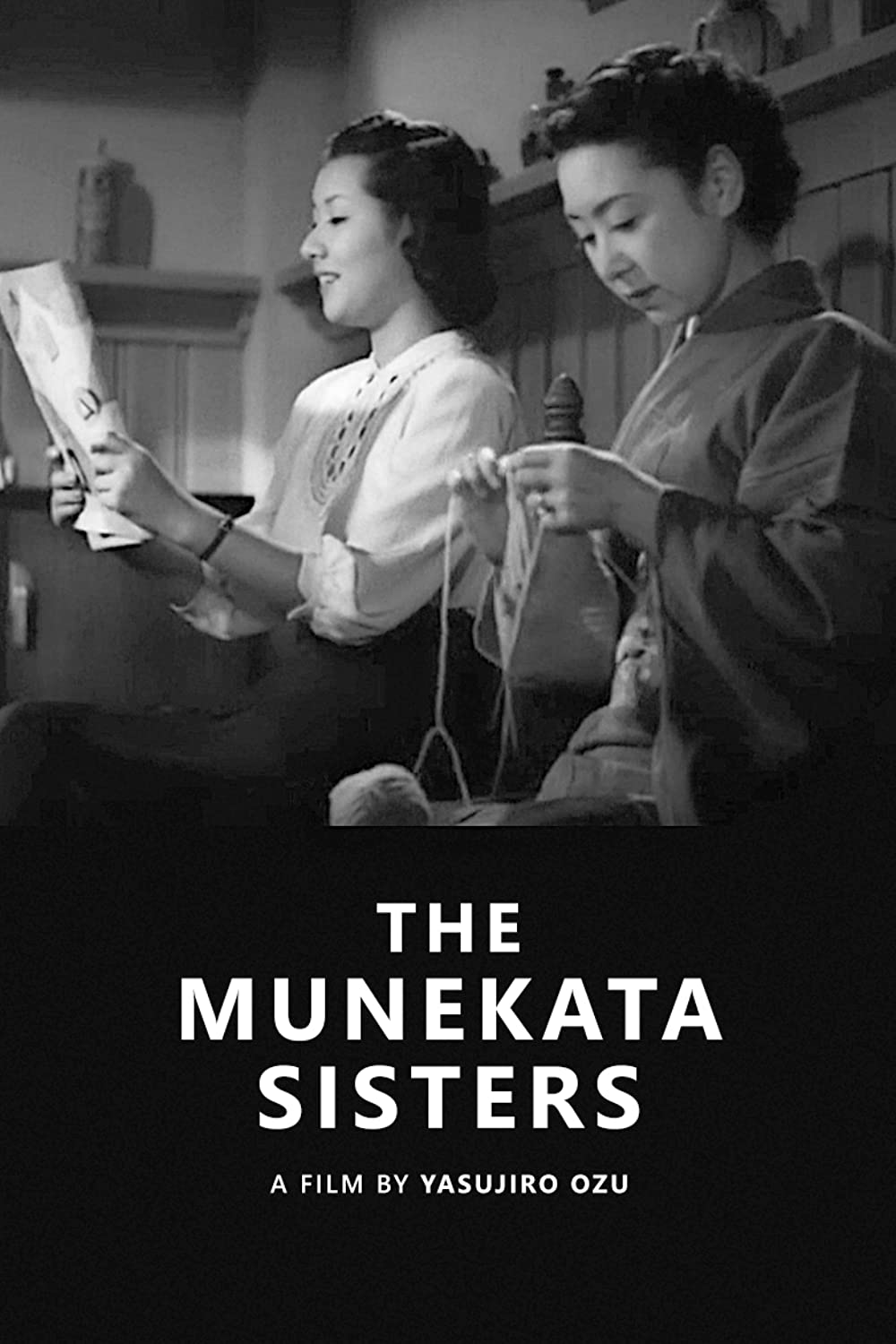
Interestingly, The Munekata Sisters has one of the more curious approaches to characterization in Ozu’s career – neither of the two titular characters are the virginal, charming protagonists we normally find in the director’s work, but rather serve as more complex individuals who are navigating hostile territory. It helps considerably that they are played by Hideko Takamine and Kinuyo Tanaka, two of the finest actresses to ever work in Japanese cinema. Their collaboration with Ozu wasn’t entirely out of the ordinary considering their status in the industry, but it also feels as if this is something new for everyone involved. With the exception of a small role in an early silent film, this was the first and only time Takamine had ever worked with Ozu, while Tanaka was a slightly more familiar face, although not being as prominent as some of the other regular actors that formed his repertory cast. Needless to say, Ozu had a magnificent tendency to direct his actors to doing some of their best work, and despite their many years of incredible performances, The Munekata Sisters contains some of the strongest efforts from both of the leads, who follow Ozu into this disorienting, often quite dark, version of the world, interpreting his characters with poise and charm, bringing their distinct personalities to roles that ultimately carry an abundance of weight as a result of their devotion to the story, and the parts they play within it. Tanaka is particularly impressive – she’s the emotional heart of the film, the person who the audience sympathizes with the most, and ultimately the character who serves as our melancholy heroine, the ordinary woman who decides to take a risk, regardless of the consequences that await her on the other side.
It’s difficult to determine who would get the most out of The Munekata Sisters. It’s not the easiest film to settle into, since the tone is quite jagged and often very bleak, so it’s difficult to recommend it to Ozu neophytes. It’s not far removed from the director’s distinctive style to be appreciated by those who are agnostic to his techniques, and it’s certainly a lot more unsettling than any of his other films, so devotees may have a hard time acclimating to these new ideas. Yet, its also challenging to not recommend the film, even if it isn’t entirely clear on how it will be received – the contradictory cheerful melancholy is replaced by a more melodramatic intensity, and the characters are much more difficult to relate to, mainly due to Ozu ensuring that he offers a deep and insightful glimpse into these individuals, even if it means sacrificing some of the more comforting aspects we’d normally find in these people and how they’re developed. As a whole, The Munekata Sisters is a really fascinating film – it is deep in the ways we’d hope from someone who dedicated his life to his craft as Ozu, and it often even feels as if the director is pushing forward in ways that he had never done before, perhaps to diminishing returns, since he never attempted such a story again. Tonally and narratively, The Munekata Sisters is a strange but worthwhile exercise, and proves that Ozu is far more than just the social realist he is often considered to be, and that like any of his peers, he was capable of incredibly strong work.
 The Postmodern Pelican