
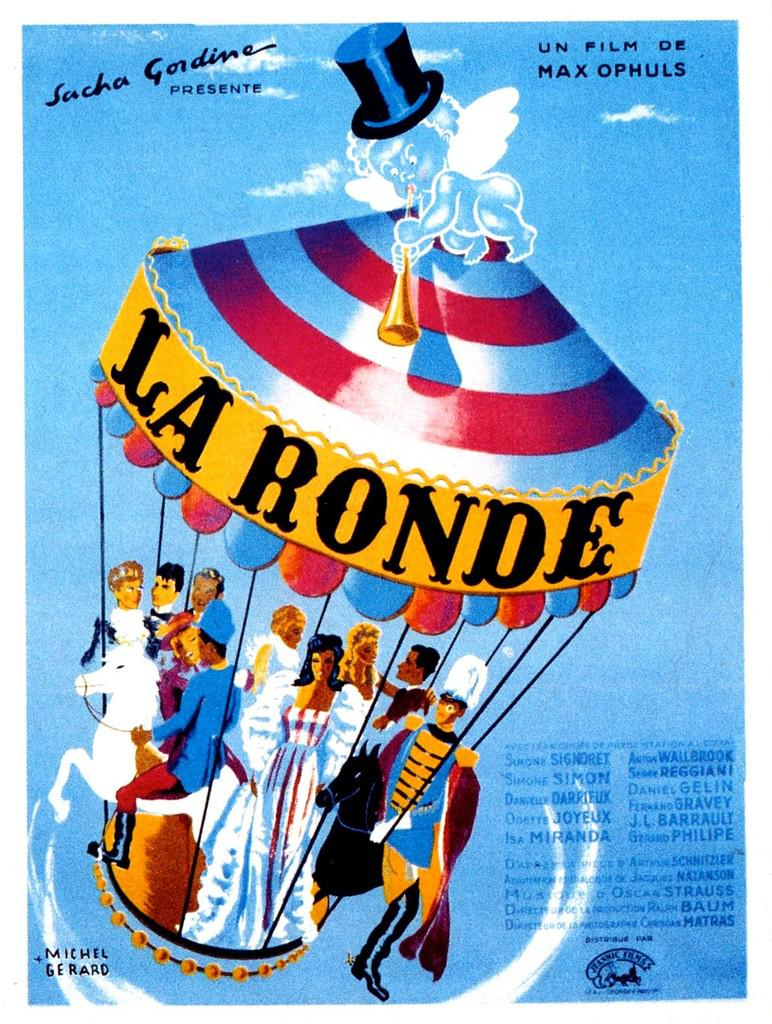
There are moments when I genuinely start to believe Max Ophüls may have just been the greatest filmmaker in the history of French cinema, and perhaps even beyond that. These don’t even necessarily occur in the immediate aftermath of watching one of his films, but rather whenever one of the evocative memories of his work comes to mind, which is a lot more regularly than one would often care to admit. Considering this, imagine the joy at experiencing one of his incredible works for the first time, and acquiring an entirely new set of images and emotions, all carefully curated by someone whose passion for his craft is reflected in every shot of his various masterpieces. Two of his most significant works are Letter from an Unknown Woman and The Earrings of Madame de…, which are often cited as two of his most important films. However, of the films he made between these two incredible works, the best is certainly La Ronde, his audacious adaptation of the stage play by Arthur Schnitzler, for which Ophüls had to fight to gain the permission to make, since the author was notoriously protective of his work, and for good reason: La Ronde (or Reigen, as it was known in its original German) is not an easy premise to adapt, and without someone with an intricate knowledge of both form and content, it would’ve most likely been a bundle of eccentric moments that didn’t lead anywhere particularly important. Ophüls honours the original work, while adding his own distinctive touch, and through some very impressive techniques, and an abundance of heart, he gradually makes a film that immerses us in a world that we are never reluctant to explore, especially when told by someone whose touch can only be described as magical.
Fortunately, if anyone was going to pay tribute to the world created by Schnitzler, it would be Ophüls, whose works are indicative of someone whose grasp on his medium knows very few boundaries, and who continuously pushed the limits of what he could tell on screen in ways that made them thoroughly and consistently ahead of their time. Ophüls has often been cited as someone who peddled mainly in melodrama – and while he certainly is someone who helped define this genre, which was still in its infancy when he made some of the earliest formative steps, there was so much more to his work than just a single-purpose generic approach to the stories he told. Even his unimpeachable masterpieces tend to be very simple in premise, but find their complexity in how they are put together – the smallest details or most inconsequential developments, whether narrative or visual, contribute to the nuanced nature of these stories that are sometimes very progressive, much more than most audiences at the time may have expected – and while it did mean that Ophüls’ was slightly more divisive at the time of its release, it aided them in ageing extremely well, with La Ronde being one that inspired countless works that followed it. How the director manages to take a text as simple as the original play, retaining the distinctive theatricality that is normally indelibly bound to the stage (and is often mistaken for excess when poorly translated to the screen), which merges with a more mature and cinematic point of view, which is the key to how Ophüls and co-screenwriter Jacques Natanson manage to convincingly take Schnitzler’s words and construct them into something that feels genuinely quite insightful, while not eroding any of what made the play so effective in the first place.
The cyclical nature of the title is certainly not lost in the film, since the term “la ronde” (as any introductory text to this film will mention) has numerous meanings in French. However, the one that is of most interest is the elliptical storytelling – La Ronde employs a narrative technique where we are immersed into a world, told by the Master of Ceremonies that we are going to witness several entries into “the endless waltz of love”. We encounter various small vignettes, all of them centred around different forms of romance, and each featuring a character carried over from the previous segment. This structure is unique, functioning less as an anthology (which implies clear demarcation and separation), and more as a never-ending tapestry, a circular mosaic of moments in the lives of various characters as they engage in a range of affairs and lust-fueled encounters, each one of them contributing to the film’s wider intentions, which is to present a broad spectrum of stories that may not be particularly daring on their own, but rather become revolutionary when placed alongside one another. This technique is one that has been used many times since, which is entirely understandable – it’s a loosely-structured method of storytelling that allows for a large ensemble, but where the focus isn’t on any individual character in particular, emphasis instead being on the more nuanced, wide-ranging representation of humanity that makes these stories so profoundly moving. In theory, it sounds like a trivial experiment, but Ophüls’ work is absolutely impeccable, and he frequently pushes beyond the kitschy subject matter to deliver something so beautifully poetic in how it represents love.
Considering how beautiful La Ronde is, we have to honestly question how anyone who came after Ophüls ever thought they could represent romance better than he did in this film. On a narrative level, the film is an exceptionally striking work – but we can’t neglect the more traditional aspects of the filmmaking, namely the visual scope through which the director was working. As we’ve come to expect from him, Ophüls pays as much attention to the appearance of his films as he did their stories – and the pure visual splendour is not to be even vaguely underestimated. The key truly is in how the director carefully creates an enchanting version of the world, one that reflects the film’s very unique tone, which occurs at the intersection between comedy, melodrama and romance, and perpetually hints at the fact that it most likely takes place in a heightened version of our world, one that is driven less by logic and more by magical coincidence. Ophüls had such a special touch, constantly being able to manoeuvre through the more intensely complex narrative details through engaging with them through the lens of an abstract, gorgeously-made visual tapestry. The camera’s fluidity adds to the vivacious, energetic nature of the film, which feels even more dynamic than the story that is transpiring around it. The actors are also excellent, bringing to life a group of interesting characters that would otherwise be considered stock archetypes had they not been so lovingly constructed by the director and his ensemble, who are as dedicated to the pursuit of this daring project as Ophüls himself, who seems oddly adherent to both the smallest details and broadest creative strokes that make up this film.
Rather than being a stifling and overly academic literary adaptation, La Ronde is a film brimming with life, which is achieved through focusing less on the plot (which is respectfully very paltry, but intentionally so), and more on establishing a particular atmosphere, which the director does through engaging directly with the root of what causes individuals to fall in love. It doesn’t have much time to waste, the story consisting of ten individual stories, as well as the wraparound narrative that exists to contextualize what we’re seeing – all into only 90 minutes. The fact that Ophüls could make something like this without the film ever seeming rushed or unnecessarily convoluted is one of many reasons that it warrants widespread celebration. The beauty of the film is already striking enough to qualify it as one of the most gorgeous productions of the 1950s, and the romance is precise and understated, never surrendering to the overtly heavy-handed melodrama that we would expect from such a story. It’s a delightfully irreverent, charming and unique glimpse into the different forms of romance, and through the careful direction of arguably one of the finest cinematic voices of his generation, a committed cast and a precise execution that draws us into this world, it is truly difficult to consider La Ronde anything other than a total, unequivocal masterpiece that understands both its characters and their audience, and makes sure to honour both of them through its peculiar but powerful portrayal of love, and its many rewards and consequences.
 The Postmodern Pelican