
No one captured Rome quite like Vittorio De Sica, whose prolific career is filled to the brim with the most gorgeous and striking depictions of the Italian capital. Perhaps a controversial opinion, especially considering some of his contemporaries, such as Federico Fellini and Roberto Rossellini, are considered formidable challengers for the title, many of their films being considered the most important in the history of the national cinema. However, my personal findings through exploring this era in Italian filmmaking continue to draw me back to the fact that, amongst everything else contained in his arsenal, De Sica was the person who best represented Italy in the post-war period. Whether comedy or drama, satire or warmhearted adventure, his films were always well-made, meaningful and interesting. It also helped that he produced them on an unprecedented level, often directing multiple films in a single year, leading to a few fantastic gems hidden deep within his already iconic career. Il Boom was produced the same year as one of the director’s greatest works, the anthology comedy Yesterday, Today and Tomorrow (which boasts arguably the finest work ever done by Sophia Loren, another unpopular opinion, considering the wealth of magnificent performances she turned in over her career), and is understandably slightly more obscure – but just because it doesn’t have the level of popularity that some of the director’s other films have gained over the years doesn’t mean that Il Boom is any less captivating, and on both a narrative and physical level, De Sica’s film is a fascinating achievement that proves what a maestro he was of Italian cinema, on which he continued to make a profound impact throughout his career.
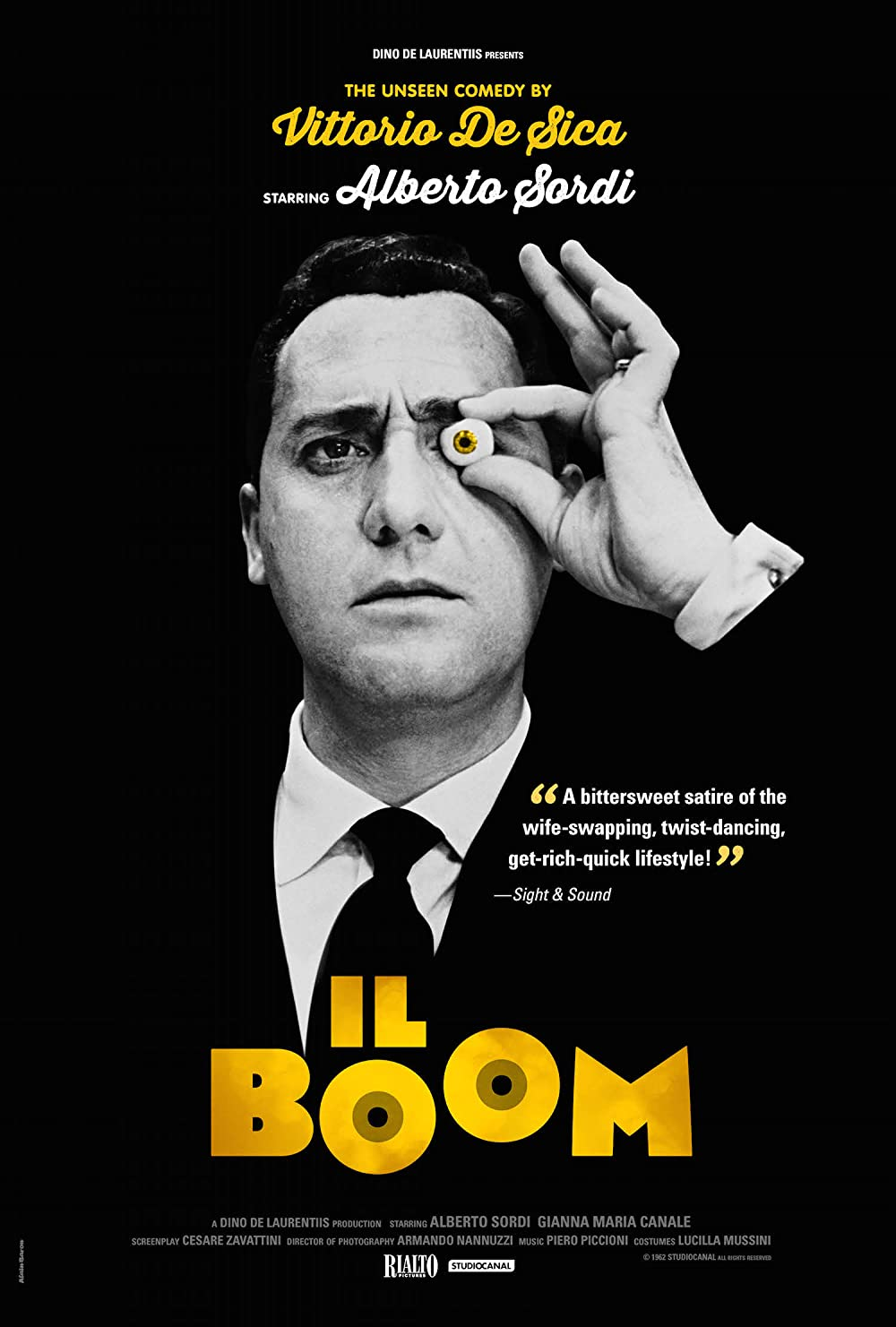
The film is set in a very particular period in the early 1960s, when many European countries were experiencing a brief but exciting moment of wide economic prosperity. This “boom” was certainly welcomed by many people, especially considering the previous 15 years had been dedicated to rebuilding after the widespread damage wrought by the harrowing horrors of the Second World War. However, for some of these people, this period was more challenging, especially for those who took advantage to fully descend into a life of luxury, not realizing how short-lived this moment of economic prosperity would actually be. This film looks at one such man and his wife, who fully immerse themselves in a hedonistic lifestyle, fully believing that this period would last forever, not realizing that nothing that positive is infinite, leading them to fall deeper into debt, with nothing they try seeming to work in alleviating the burden of what they owe for their reckless lifestyle. The premise is a very simple one, since it follows this member of the petit bourgeoisie as he makes every effort to pay off his debts, showing himself willing to do anything, as long as it keeps him out of prison (and more importantly, prevents his name from appearing in the debt register, which he would consider the biggest disgrace imaginable to someone of his status), even going so far as to agreeing to donate a vital part of his body for the sake of ensuring that he and his wife can maintain this extravagant lifestyle, proving that even when confronted by crippling debt, there are some individuals who would rather stay comfortable than admit defeat, which is one of the central themes of this film, which ventures deep into the heart of Italian society to tell this peculiar but enthralling story of the social and economic divide.
There are many strong components that went into the creation of this film, but one of the most prominent (and arguably the aspect that helps it become such a successful satire) is how De Sica calibrates the humour, putting it alongside the more dramatic content to create a multilayered satire that may not necessarily be all that heavy-handed in terms of emotion, but does have a weight to it that may not be entirely expected at first. Understandably, this comes from De Sica’s history in the Italian neo-realism movement, and while Il Boom is very much indebted to the Commedia all’italiana school of humour, there is an earnest approach to the subject matter that keeps it quite authentic – instead of placing the characters in absurd or heightened situations separated from logic, the director finds the humour in the most realistic scenarios, focusing on the more authentic representations of life in the decades following the recent war – and in 1963, the country had established some distance between those austere years, but the remnants of the impact made by the war was still very much present, which informed much of what De Sica was conveying with this film, which is a lot more simple to execute than one would expect based on the subject matter. It’s an intricately-woven comedy with a lot of depth, and through engaging with some bold ideas that would not normally be considered the folly of an upbeat and hilarious comedy, Il Boom manages to be quite a profoundly moving film, the kind of thought-provoking satire that may not always be as coherent and straightforward as we’d expect based on the story, which goes in numerous unexpected directions, but it does find the charm in the more challenging narrative recesses, turning this into quite an unexpectedly complex glimpse into the other side of Italian society, the kind that isn’t as often represented in hard-hitting realist dramas.
Obviously, at the heart of Il Boom stands Alberto Sordi, whose status as one of the finest actors in the history of Italian cinema only continues to rise with every new film of his I encounter. He is something of an oddball amongst his contemporaries – he may not have had the gravitas of Marcello Mastroianni, or the intensely charming machismo of Vittorio Gassman (two other actors who emerged at roughly the same time as him), but his very peculiar acting style, and seeminly complete lack of hesitance in playing any role, regardless of how unlikeable the character may have been, made him one of Italy’s finest character actors. Il Boom rests squarely on his shoulders, Sordi being present in virtually every scene, the entire plot depending on this hopelessly pathetic hedonist who will do anything to maintain his life of luxury, even if it means literally selling one of his eyes to ensure that his wife (who is equally as selfish) doesn’t leave him forever, since in their world, being rich and miserable certainly beats being a happy vagabond content with his or her place in the world. Sordi is wonderful, as usual – it’s not his finest performance (but when your best work is the outstanding An Average Little Man, it’s difficult to compete when you simply fail to compare), but its one that consistently showcases his gifts as an actor, each moment he is on screen filled with the kind of hilarious passion he always brought to his roles. Veteran actress Elena Nicolai is also a scene-stealer as the sympathetic but maniacal older woman seeking out a worthy applicant for the most bizarre request, while the likes of Gianna Maria Canale and Ettore Geri also turning in memorable performances, which ultimately service Sordi and his character’s journey to move out of this dreadful situation, with outrageous results.
Hilarity consistently ensues through Il Boom, which is a film about the social consequences of economic prosperity, a combination that may be surprising to many, as it doesn’t appear to be something that is feasible, but has actually been proven to be a reality for many individuals who find themselves losing their sanity when confronted with a fleeting moment of opportunity, in which they capitalize on the riches offered to them without making a solid plan for the future. In the midst of this very interest critique of postwar Italian society, De Sica manages to consistently provide an abundance of laughs, placing the characters in increasingly strange situations that may seem outrageous, but are actually solid representations of the social and cultural milieu at this time, which saw many individuals doing whatever they could to ensure their lifestyle remains intact. Desperate times breed different measures, and Il Boom proves exactly how many people embodied this very idea, to the point where it becomes almost farcical, an off-the-wall satire that has its roots firmly in reality, its intentions always being purely based around a heightened but earnest depiction of reality that pushes beyond what was being done in the more realist texts at the time. At its heart, Il Boom is a well-meaning satire about an idiotic man doing anything he can to avoid admitting defeat – and as we’ve come to expect from the director, it leads to an enthralling and wonderfully bizarre satire with a lot of heart underneath its thorny exterior, all of which is part and parcel as to why De Sica was such a brilliant filmmaker, capable of mastering both comedy and drama, and frequently delivering stunning work, regardless of the genre.
 The Postmodern Pelican