
I have nothing but the most sincere admiration for artists who can forego comfort for the sake of telling important stories. We often see many individuals use their creativity in a chosen medium to tackle subject matter that would otherwise not find a place had they not put in the effort, many of them drawing from their own experiences. Audrey Diwan has officially confirmed herself as one of the most exciting voices in contemporary European cinema with the arrival of her sophomore feature film, which is an adaptation of Annie Ernaux’s semi-autobiographical novel, Happening (French: L’événement), in which the author writes a slightly fictionalized version of her experiences as a young student in the early 1960s, in particular the challenges she faced when she discovered that a casual affair resulted in an unwanted pregnancy, which would not only make her a social pariah, but get in the way of her extremely promising career as a young writer, impacting her studies should she choose to carry the child to term. Diwan works alongside fellow screenwriters Marcia Romano and Anne Berest to write an exceptional and heartbreaking adaptation of Ernaux’s novel, whose beautiful prose is brought to life in the form of this stunning film, which pays tribute not only to the original material, but to a particular time and place, being as much about the author’s experiences as a young woman as it is about a specific moment in French history, which Diwan explores with such intricacy. A social realist text that is both harrowing and vibrant, and told with the kind of steadfast dedication that normally comes when younger filmmakers are allowed to realize their passions, Happening is a truly extraordinary film, and one that is undeniably going to come to be seen as one of the most important, both for its subject matter and the very distinct ways in which the director handles the material.
Any discussion of art as being a form of therapy needs to take into account the people involved in its creation – Ernaux herself is not directly involved in this adaptation of Happening in any official capacity, with most of the work in translating her novel to the screen being put on a team of young artists who clearly admire her, and are willing to engage with her source material in a way that is constructive and captivating. However, this does not change the fact that Diwan is undertaking the terrifying task of bringing Ernaux’s experiences to the screen, a format that doesn’t always honour novelists as well as it should. Ernaux’s work has previously been the subject of a couple of films, namely The Occupation and Simple Passion, but yet it was this adaptation of Happening that seemed to finally do her work justice. The first step towards adapting this novel took place in the clear acknowledgement by Diwan and her fellow screenwriters that what they’re working from is an extremely personal text – regardless of how much they try and adapt it perfectly, their perspective will always pale in comparison to that of Ernaux herself. It sounds like a way of allowing for artistic liberty in what is supposed to be a very straightforward account of the author’s earlier life, but it gives Diwan space to explore other themes alongside the central narrative, which begins to blur with external factors in the creation of this rivetting cultural document, which uses Ernaux’s haunting story and the challenges she encountered as a young student trying to make her way through a hostile world as an anchor for a poignant examination of the socio-cultural history of France, which is one of the essential components of the author’s work, where her candour and willingness to speak to a range of broader issues through her own experiences have made her an engaging and acclaimed artist, whose work is universal in theme, but deeply personal in scope.
Happening is a portrait of France at a particular point in time, both in terms of certain locales, and the people who occupied it. It is primarily a social realist text, using Ernaux’s beautiful words as a way of venturing deep into the cultural history of the country, and its varying mentalities when it came to the major issues. The 1960s are a peculiar period – it’s a decade that was sufficiently recent for us to be able to relate to many of the same beliefs, but far enough for the filmmakers to put some distance between contemporary perspectives, and those present at this specific moment in history. Life has considerably changed in many ways, but there are some instances where archaic beliefs linger on, being passed down through generations as remnants of the past, many of which still evoke deep discussion, especially in regards to inter-generational stories. Happening takes on an enormous subject in the form of abortion, which was only legalized in France in 1975, over a decade since the events depicted in this film. Using Ernaux’s heartbreaking account of her journey to terminating an unwanted pregnancy, which not only comes with deep ruminations on the subject of femininity and motherhood, and how various people them somewhat differently, but also an unsettling portrait of the consequences. Throughout the narrative, the main character is presented with a number of scenarios that explicitly state that, should she decide to engage in a back-alley abortion, even if she manages to survive these dangerous procedures, she is bound to pay the consequences, with very little mercy being shown to those who engage in what was considered an immoral destruction of life, rather than a choice each woman should be allowed to make about her own body. All of this is filtered through Diwan’s gorgeous depiction of urbane French society at a watershed moment in the feminist movement, which is perfectly captured through the stunning testimony provided by Ernaux, which is the solid foundation for this film.
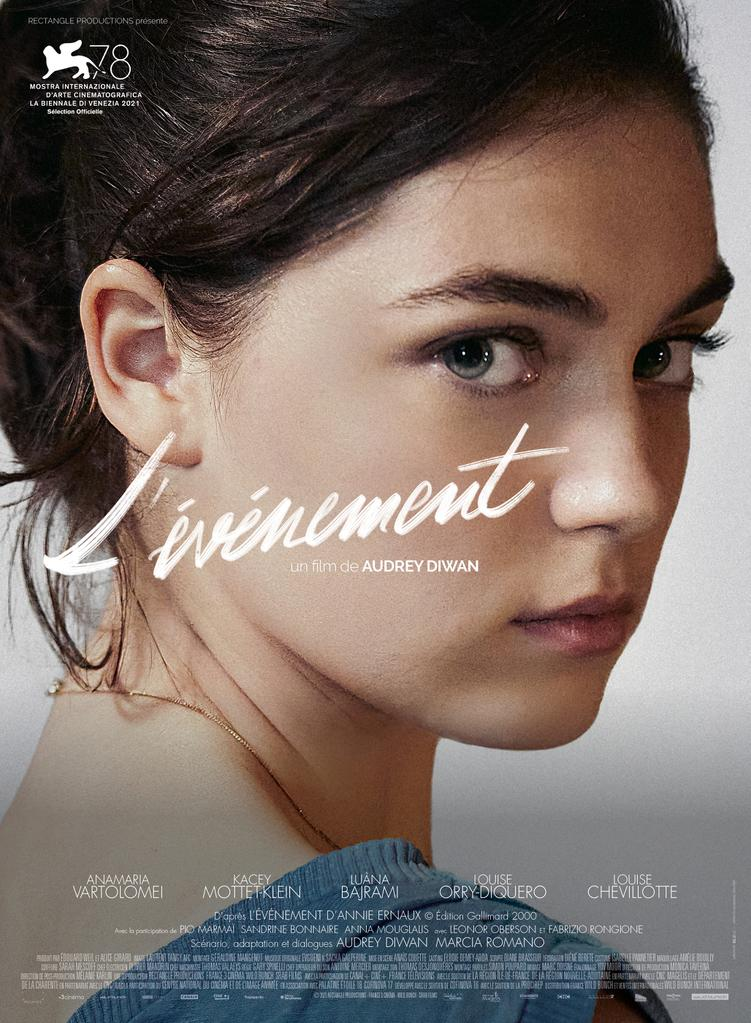
In painting a vibrant portrait of France and its people, Diwan makes sure that the primary roles are occupied by actors who can handle the extraordinarily bleak material. Anamaria Vartolomei, who has steadily been rising in stature to become one of the most promising young actresses in contemporary French cinema, is an absolute revelation in the role of Anne, the semi-fictional character based on Ernaux in her younger years. This is an extremely internal role, one that required the actress to make use of a deep set of emotions, which manifest in more subtle ways. There needed to be a concerted effort to avoid hysterics, since that would immediately take us out of the film and its very precise method of calibrating the hard-hitting drama with the more subdued social realism. Happening is primarily focused on the character of Anne, so everyone else is essentially on the periphery – however, this does not preclude the film from having some incredible performances in the supporting cast. Sandrine Bonnaire (who played a similarly troubled young woman in another feminist masterpiece, Agnès Varda’s groundbreaking Vagabond) plays the main character’s mother, who has a difficult relationship with her daughter, especially when there are brief interludes where she starts to doubt Anne is intent on achieving what she set out to do. Fabrizio Rongione (who has worked with masters of social realism, Jean-Pierre and Luc Dardenne) is excellent as an empathetic doctor, while Kacey Mottet Klein is as reliable as ever as the aloof but good-natured friend to Anne, perhaps the only person she feels she can truly trust. However, it is Anna Mouglalis as Madame Riviere, the mysterious woman who conducts the abortion, who grounds the film, being an enigmatic presence that complicates both the life of the protagonist, and the film that surrounds them. There is some absolutely stunning work being done by this cast, which is composed of actors who genuinely feel like they’re inhabiting the minds of these characters, surrendering to the more bleak material with an authenticity that is beyond admirable, making the film far more realistic than one might expect.
The quality that is most striking about Happening comes directly from how strong the characterization is – without such well-curated individuals functioning as the centre of the narrative, Diwan would’ve had a much bigger challenge when it came to adapting the novel, which takes the form of a first-person narrative, thus making most attempts to translate this perspective directly to the screen quite difficult. She manages to address these themes through the film’s perpetually engaging approach to the material. Films that focus on very important subjects have a tendency to be quite heavy-handed in how they address these pivotal issues, almost as if the director is intent on providing us with a lecture on a particular subject. This overwrought preaching is mercifully entirely absent from Happening, which instead uses the platform as a way of presenting the reality of the situation. The film is not averse to placing the main character in bleak situations, nor is Diwan opposed to showing her struggles in explicit detail. There are numerous moments where this film is extremely graphic, with the discomfort we feel in those situations being the result of the film’s fervent dedication to presenting a visceral portrayal of the main character over these excruciating few months of her unwanted pregnancy, which she constantly tries to terminate, each new effort putting her through more physical and psychological torment. We’re privy to her struggles as she navigates a world that aims to dictate how she, a young woman, should conduct herself, and what she is permitted to do with her body, of which she learns she does not nearly have even close to the amount of autonomy that she thought, legally at least. The contrast between what is considered moral, and the desperation felt by the main character in how she will go to any lengths to have this problem rectified regardless of the consequences awaiting her, makes for profoundly beautiful, thought-provoking filmmaking
Happening is an undeniably difficult film to watch, but one that is worthwhile purely for the perspective it offers. It is a heartbreaking, character-based psychological drama that presents us with the story of an ordinary young woman who finds herself in an uncomfortable situation that eventually becomes a major crisis in her life. It’s a complex ode to femininity that takes the writings of one of literature’s most important voices, and channels it to the visual medium, shepherded by a young director who openly acknowledges that her perspective may not be identical to that of Ernaux, particularly in regards to the fact that Happening is based on an autobiographical novel, but still comes through as a work of unbridled compassion for the myriad of women across the centuries that have found themselves merely objects, pawns used by a patriarchal society to represent their archaic views. The character of Anne may seem like a relatively ordinary young woman, but she comes to represent every young woman who has decided to fight against the system that seeks to oppress her and view her simply as a body, rather than an autonomous individual – and the exceptional simplicity of the film is underlined by a ferocious anger that simmers consistently throughout, showing the extent to which some had to go in order to retake control of their bodies. Empathetic but extremely haunting, Happening is a powerful manifesto on womanhood, filtering the world through the lens of a young woman in the 1960s who has grown weary of being told what to do with her body, which sadly contrasts sharply with contemporary perspectives of the same conversation, proving that, despite considerable efforts in terms of shifting mentalities, that not much has changed, and the same struggles Ernaux experienced over half a century ago remain unfortunately resonant to this very day.
 The Postmodern Pelican