
James L. Brooks may not make films that necessarily stand out as the most innovative or experimental works, but are instead the epitome of consistency, which is likely drawn from a long career working as one of the more powerful executives in Hollywood, being responsible for the creation of many cherished works, many of which endure to the present day. More known as a producer for television, he has also had his fair share of triumphs behind the camera as a director, having made a small handful of films, almost all of which carry merit, even when they veer towards being conventional, which can sometimes be their most significant strength. One exception to this is Broadcast News, which is unequivocally his best directorial outing – Terms of Endearment may be his biggest success critically, and As Good As It Gets has its supporters, but nothing comes close to the brilliance that is embedded deep within the director’s masterful satire on the news industry, a world that is driven by the incessant desire to produce the biggest headline in the shortest time imaginable. Far from perfect, but as close to it as Brooks ever managed to reach, the film is constantly grasping at greatness, and it undeniably does manage to catch hold of it at many moments, which prove to be some of the most riveting ever made when it comes to a genre that is much more inclined towards cliche than others, much of which Brooks may not be able to fully avoid, but rather works with it in a way that feels genuinely quite insightful, drawing on his own wealth of experience to construct this wonderfully endearing and deeply provocative satire that wears its heart on its sleeve, and makes it very clear that it is aiming for a much more special kind of approach to something as objective and consistent as the news.
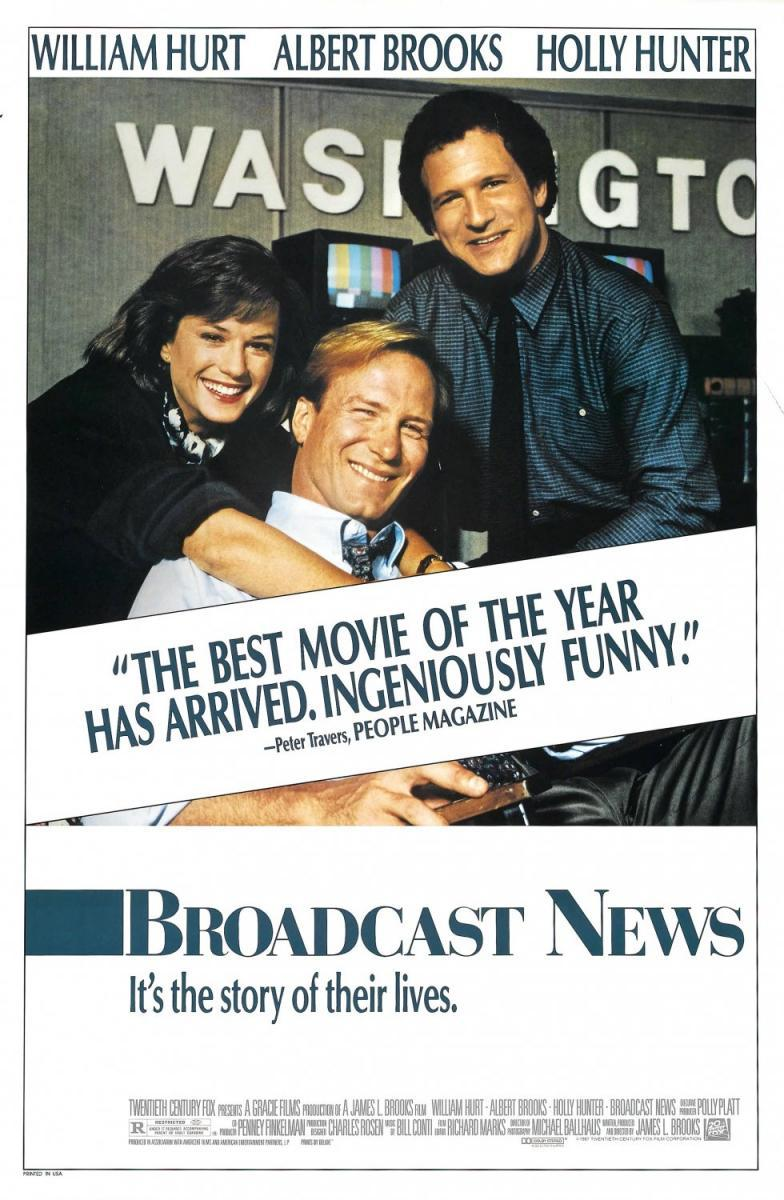
I was thoroughly charmed with this film – not too many comedies can evoke such a feeling of warmth and comfort, especially not when it is centred on something as cold and brutal as the news industry, which is built on capturing human suffering and global conflict, since these make for riveting viewing. The film exists in a genre that has been so thoroughly explored, that one has to wonder whether anyone will be able to reconfigure something that has seen every conceivable interpretation. The answer that Brooks offers in Broadcast News is quite simple – you don’t have to. Being reliable and playing by the rules can be perfectly appropriate, granted it is done in a way that is interesting and compelling, which is one of the primary reasons why this film succeeds. The premise is extremely simple – two rival news reporters battle for dominance in a satellite office of a major news network, while simultaneously trying to win the affections of their steadfast producer, who is more invested in her job than she is in any kind of relationship. Brooks seamlessly blends together satire and sentimentality in this charming comedy, which is able to evoke such sincere emotions without seeming to be putting in too much laborious effort, one of the many great qualities of the director’s work, since he manages to put together stories that make their intentions very clear, but never feel as if they’re aiming for the obvious resolution, instead taking us on a narrative voyage that may have a predictable conclusion, but where the actual journey is what makes it so worthwhile. Every scene seems intentional and well-placed, so much that we barely notice the unexpectedly long running time, since we’re so transfixed by the world Brooks has managed to construct in this newsroom that may feel physically small, but is the stage on which a truly fascinating story gradually unravels.
Perhaps the most important quality of Broadcast News is that this is a film that feels profoundly and unabashedly human. Considering it exists in a genre that often thrives on archetypes, the fact that this film has a core set of performances that feel real to the point of bordering on something much deeper makes the film all the more compelling. Undeniably, the responsibility for bringing these characters to life fall to the actors, who prove themselves to be incredibly capable of handling Brooks’ sometimes verbose and precise dialogue. Holly Hunter and William Hurt were both at their peak at this point, grappling with the boundary between both the mainstream and more artistic fare, which allowed them to flourish into remarkably intelligent and interesting actors. Neither are known for their comedic prowess, which is exactly what makes their work here so impeccable – they’re not oblivious to the humour of the film, but they play the characters as if they were in a straight drama, which in turn allows the film to be a much more playful affair, since it never feels as if the actors are leaning into the comedy, but rather allowing it to highlight their more stoic performances, which works in the context of the story being told. Both are doing absolutely brilliant work here, and there is an argument to be made that this is a peak for both of them, especially in comparison to the more dramatic work that has been more definitive of their respective careers. Of course, the reality of Broadcast News is that despite being constructed as a vehicle for Hunter and Hurt, the true star of the film is Albert Brooks, who turns in the performance of a lifetime as Aaron Altman, the ambitious young reporter who has his sights set much higher than many would allow, which results in him consistently being on the receiving end of some tirade, despite being someone who is constantly doing his best to master his profession. Brooks is one of the funniest individuals in the industry, but he is also someone with an unprecedented level of sincerity, which makes his performance here such a revelation. He may not be one of the romantic leads, but he is undeniably the heart of the film, someone who is more than just comedic relief, but rather the moral, soulful compass that keeps the film on course and allows it to be such an extraordinarily complex human comedy.
If there is a flaw in Broadcast News (and to be clear, this is only a minor issue, something that doesn’t bear much relevance in swaying any opinion on the film as a whole, but it is worth noting as a point of discussion), it is that it is slightly tonally off-kilter – it is caught somewhere between a caustic satire and sentimental romantic comedy, which may not sound like a conflict in theory, but does tend to be somewhat contradictory in terms of tone. Much like his previous directorial effort, Brooks has a hard time establishing a clear tone, and while this was easily concealed in Terms of Endearment, which could justify its excess under the category of being just part and parcel of the domestic melodrama that it was aiming to evoke, it is much harder to hide in this film, which starts as a scathing satire of journalism and the people who live their lives reporting on the major events, but briefly becomes a very sincere romantic comedy, before reverting to something more serious in the third act. This adds up to the film being slightly inconsistent, but not in a way that is necessarily distracting or even vaguely a shortcoming. Instead, its shows that Brooks was actively trying to create something more engaging than just the run-of-the-mill film we’d normally expect from this material. Whether or not he is successful remains to be seen – the most interesting material is found outside of the central dynamic between the two protagonists (and the attempts to introduce a love triangle feel forced, especially since it never has much of a resolution, and mainly exists to provide more conflict, which wasn’t all that necessary), and while the focus logically goes towards the romance, since this is likely what audiences were seen to be most responsive to – but it’s in the moments in between where Broadcast News is most effective, with its strange sense of humour allowing the film to have some subtext that is far more appealing to those who aren’t interested in the more hackneyed conventions of the romantic comedy.
In an industry where pushing the envelope can be seen as risky, a film that plays by the rules can sometimes feel gloriously defiant in its own way, especially since a story like the one in Broadcast News is addressing issues that were slightly ahead of their time. It’s staggering when we suddenly remember we are watching something that was made in the mid-1980s, which was a considerably different time in the global culture (and some of the content is dated to that specific era – a bewildering scene sees Hunter and Brooks venturing into Central America to immerse themselves in a guerilla group of Contra fighters, which is so absurd, it almost makes sense in the context of the film), but yet the themes they’re touching on are timeless, and speak directly to modern sensibilities. Naturally, the film was made before the advent of the 24-hour news cycle and the omnipresence of the media, being made at a time when the nightly news was a brief but cherished affair – and offering us a behind-the-scenes glimpse into the processes that go into producing this content is fascinating, and is likely plucked from the director’s own invaluable experience as a very powerful figure in the industry. The fact that Broadcast News can be a conventional romantic comedy, but still make a considerable amount of time for the more subversive commentary proves that it is far more than the straightforward film we expect based on a cursory glance. The important distinction here is that this film is as strong a satire as any other, but rather than bursting through with the scathing commentary from the first moment, it invites the viewer into this world, easing us into the position of passive observers, and then gradually unravels its much deeper meaning, which somehow manages to exist alongside the romantic plot, rather than in spite of it. As we’ve said already, Brooks is the embodiment of consistency, and this only proves how, when used correctly, dependability can be a great asset to a filmmaker.
Broadcast News is a film about pushing boundaries – it may not do so in a way that is all that evident, but it certainly is not a film that is necessarily trying to depend on conventions, at least not in a way that could be seen as veering towards the default. This film is an actively engaging, genuinely exciting comedy with astonishing performances and a strong script that is amongst the best writing Brooks has ever done, which is certainly high praise for someone who has been present in the industry for over half a century. As one of the most memorable lines in the film says, there are certain lines that are inevitably going to be challenging to not cross, and in a film as actively vibrant as this one, “the little sucker” that governs morality and decency is certainly never far from view. The film may be drawing our attention to the romantic plot on which much of the conflict is based, but we often find ourselves drawn to the more intricate details that come in the moments of sincere social commentary. The film is a striking meditation on a range of complex themes, carefully curated by a director who understands that a great work is one that balances both broad strokes (and they don’t get broader than some of the moments in this film), and the more detail-oriented moments in which the film sits in quiet rumination on what it means to be in a profession designed to deliver the major issues of the day in a way that is accessible and factual, but also captivating. There is such a narrow boundary between entertainment and the news, and this film finds a happy medium between them, ultimately showing the fact that, regardless of how much we tend to view one it as objective, the news is simply yet another version of showbusiness, and under the guidance of a director like Brooks, it is absolutely magnificent and as thrilling as any satire the viewer is likely to come across, earning every bit of its reputation as a true classic of socially-charged, deeply sentimental comedy.
 The Postmodern Pelican