
One of the reasons I revere Alfred Hitchcock as much as I do is because, despite being arguably the finest filmmaker to ever work in the English language, he wasn’t afraid to take a few risks on occasion. Some of these turned out splendidly, many of his films being subversive and influential entries that would go on to inspire countless other filmmakers in later decades. However, it only seems logical that some would be less successful – and even when confronted by failure, Hitchcock didn’t let that impact his other work, which was always fresh and taken from a new artistic perspective. Stage Fright was produced at the beginning of what many argue is the director’s most important decade – the 1950s contained many of Hitchcock’s greatest works, and the ones that are mostly considered his greatest (had Psycho been produced only a year earlier, this fact would be undeniable). Yet, it is relatively underseen, and often appears as more of a footnote when discussing a decade that is otherwise filled to the brim with quality motion pictures. The reason for this isn’t that it is some unheralded, misunderstood masterpiece – it’s that Stage Fright is quite simply not a very good film, and is firmly within the director’s lower tier. However, this doesn’t at all imply it’s entirely without merit – a Hitchcock film is always going to contain something interesting, even if these elements are mostly relegated to the margins. This film has its positive aspects, and they’re not too difficult to find, granted the viewer is willing to sit with the film and really look beyond the exterior, and instead focus on some of the smaller moments that prove that, even when playing in a slightly minor key, Hitchcock’s work has value.
Interestingly, the problem with Stage Fright isn’t the story – the premise is quite solid, and is quintessentially something we’d expect from the director. The story of a young actress and her father trying to help prove her love interest’s innocence after he is supposedly framed for murder by a malicious stage performer is fertile ground for a fascinating and insightful character study, especially under the guidance of someone as gifted as Hitchcock, who is used to these kinds of narratives, at least in terms of their fundamental aspects. The problem comes through in terms of the tone – Stage Fright isn’t sure whether to play it as a psychological thriller or overly theatrical drama. Its humour is also quite strange – it is caught somewhere between an outrageous farce and a bleak, harrowing dark comedy that traverses some risky subjects. The inability to choose means that the story is constantly meandering, never having the opportunity to settle on one particular aspect, instead trying to manoeuvre itself around many different tones and themes, which does the narrative a great disservice, since there is always some deeper meaning lurking beneath the major themes, but it just struggles to manifest since there is inconsistency in the tone. It doesn’t mean that the film is without merit, but that Hitchcock seemed to be neglecting some of the more familiar elements that he was more known to achieve through his directorial efforts – the tone is off-kilter, and the constant oscillation between thematic registers creates an imbalance that truly doesn’t give the necessary credence to a film that warranted a bit more attention.
Tone doesn’t normally matter too much in a film, at least not to the point where it can be considered unsuccessful if it doesn’t work as well as other elements. At a cursory glance, criticizing Stage Fright for its tone, and implying that this is its most substantial problem, seems inappropriate, a clear case of nitpicking for details. However, if there was anyone who knew the importance of setting a particular mood and establishing an atmosphere, it would be Hitchcock, whose films almost uniformly adhered to the belief that a good story needs to be entertaining and intriguing. It’s not so much that Stage Fright is dull than it is that the film doesn’t know what to do with itself in the more quiet moments, since there isn’t really much suspense. The story itself is interesting, but it’s not well-composed enough to entirely depend on the narrative channel, since there are many moments that are painfully obvious, and the big twist (while shocking) doesn’t warrant a middling execution. We want to become invested in this film, but it’s truly difficult when nearly every component within it isn’t all that strong in the first place. It’s a classic case of an idea that seemed like a strong premise in theory, but struggled to maintain that promise when it came to actually putting it into practice, every scene seemingly having different intentions, and a lack of cohesion forcing us to gradually grow weary of this story, which isn’t compelling enough to warrant such inconsistency, especially from someone as esteemed as Hitchcock. This story deserved something much better, even more so considering the screenplay was written by the director’s long-term professional and personal partner Alma Reville. Stage Fright had all the components for a successful thriller, so it’s disappointing that it doesn’t use them all well.
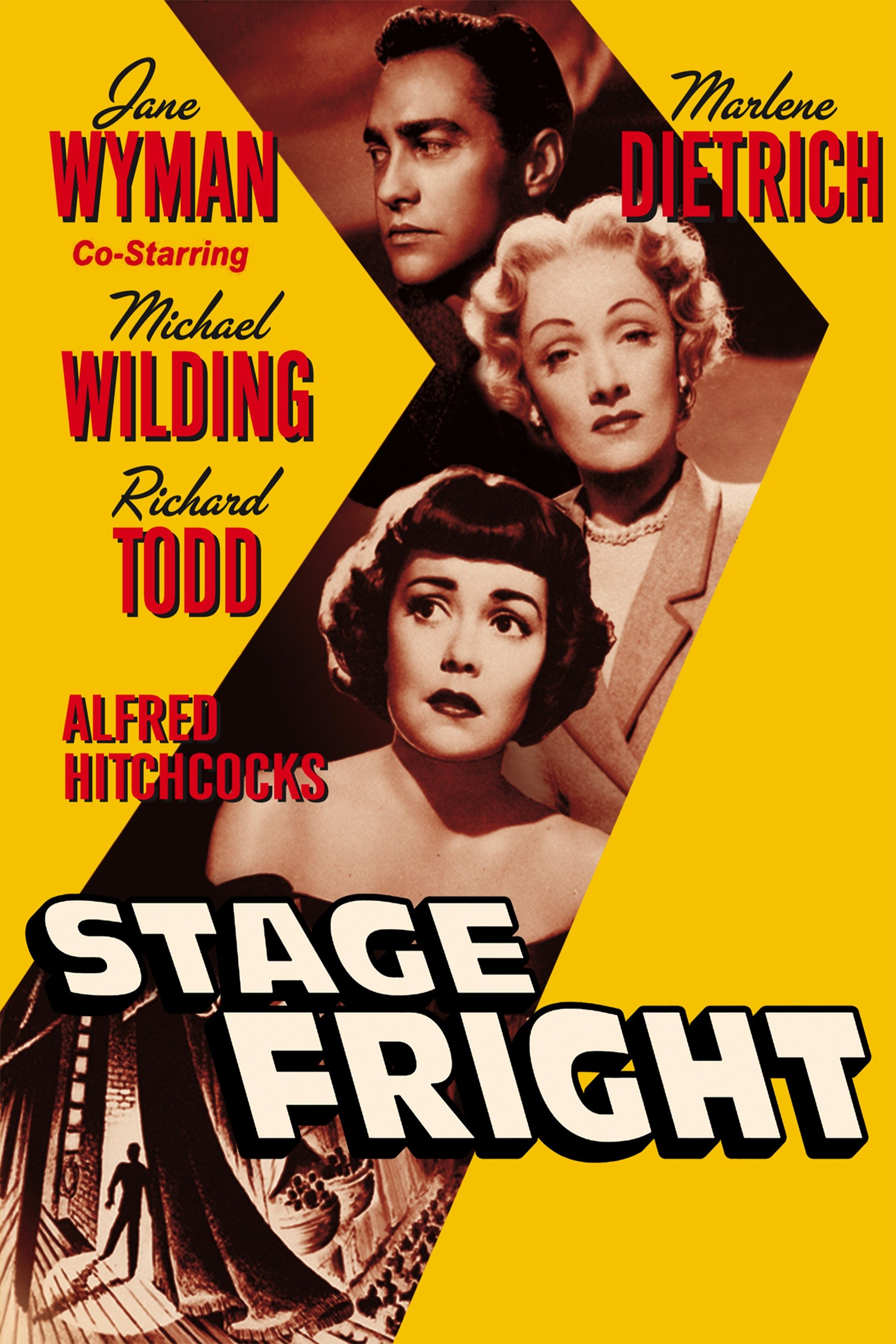
Inarguably, the best parts of this film come on behalf of the cast. Hitchcock does work with a small but memorable group of actors, mainly Jane Wyman in the central role. She leads the film with poise and humour, working hard to be the endearing lead that the film deserves. Playing the role of a young starlet caught in the middle of a murderous plot and the subsequent attempts to cover it up, Wyman is terrific – she’s consistently interesting, and plays the part with nuance and wit, being the heart of the film. Alastair Sim is also extraordinary as her father, proving that he is inarguably one of the most endearing character actors to ever work in the medium, and someone whose presence consistently elevated every film he was involved in. Throughout Stage Fright, he brings both humour and pathos to the film, seemingly being the only person who understood the tone in every scene in which he appeared, and adjusting his performance to suit the atmosphere with stark consistency. Marlene Dietrich is also one of the primary reasons this film has attained something of a reputation, and while her role is small, it’s a classic case of a performer taking a limited part and making it special. In this case, her aloof, effortlessly blase glamour does well in her characterization of the film’s primary antagonist, a malicious singer with a thirst for revenge. Fortunately, even though the story itself needed a bit more precision, Hitchcock does direct his actors well, choosing performers who could play these characters in a way that didn’t lean too far into archetypes, but instead keeping them fresh and entertaining. Sadly, the film around them doesn’t seem willing to adopt the same approach, leading to a considerable imbalance between the two, which only further complicates one’s feelings about this film and the extent to which it succeeds in what it aimed to do.
In many ways, Stage Fright feels less like a Hitchcock film, and more like someone trying to parrot the director’s style. It may not be the chore that was Marnie or Frenzy in this regard (still retaining much of the elegance and wit of those films), but it certainly isn’t much of success outside of it. As much as one can try and grasp for some underlying meaning, there really isn’t much lurking beneath this film that warrants it – the story is perfectly serviceable, and there is a palpable sense of tension, and while this may be entertaining enough to an extent, it ultimately begins to just become tiresome the more we realize that there aren’t going to be any massive surprises. There are the quintessential red herrings that help keep the story exciting, and the characters are as eccentric and fascinating as any of the director’s other creations. Yet, it just doesn’t come together nearly as well as it should, and it’s doubly disappointing to consider how this is ultimately not a particularly complex film – these shortcomings would make more sense had there been some degree of audacity behind the project. Instead, this is so close to what we’d expect from Hitchcock, it’s surprising he didn’t produce something better, since this is a story that would’ve been a great place for the director to thrive, since everything about it aligns with his sensibilities as an artist. Regardless, Stage Fright is a marginally entertaining, but unfortunately undeniably minor, entry into a career that had many peaks in quality, so it only makes sense that we’d stumble on one of the rare valleys on occasion.
 The Postmodern Pelican