
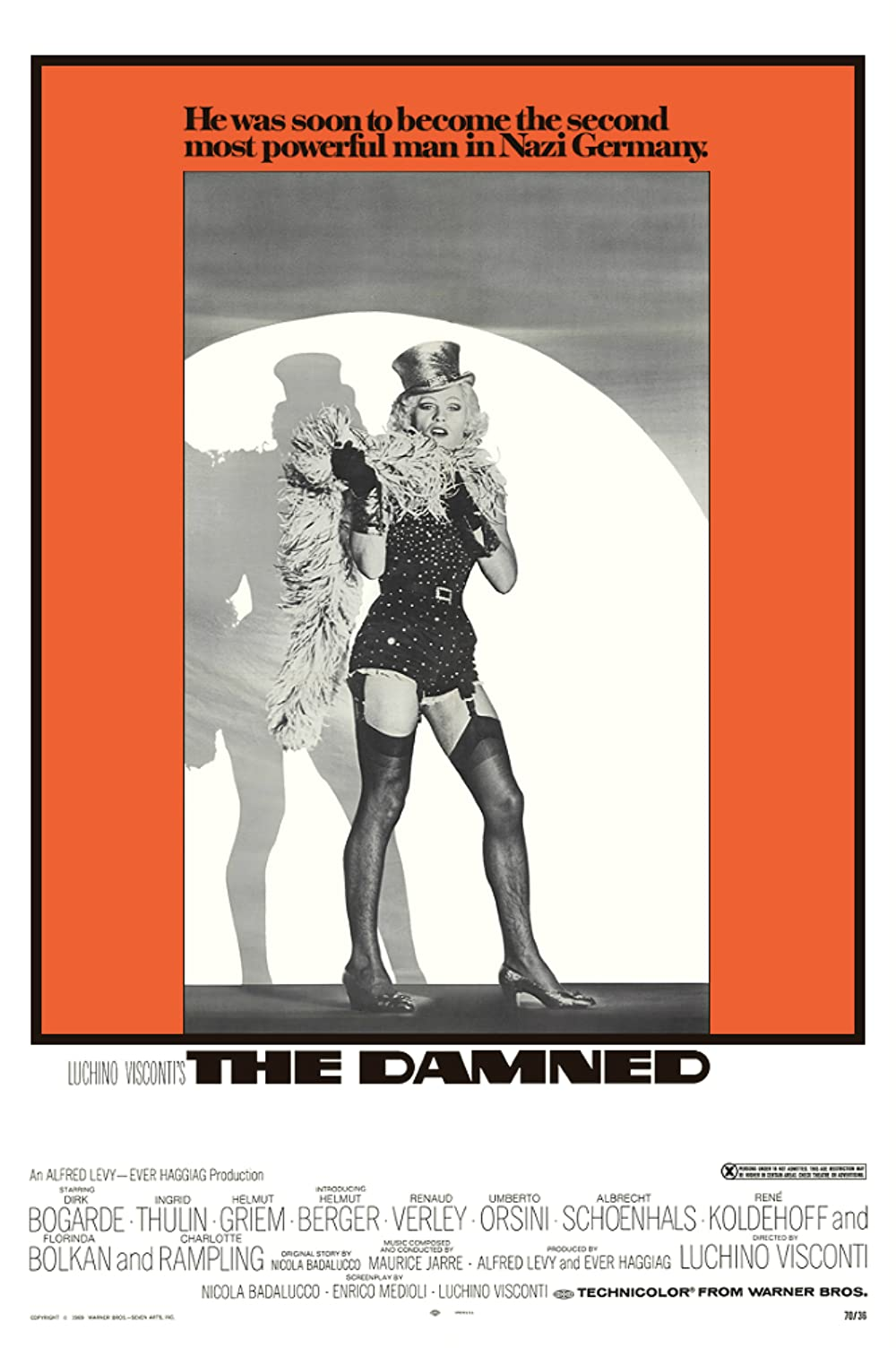
In the decades following the end of the Second World War, we saw countless examples of films that tackled the period, looking at different subjects that ultimately all lead back to the central issues that provoked the conflict. Whether it be the harrowing conditions for soldiers, or the more disconcerting situations that came about behind closed doors in urban centres, it became almost a right of passage for artists (particularly those in Europe) to reflect back on the period, especially if they had been alive during it. Luchino Visconti, one of the great stalwarts of Italian cinema (and by extension the entirety of the continent, since he wasn’t averse to venturing out of his country to explore other cultures), looks at the sinister machinations that took place amongst the elite in high society during this time in his masterful The Damned, focusing on the trials and tribulations of a family of wealthy industrialists in pre-war Germany, focusing on their struggles for power and influence in a time of enormous social and political upheaval, which coincide with the growing threat of Nazism, which gradually starts to encroach on their lives, infiltrating every aspect of their family dynamic and taking over each part of their lives, until there is nothing left but the hollow shell of a once-prosperous clan, which has fallen into disrepair as a result of the looming danger of a system designed to reward those who comply, and annihilate those who dare object. As one of Visconti’s most hauntingly unsettling and deeply provocative works, The Damned is the closest the director has ever come to pure horror, with the shadowy filmmaking complementing the bleak story, which was likely drawn from his own observations of Europe in the aftermath of the war, which are woven into the fabric of this deeply disconcerting and frequently horrifying story of the rise of Adolf Hitler, and the ramifications this cataclysmic event had on different levels of society.
Visconti’s career is one that is perpetually interesting – each of his films is fascinating when viewed independently, since they’re all well-crafted, compelling psychological dramas that draw on a range of themes. However, if we look at them in comparison to one another, we can see that the director was gradually making a series of films that take place throughout Europe across many different decades and centuries, each one being a piece of a broader existential puzzle that seeks to capture the entirety of European history through selectively-chosen stories that best represent the issues he aims to explore. Whether social, political or economic, there is always something historically resonant in a film by Visconti – and The Damned encapsulates all of them, perhaps being the director’s most complete work in terms of covering many different cultural strata. There are several different storylines that interweave throughout the film – it’s surprising to discover that The Damned is not based on some dense historical novel, but is rather an original piece, written by the director in collaboration with Enrico Medioli and Nicola Badalucco, both of whom drew on their own knowledge in constructing this sprawling tale of greed and betrayal within a family fending off the terror-fueled regime that is sweeping over their country. Under the direction of a less-gifted filmmaker, The Damned would’ve likely devolved into an incomprehensible, directionless bundle of scenes masquerading as a historical epic – but mercifully, Visconti’s grasp on the material is strong enough to handle the various deviations that are needed to convincingly tell this story, and his ability to draw on a range of different ideas and still make a solid, well-crafted psychological thriller is further proof that he was a master of his craft. At nearly three hours in length, there was a lot of content that needed to be covered in The Damned, but rarely being one to feel intimidated by a wealth of content, the director throws us into this disorienting world, guiding us through a deeply unsettling version of the past.
Visconti often oscillated between having films that centred on the perspective of one or two characters, and those that featured larger ensembles, where there is a relatively equal balance between the main characters. The Damned fits into the latter, but does have a few more significant parts. Primarily, the story is divided between Dirk Bogarde and Helmut Berger, who play feuding members of a family that are both grappling for power and dominance – Berger is the young, audacious upstart with ambitions greater than anything his family believes him to be capable of, while Bogarde is the outsider, someone who has found himself given the opportunity to take control of this group by way of simply asserting power that he does not officially have, but rather forcing those around him to genuinely believe that his voice is the most dominant. The film often plays like an update of Macbeth, particularly in how Bogarde goes from a passive and obedient adherent to some powerful figure, to the very person responsible for his demise – and Berger is there as the spectre of guilt, the person who knows the secret, and is willing to use it to garner his own level of power. Ingrid Thulin is a perfectly adequate villain in her own right, playing the maniacal Sophie with a stone-faced cynicism that makes her one of the most terrifying characters in the film, while Charlotte Rampling only has a few scenes, but is absolutely spellbinding in all of them. Even the smallest roles are occupied by great actors, and Visconti is able to draw attention to all of them, making The Damned a truly communal film, even when the focus tends to be divided between the two leads more than anyone else (which itself caused quite a stir within the cast, with Bogarde’s insistence that the director favouring his beau leading to his role being substantially cut down, which is noticeable, but not distracting to how his character develops). A sprawling historical epic needs actors that can easily handle the material, and this film certainly has it in an abundance.
Another aspect of The Damned that is quite striking when we place it in contrast with some of Visconti’s other work is how it highlights certain elements that are not present in previous and later films. While it is a film based in the past, and told with a combination of epic scope and intimate detail, it serves as a slight departure for the director, who exchanges achingly beautiful grandiosity of a different kind of excess, one that is much more grotesque and harrowing. This film represents the director at his most deranged, since he is telling a story about pure debauchery, and shows himself willing to push the boundaries of decency, granted it is restrained in such a way that it doesn’t spiral out of control. This is a film that equates the desire for wealth and influence with that of carnal lust, the craving for human touch, which is shown as vicious and scarring, rather than the more delicate, sensitive approach that we saw in films such as The Leopard or the subsequent Death of Venice (which is often cited as the second part in an unofficial trilogy that Visconti made about different eras in German history), which thrives on its ability to evoke emotion in a more simple manner. Perversion is primarily what motivates The Damned, and while it may be an excruciatingly difficult film to watch purely based on the fervency with which Visconti is willing to surrender to the more macabre aspects of the story, we find ourselves constantly mesmerized by the sheer excess, and how creatively it is used. The film is arguably his most controversial, with these characters engaging in actions that are the definition of taboo – and while most of them do ultimately face the consequences, it never feels like a morality tale, with the brutal realisation that there are individuals that engage in these sordid activities, and are often seen as paragons of their society, being one of the most unsettling elements of a film dedicated to showing the darker side of humanity, which is accomplished in nearly every scene of this film.
The Damned aims to explore the lives of people who were not directly responsible for the atrocities caused during the Second World War, but were integral to its unfortunate success. A regime can only be powerful if there are followers, and whether these are garnered through members of society (particularly those in the upper echelons) volunteering their time and resources, or through forcing passive civilians into submission, power can only be gained through having a segment of the population under one’s control. This is what The Damned is emphasizing, looking at a family that may not be benefitting from Hitler’s horrifying politics, but are still forced into a position where defiance could be fatal to anyone who steps out of line. There are so many layers to this film, and it sometimes feels like it is on the verge of shattering under the impossible weight of the many ideas embedded within it – but Visconti was always able to prove that his prowess as a filmmaker did not only yield strong results in regards to the visual palette, but that he was a masterful storyteller, capable of weaving together many complex ideas, allowing them to flow together in a way that is always interesting, even when it can be extremely difficult to watch some of this material. The Damned is not a film for the faint of heart – it is brutal, grotesque and violent in nature, but the most haunting aspects are those that focus on the more insidious details, the kind of dark and brooding inhumanity that exists in every society, and which the director is constantly seeking to evoke, in an effort to challenge and disconcert in ways that are increasingly hostile. Uncomfortable but brilliant in a way that a lot of complex art tends to be, The Damned is an incredible and unforgettable achievement that proves that there is always merit in daring audiences to bear witness to a more bleak version of reality, and the countless lessons contained within them.
 The Postmodern Pelican