
While it may not be widely known to those outside of the target audience, the play Brother Rat is considered a seminal text on the subject of pre-war patriotism. Written by John Monks, Jr. and Fred Finklehoffe, who were graduates of the Virginia Military Institute (which their story constantly emphasizes as being one of the most elite academies in the United States), the play is a rollicking and entertaining romp that was designed to offset accusations that life in the army is dour or stringent, and that it can also be entertaining. The film version of the play was directed by William Keighley (a mildly successful director who was better known for mounting productions on Broadway, but had occasional forays into film from time to time during the Pre-Code era), who really did not have much of a challenge ahead of him when adapting it to the screen, as the original text was simple enough to be easily translated, and that audiences would not need to be convinced to the merits of this film – after all, it was aimed at those who are likely more interested in seeing a film about the lives of soldiers, so for the film to expect to have a reach much further than this seems implausible. Undeniably, Brother Rat is an acquired taste, and it certainly has not aged all that well, especially when we consider that the Second World War was on the horizon, which would change the course of how we explored the subject of war on screen permanently. It has its moments of genuine humour and it can certainly feel a lot more fun than it perhaps ought to have been – and like any logical viewer, we should look at this film as a product of its time, and while no one has ever suggested it to be some obscure masterpiece, it does have a lot of charm, enough to carry us through the paltry 88-minute running time, which is a lot more manageable when the story that it tells aims to be genuinely entertaining.
There is such a narrow boundary between a lighthearted look at the lives of soldiers, and outright propaganda, and Brother Rat is a film that certainly does put this distinction to test quite regularly. The central premise being based around a trio of trouble-making soldiers having fun while trying to complete their tenure at this elite academy is one that is rife with the kind of overly sentimental, vaguely jingoistic sensibilities of those who see war as something to be celebrated. Obviously, the film was not made with any such ideas in mind – both the play and film that inspired it were produced long before the start of the Second World War, so while we may not be appreciative of how flippant the film can be about military life, we can still watch with amusement to see the extent to which the film tries to convey the idea that life as a soldier should be coveted by every young man (and that every young woman should in turn desire those valiant boys who decide to serve for their country), knowing the perils that likely await these characters in just a few years, if our imaginations lead us to wonder whether we’d be seeing a film so invested in underlining the supposed pleasures of military service, which is certainly one way of keeping us entertained and distracting from how dated the film is. Naturally, we can’t expect every film to possess the progressive mindset needed to ensure that it will resonate with future generations, and taken as a product of its time, Brother Rat is certainly at least marginally successful even from a contemporary perspective, particularly to those with any kind of interest in seeing a very authentic piece of American literature, one that may not be essential in terms of offering the most thorough and insightful critiques, but rather one that is authentically American in every way, almost to the point of being parodic – but despite its humorous tone, this film is genuine in its reverance to the nation from which it sprung, so much that we eventually start to question what the actual aims of the film were, and whether they were able to be met. Records from the time show that both audiences and critics approved of it, so it must have registered with its intended audience, and will likely evoke some interest in contemporary viewers, even those that fall outside these parameters.
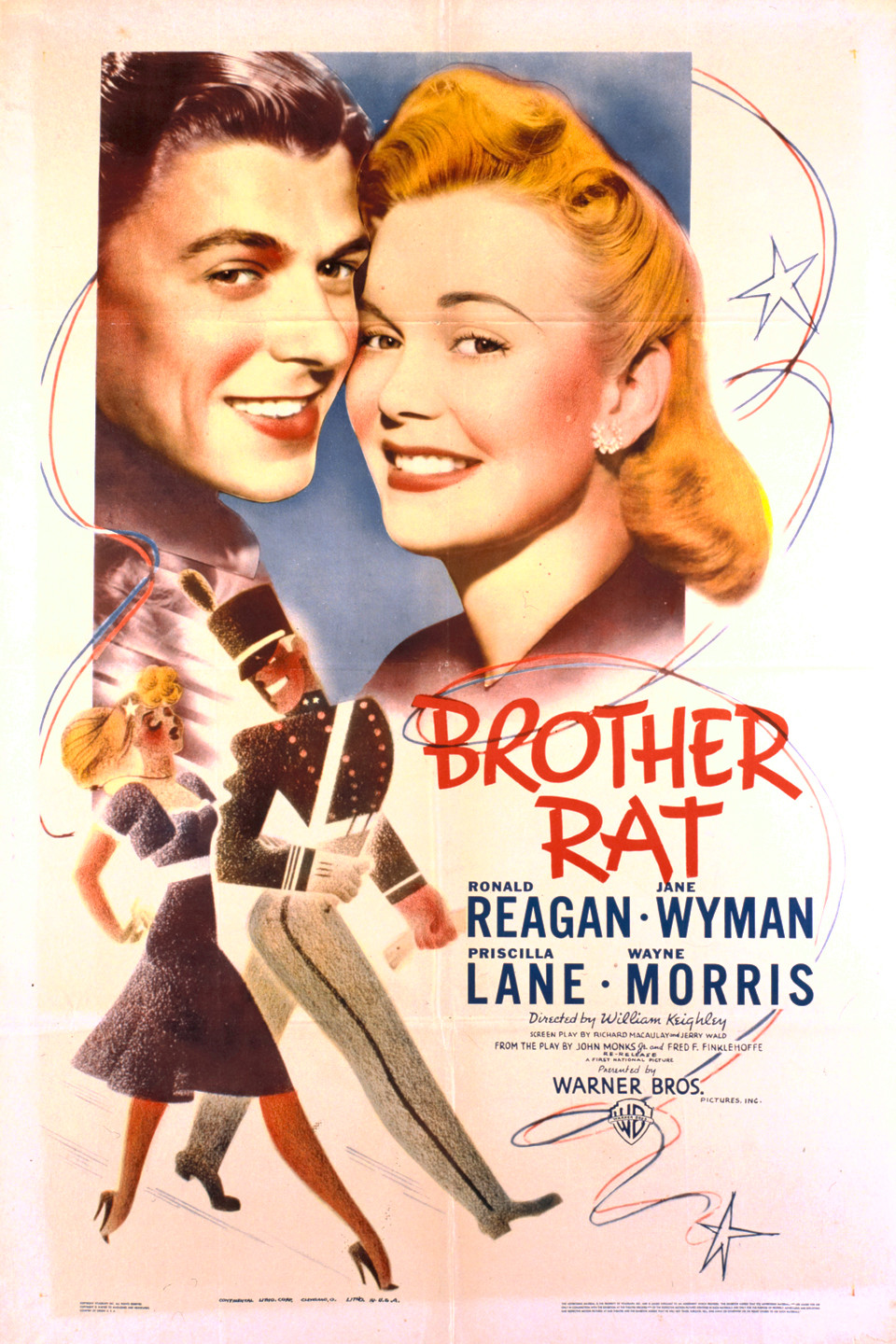
One of the more interesting components that we encounter when watching Brother Rat is how, despite being marketed as being a vehicle for his talents, Ronald Reagan is oddly in very little of the film. He is one of the three main characters, but is by far the least important, not in terms of presence, but rather his importance to the plot. Whether this was done to capitalize on the fact that he was undeniably the biggest star in the film (especially since Eddie Albert and Wayne Morris were novices in comparison, despite having the more important parts), or in hindsight to demonstrate how the former President of the United States was a well-established actor, and not just a middling journeyman performer like many assume him to be. In this regard, Reagan barely even registers – he enters the film quite late, and really doesn’t make much of an impact, just bringing a level of genial charm to an otherwise forgettable character. None of the individuals depicted in Brother Rat are actually that well-developed – there is barely a three-dimensional character to be found anywhere in this film, and many of these people seem to be constructed as if they were pieced together from fragments of what a “real” American should be – the men are clean-cut and obedient, with only slight streaks of lovable mischief, while the girls are virginal and bubbly, and exist mainly as objects of the men’s affection, the trophies they sneak into their barracks after a day of hard work at the notoriously tough college that aims to carve the idealistic man from these promising young people. The gender politics in Brother Rat are not perfect (and when you have an actress as gifted as Jane Wyman in a major role, and somehow manage to have her struggle to register, it becomes slightly troubling), but they do suggest that there was work being done to expand on the roles women played in these stories, it just rarely gets to the point where it feels like it is interested in having that conversation, which is disappointing but certainly unsurprising for a film built on the supposed American ideal at the time.
Brother Rat is a film that offers no more, nor no less, than it promises at the start – it is a reliable, funny film that keeps us entertained for a short amount of time before bidding us farewell and allowing us to move along, having seen a small but entertaining comedy. It does very little else other than offer us the chance to get insights into the celebrated school that the authors so deeply revere (almost to the point where we have to wonder whether the entire film was a ploy concocted by alumni to make the Virginia Military Institute more appealing to prospective students – not that an academy that had existed for over a century by this point, and had a reputation for impeccable decorum needed assistance), and many may feel like it intentionally aims to celebrate something that never really warranted it in the first place. Ultimately, regardless of where one stands on the subject matter, or what can be described as such, Brother Rat is a charming diversion, a small and entertaining film that gives the viewer exactly what they expect, meaning that the onus is on the audience to curb their enthusiasm and ensure that expectations are appropriately tempered. A solid film about military life (although heavily filtered, with most of the more unappealing details left on the cutting room floor), that is well-acted by a group of gifted actors, and running the ideal length for a very simple comedy, Brother Rat is a fine film that may not be all that original or innovative, but does provide a few solid jokes and never overstays its welcome – and while the ideal is for every comedy to be inventive and unique, we can appreciate it when some of them are just merely reliable, which is exactly what we encounter here.
 The Postmodern Pelican