
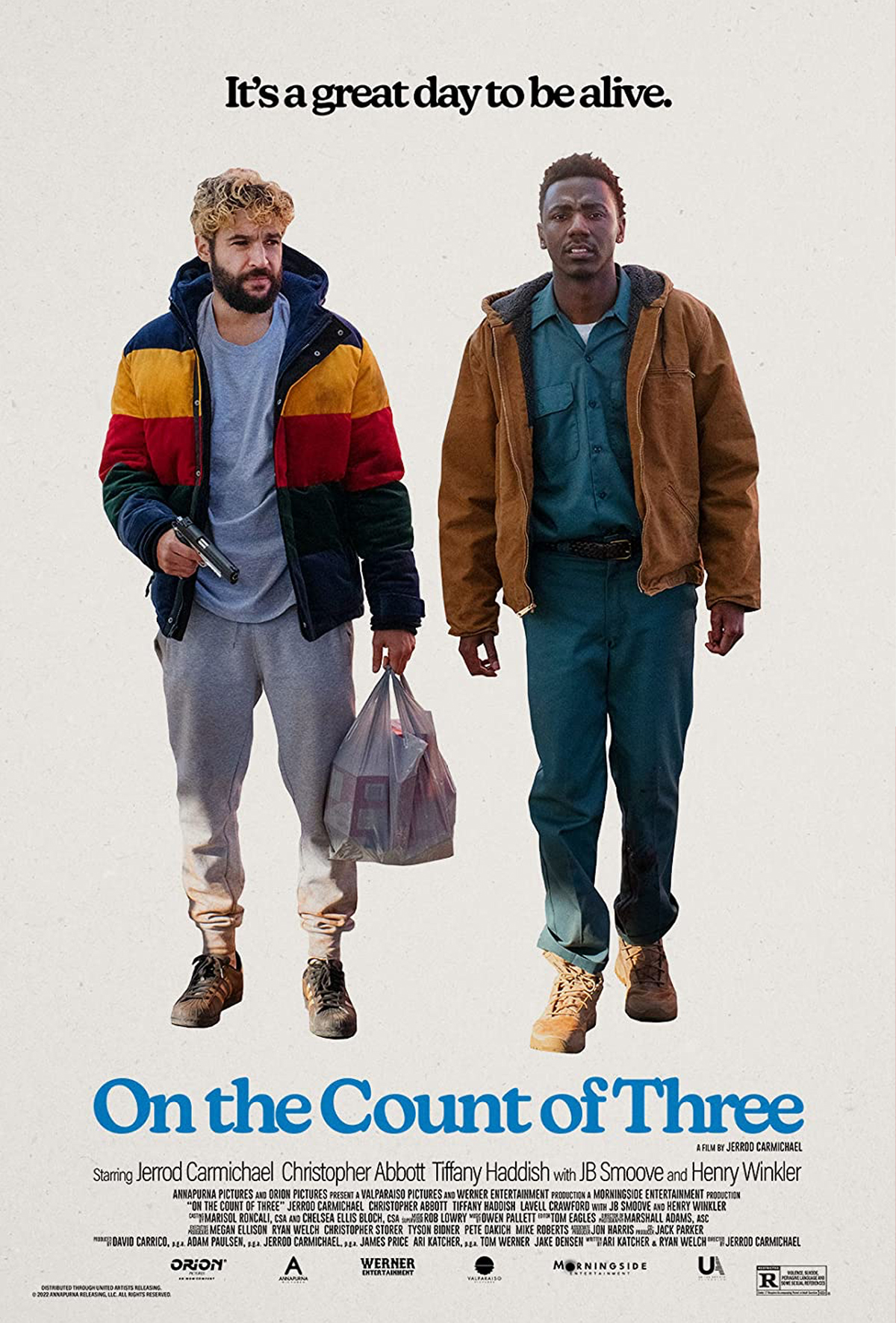
It is often said that in order to create good art centred around the concept of death, one has to be either fond enough of living to be entirely objective to the realities of this great inevitability, or so far gone into a space of almost nihilistic despair that this serves as a way for them to channel their inner depression. Jerrod Carmichael proves that these are not mutually exclusive with his feature directorial debut, the ambitious but bitingly scathing existential dark comedy, On the Count of Three, which is one of the more bleak works of satire produced in recent years. Telling the story of two terminally depressed young men who decide to end their suffering by planning a suicide pact, spending one final day together tying up the loose ends, in the hopes of not leaving behind too much damage once they take their own lives, the film is a fascinating character study that tests the very narrow boundary between life and death, which we see as being far more narrow than we’d initially imagine based on a cursory glance, especially since so much of the media has tended to portray it as a binary, with very little space to manoeuvre between them. Carmichael, who directed the film in addition to playing one of the two leads, makes quite an audacious debut, avoiding the common trend of actors-turned-filmmakers making more gentle, nuanced films, and instead aims straight for the jugular, going for the most harrowing social commentary imaginable. As one of the year’s most caustic but unforgettable comedies, On the Count of Three has a heft to it that most similarly-themed films will often struggle to achieve, and whether we see this as a triumph for Carmichael as an artist telling a story that resonates with him, or simply because the film presents us with a new perspective on an issue as simultaneously simple and intimidating as death, we are always captivated by every detail in this film, which feels so extraordinarily complex, even when it is operating from a place of purely visceral existential anger.
While the impact made by the story at the heart of On the Count of Three will be different for every viewer (since the premise is intentionally quite divisive), you have to admire the sheer gumption demonstrated by Carmichael in telling this story. In addition to the central theme of mental health, which is the primary concept around which the film orbits, Carmichael draws on a number of other conversations – as a socially-minded young artist growing up in modern America, the director is keenly aware of the realities that face many of its citizens, especially those from marginalized communities, and while they aren’t foregrounded for longer than a few moments, we see references to race relations, police brutality and sexual assault, all of which are woven into the fabric of the film, with Carmichael constructing a vivid tapestry of contemporary society. He looks at these issues with a profoundly cynical lens – it is not his intention to nullify the impact of these discussions, nor is it his desire to provide definitive discussions on any of these issues. Instead, he is aiming to provoke thought – and as we’ve seen on countless occasions, sometimes the most effective way of disseminating a message is not through dour, frequently unsettling melodrama that assaults the audience with factual, guilt-ridden commentary, but rather through humour, which On the Count of Three does not neglect. Unlike many social issue films that focus on some major societal or cultural problem, the film refuses to take a side – the main characters are flawed human beings, and while the story does give them space to plead their case, it does not indicate one way of thinking is more superior than another. These are not people who represent the wider populace – both of the protagonists stand in firm defiance of the status quo, choosing to make these decisions out of their own accord, knowing that their decision will be final. Carmichael was not aiming to craft a film that exists as a cautionary tale, but rather creating a story that looks into the human condition from an objective perspective, which is increasingly rare, especially in works that focus on major social or psychological matters.
On the Count of Three was designed to essentially be a two-hander between the two leads, since a lot of the film is based around their interactions – and as a result, it was absolutely essential that the roles were occupied by actors who weren’t only adept at handling the more challenging material, but also those who could find the humanity in a pair of relatively unlikeable (but not antagonistic) individuals. Carmichael takes on one of the roles, while Christopher Abbott is cast in the other, and both are doing incredible work. What is most interesting about Carmichael is that, even though he is a comedian, his work is often so self-reflective and poignant, it sometimes feels like he is conversing with his audience more than he is attempting to make them laugh. He is undeniably a very funny individual, but when given the opportunity, he is able to show a more serious side that proves that he is a gifted dramatic actor. In casting himself as the more optimistic of the two leads, he is able to run the gamut of emotions, working through an abundance of challenging ideas in his pursuit of a version of a character that feels very much based in reality – a and while we aren’t likely to know how far the character of Val was inspired by the actor himself and his own experiences, we can certainly see generations of lonely lost souls reflected in this performance. If On the Count of Three is anything to go by, Carmichael has a very promising career ahead of him as a serious actor, especially in roles that don’t have him depend on his ability to deliver a joke, but rather on a more complex, well-rounded character. Conversely, Abbott has been doing tremendous dramatic work for over a decade now, being something of a darling of independent cinema, and while he has mostly rejected the mainstream (outside of a couple of forays into larger productions), his talents speak to an actor who is capable of finding so much nuance in even the most ambigious of characters. The chemistry between the two leads of On the Count of Three is pivotal to the film’s success, since if the audience is not invested in their friendship, we will very likely struggle to find the plot convincing – and mercifully, both actors find the perfect balance, and manage to complement each other in a way that makes this film an even more invigorating and fascinating tale of companionship.
There comes a point in On the Count of Three where we wonder whether we should be laughing or not – Carmichael, who has previously made his name through comedy, certainly does mislead us into thinking that the general premise of the film is simply a ruse, much like other comedies that centre on very important topics, but do tend to have neat resolutions that leave the audience satisfied. As far as this film is concerned, there is very little need to shoehorn in a happy ending, or even a conclusion that allows us to walk away in a positive mindset – sometimes, even an irreverent comedy needs to make us profoundly uncomfortable, since these are the works that provoke the most thought and cause us to look at the broader issues in a way that doesn’t conceal the more serious and sobering sides of these conversations. On the Count of Three is a very funny film, but the humour is rarely used to contradict the darker material – in fact, it actually services it, highlighting how harrowing reality can tend to be, but that there is nearly always humour to be found in moments of darkness. A lot of the comedy comes in the small details, essentially being supplementary to the robust discussions that persist throughout the film and lead to one of the most deeply unsettling conclusions out of any self-labelled comedy of the past decade. It is difficult to view On the Count of Three as a work of comedy, especially since previous works that seemed to inspire it (such as Gridlock’d and Blindspotting) are similarly designed as stories that use humour as a means to subvert what we’d typically associated with the proverbial “buddy comedy” sub-genre that we’ve seen become quite prominent over time. Yet, it is important to remember that Carmichael is primarily a comedian, and while there is always a level of complexity to his work, the aim here has to use the medium as one to facilitate many deeper and more insightful conversations on very important subjects.
On the Count of Three immediately establishes itself as a film that will constantly be referred to as an acquired taste, as it will divide viewers by virtue of the subject matter alone – and the hauntingly bleak execution of these ideas are not going to help pacify allegations that this is a film that is far darker than it may have needed to be. We can attribute this to the fact that On the Count of Three is a film that is fueled primarily by rage, being made by someone who has shown himself to have enough awareness of the modern world to have a firm grasp on the collective cultural pulse, and the enduring talents to be able to execute them into a vibrant and thought-provoking satire that plumbs the emotional depths in order to find answers to questions that no one has yet been able to answer. Perhaps this isn’t enough to qualify Carmichael as one of the great contemporary philosophers, but based on the extent to which he is willing to go in order to explore these themes, it seems quite plausible that he is an artist whose point of view is one to certainly one to follow. The film is an extraordinarily complex and beautiful work – it can be challenging, but very few works of art are successful through providing audiences with all the answers. If anything, the film relishes in the knowledge that it is provoking conversation that will very likely never be resolved. It takes a very simple story about two young men on a journey of self-discovery (or perhaps self-destruction is the more appropriate term) and forms it into this harsh but beautifully poetic story that tackles some of the most intimidating issues of our time, opening the channels of communication in a way that may first be misunderstood as being wildly inappropriate (since the lack of outright condemnation for the act of suicide can be seen as supporting the act, rather than being a silent tribute to those who fell victim to the horrors of mental illness), but which come together to create a haunting but striking existential film that grapples the boundary between comedy and drama in a way few modern films have been able to do. An incredible debut for an artist whose career continues to develop in new and unexpected ways, On the Count of Three is a vitally important film that proves that the most important conversations are those that are more difficult. A celebration of life and a rumination on death, the film is bound to be controversial, but for those who can look beyond the surface and see exactly what Carmichael was trying to say, you’ll likely find one of the most poignant examinations of the human condition produced in recent years, and a truly special film.
 The Postmodern Pelican