
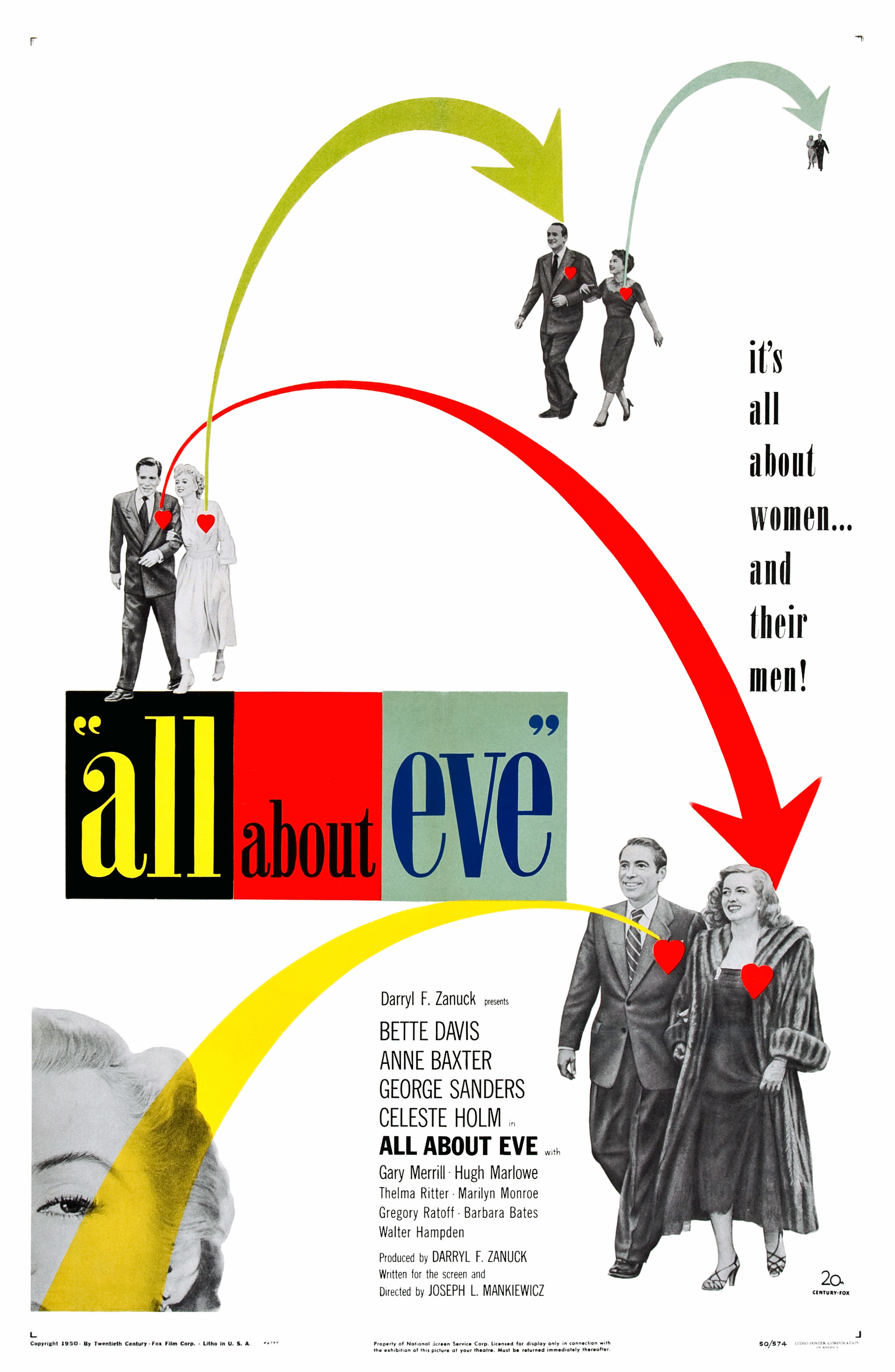
What is there to say that hasn’t already been said countless times before when it comes to All About Eve? The film, which is almost unanimously considered not only the personal best work of the brilliant Joseph L. Mankiewicz, but one of the most well-regarded and iconic pieces of cinema to ever be produced, has managed to enrapture audiences for over seven decades now, each new generation bringing a new level of appreciation to this film, which has (much like its enigmatic lead character) aged like the finest wine, new perspectives proving that we have yet to entirely decode the scope of the esteemed director’s critique of the entertainment industry and the lust for fame, as well as the various obstacles those that manage to achieve these goals ultimately find themselves facing as a result of being in the public eye. Mankiewicz had a magical touch that allowed most of his films to be extraordinary achievements in terms of both theory and execution – but All About Eve is something much more special, the kind of film that comes around once in a lifetime, being so rare that not even many attempts to replicate this film (whether through directly paying homage, or using it as a point of reference for more loosely-defined works, which has happened countless times in the last 70 years) manage to come close to achieving what Mankiewicz did when he set out to adapt the short story “The Wisdom of Eve” by Mary Orr (an interesting but otherwise minor text), which unknowingly would go on to become the source for inarguably one of the greatest and most vitally important films made in the history of cinema, a fact that seems hyperbolic until we actually finds ourselves lost in this puzzling but fascinating version of the world we thought we knew so well. Yet, there is still always value in trying to find new ways to look at even the most sacred cinematic texts – and there have rarely been films more potent and relevant to modern issues that All About Eve and its peculiar relationship to the idea of fame, and the people who are (un)fortunate enough to earn such a title.
Fame is a subject that has been well-explored in cinema – celebrity culture has existed in some form or another for about as long as audiences across every medium have ascribed value onto particular individuals, who they consider to be the pinnacle of success. Film has made it a regular subject of discussion, and 1950 was an unexpectedly remarkable year for such conversations around celebrity – there were at least three magnificent films produced in this particular year that provide scathing commentary on the nature of celebrity. There is the magnificent Sunset Boulevard, the darkly comical film noir with a sardonic edge, and there is also the hilariously irreverent Champagne for Caesar, which isn’t too well-known, but has its fierce supporters. Then there is All About Eve, which stands head-and-shoulders above perhaps nearly any other film on the nature of becoming (and staying) famous in an industry known for its volatility. Both in terms of looking at the process towards becoming famous, and how it is often an ongoing process that is seemingly infinite in its cyclical nature, and the extents to which some will go to maintain that level of fame, All About Eve is frequently quite fascinating, even when it may not intend to be entirely focused on the intricate minutiae (which ultimately do become part of the charm of the film once we start paying attention), clearly aiming less to flourish into a canonical classic. Instead, All About Eve is frequently functioning quite simply as a story well told, which just so happens to carry an emotional and artistic heft that makes it particularly special in a time when depictions of the darker side of fame weren’t entirely revolutionary (in addition to the previously-mentioned films, there are ones like In a Lonely Place, also this same year, that look at the more bleak realities faced by someone in the public eye). There isn’t enough praise that can be heaped on this film, especially when repeated viewings over the years have allowed the viewer to approach the story from a perspective of deconstructing the well-composed exterior in the hopes of creating something from the raw, scathing satirical edge with which the film was written.
I tend to revisit this film every few years (particularly at times when it seems appropriate to be enjoying a more simple but effective work), and while nothing will ever quite come close to the first time, where the experience of watching Margo Channing and her meandering through high society, armed with nothing but a sarcastic tongue and a burning cigarette, there is always something so vivid about seeing what Mankiewicz does with such a relatively simple story, there is still something extraordinarily valuable about what the director is doing with this material. It doesn’t need to be overly complex or convoluted – it’s the story of an ageing actress who regrets showing compassion to a young ingenue, who she initially believes to be a helpless street urchin, only to find her life becoming, as the title suggests “all about Eve” and her many malignant schemes to get ahead of Margo. Some people will say its dangerous to meet your heroes – the argument being made here is that, in order to avoid disappointment when interacting with an idol, it’s better to usurp their entire lives, taking control of their affairs, daily routines and eventually working their way into dominating every waking moment. If there is ever a film that could be considered a cautionary tale against relishing in whatever fame one manages to encounter (whether long-lasting or fleeting), All About Eve would be a prime contender, especially since Mankiewicz perpetually avoids allowing the film to descend into saccharine melodrama, keeping the tone fresh and effectively ruthless, keeping with the scathing nature of the satire we hoped to construct with this film. All About Eve is a film that can be called both crude and sophisticated, without it appearing like a contradiction, but rather the interplay of two radically different concepts coming together to form a vitriolic dark comedy that brutally eviscerates every preconceived, positive notion of what it means to be famous, and seems to be enjoying the process of merciless deconstruction.
Bette Davis – the mere mention of her name evokes the sensation of prestige, quality and brilliance more than any description ever could. There are days when I genuinely believe Davis to be the greatest actress to ever work in the medium of film – and those are becoming more regular the more I venture deeper into her work, almost to the point where it is an unequivocal fact. All About Eve is arguably her signature role, the performance that is nestled neatly at the midpoint of her career, proving that the previous two decades of wonderful work were not accidental, while establishing a clear path towards an almost mythological amount of praise that persists to this day as her legacy continues to become an even more unimpeachable reality. To speak about Davis in this film is to speak about what a great performance should be – no one has yet been able to even come close to doing what she did in this film, at least not at the time. The fact that she was not the first choice for the role (or even the fourth or fifth, since there were numerous actresses considered for the role, amongst them Susan Hayward and Barbara Stanwyck, both of whom are cleverly referenced in a moment of delight for anyone who knows the production history of the film) is absolutely bewildering, since Davis embodies not only the character of Margo Channing, but the entire concept of the faded older woman desperately trying to hold onto her youth. The major difference is that Davis is never melodramatic or excessive, and refuses to lean into the hysterical components that lesser performers would use as their foundation. Instead, Davis focuses on the small details, working with the stunning screenplay in an effort to gradually dismantle everything that we previously would expect from such a character, and going in a very different direction. Whether delivering Mankiewicz’s stunning dialogue in her iconic voice, or using her incredible expressivity to add nuance to the character, Davis is simply incredible.
However, she is not alone, since All About Eve has a sprawling cast of many fantastic actors, all of whom are standing in Davis’ shadow, but still get wonderful moments that prove that this is a film composed as a tapestry of characters, where the ensemble is just as integral to the success of the film as Davis’ character. The film is named after the character played by Anne Baxter, who comes very close to being as strong as Davis, playing the malicious and scheming Eve with the kind of sincerity that makes her one of the most effective villains in the history of Hollywood, someone whose manipulation seems to come from a truly dark place – and the film does exceptionally well in positioning Eve as a central character, but never once making us feel sympathy for her. She is not misunderstood or underestimated – she is a malignant sycophant who will do anything to get ahead, even if it means using her obsessive behaviour to infiltrate the lives of her idols, who she eventually aims to usurp once they trust her enough. Celeste Holm and her character of Karen is, in many ways, the complete antithesis of Eve, being the ever-loyal and endearing colleague to Margo who does her best to look out for her friend’s wellbeing, seeing through the twisted plot transpiring right in front of her, while being unable to do anything about it or risk complicating matters. George Sanders is a secondary villain, but one that is still extremely iconic – outside of Davis, his performance as Addison DeWitt remains the most memorable part of the film, and the actor consistently plays on his unique qualities to deliver a spellbinding, and often quite unsettling, portrayal of a man driven by his own desire to remain the foremost authority on all matters relating to the theatre industry, even if he has to engineer many of the scandals himself. All About Eve is very much an ensemble effort, and while Davis may be the most unforgettable aspect, it’s impossible to ignore the incredible work being done by the rest of the cast.
Mankiewicz had a keen eye for his craft, and not only was he a terrific writer (especially at a time when many mainstream films separated the job of the director from the writer, the two previously being seen as distinct tasks that could not possibly be done by a single person), but his visual style and approach to his stories make him someone very special. All About Eve works because it is a film about finding the right balance – the director is perpetually trying to find a way to support both the very bold strokes of social and cultural commentary, with the smaller details that may not be noticeable on first glance, but carry an immense weight when it comes to exploring the depths of the story (most of this is found in Davis’ spirited performance, with the smallest glance or change in her iconic voice’s cadence conveying a world of meaning). The intentions of this film are not to destroy the very idea of fame – this doesn’t follow the same pattern of A Star Is Born where there is a never-ending cycle of success and failure. The people who are on top of the world at the start of this film end up in the same position at the end, perhaps not in terms of fame, but in having taken the moral high ground, rather than succumbing to the brutal manipulations that tempt them. Instead, the director is peering behind the proverbial curtain, presenting us with a fascinating backstage drama that is filled to the brim with acerbic wit and never-ending complexity, the likes of which is rarely commonly seen, at least not in a form nearly as complex and interesting as we see here. Fame is a tricky subject, but it is one that has been explored countless times before – but when it comes to the gold standard of looking at the concept of celebrity culture, All About Eve remains entirely untouched as the definitive text on the matter, and it doesn’t seem like it will ever budge from that position, with every subsequent foray into the subject ultimately only being able to stand in the towering shadow of this iconic film.
 The Postmodern Pelican