
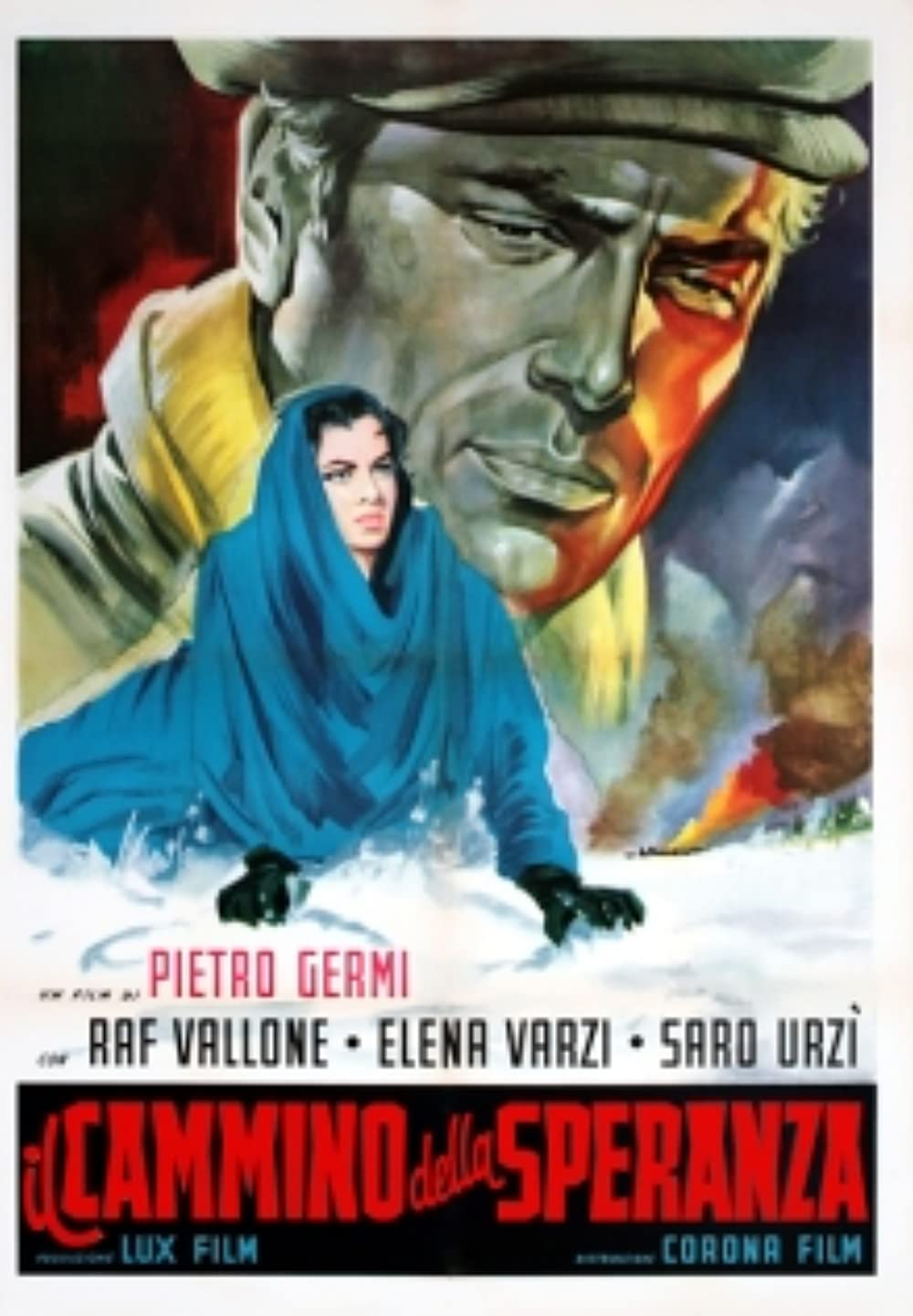
As the adage goes, desperate times breed desperate measures – and a group of filmmakers that implicitly understood this concept were those that worked under the umbrella of Italian neo-realism, the movement that emerged during the Second World War, and sought to describe the challenges faced by ordinary people that fell victim to the social and political obstacles presented to most citizens, who held very little power in determining their fate, or the direction in which their country was going. Pietro Germi emerged as one of the most essential voices in Italian cinema during this movement, with one of his films being amongst the greatest accounts of the post-war era ever produced by the nation. Path of Hope (Italian: Il cammino della speranza), is a powerful, heartbreaking ode to the human condition, and the inherent resilience that drives us forward in times of desperation, proving to be an immensely complex and often quite tragic story of overcoming seemingly insurmountable challenges that seem to continuously present themselves to the very people who the changing political system was designed to protect. Germi achieved something incredibly special with this film, venturing deep into the heart of the past to tell a riveting but deeply disquieting story about a group of people leaving their previous lives behind and voyaging into the unknown, in the hopes of finding prosperity on the other side of their journey, which they sincerely pray will yield positive results, rather than placing them back in the uncomfortable position in which they had been forced to live for several years.
Path of Hope was written by Germi in collaboration with a very young and rambunctious Federico Fellini, who was working concurrently with another essential voice in Italian neo-realism, the tremendous Roberto Rossellini in his own bare-boned social drama, The Flowers of St. Francis, another tremendous drama that drew parallels between the past and present. Germi was a very simple-minded filmmaker that rarely succumbed to excess, making his collaboration with Fellini, who was arguably one of the finest social critics to ever work in the medium of cinema, all the more captivating. The story centres on a group of impoverished Sicilian citizens who are presented with the opportunity to escape their dire situation by escaping to France, where a fast-talking stranger promises them a much better quality of life, with regular work and steady incomes to every household that followed him across the border. Obviously, it stands to reason that this is not the truth, since Path of Hope focuses on the several people who foolishly take this promise at face value, giving up their entire livelihood (and selling everything they owned) in order to surrender to the promise of someone whose credibility is consistently questioned. It’s a harsh, challenging story that hinges on many very human elements – blind faith in those that have the charisma to convince anyone to go against their instincts, the challenging decisions myriads of people have to make when confronted with difficult choices, and the fury that comes when realizing that not every promise carries weight. It is all sewn together beautifully throughout this film, which boldly proclaims itself as one of the most important to come out of this period in Italian cinema, if only for the message residing at the heart of the story.
Of the many themes embedded at the heart of the film, it’s quite easy to tell what the primary motivation for Path of Hope is, since it’s quite explicitly stated in the title. This is where Germi slightly deviates from what his fellow compatriots under the neo-realism movement were doing, whereby this film isn’t solely focused on providing an explicit, raw depiction of the lives of ordinary people, but rather adding in a layer of narrative complexity. It’s something that aligns him more with De Sica than it did with Rossellini (whose portrayals were often much more gritty and fervent in their documentary-style realism), and allows the film to carry an emotional heft that was always going to be present by the nature of the story, but is streamlined into this touching story of a group of people who find themselves presented with an entirely new set of challenges that they did not expect to encounter when venturing into an uncertain future in the hopes of improving their quality of life. Each scene is a vignette into the lives of these people, forming a captivating tapestry of the conditions many people under this brutal system faced, and would continue to endure for decades to come, making Path of Hope an essential film, not only for the story it tells, but also the message of resilience. This is embodied in most of these characters, with Raf Vallone and Elena Varzi carrying most of the burden of portraying individuals struggling to find joy in a world that has become increasingly hostile to them. As the representatives of an entire group of people dealing with unforeseen challenges, the character of Saro and Barbara are fascinating creations that consistently raise the stakes and allow this film to be such a nuanced and layered exploration of the human condition.
Hope is not something that is easy to acquire in situations where every new day brings an additional set of challenges – but Germi is far too optimistic a filmmaker to ever allow all joy to erode, keeping the film at a place where everything may seem difficult, but not impossible. It helps tremendously that his characters refuse to succumb to their circumstances, and while they may be consistently tested by elements out of their control – and it all converges in this achingly beautiful portrait of lives in flux. It’s not a particularly complex film, but it has a soulfulness that makes up for the very linear, predictable story. The filmmaking itself is impeccable (Germi has to represent many different aspects of Italian society, traversing everything from the rural countryside to the bustling big city), and the tone the film takes is melancholy but inspiring, each moment brimming with the kind of inspirational energy that only came from the most precise and meaningful entries into this genre. Path of Hope is an absolutely beautiful film, an essential entry into a genre that consistently told inextricably human stories that were often quite difficult, being both narratively and emotionally heartbreaking, but which conveyed deep messages about the human condition, all filtered through raw, unflinching stories of suffering and hardship. The difference is that in Path of Hope, while there may not be a particularly happy ending in the traditional sense, it does carry a sense of optimism that, at some point in the future, these characters will find the happiness that they so desperately seek – but for now, their only way to get there is through pressing on through this unpredictable voyage, and hopefully surviving long enough (physically and mentally) to reap the rewards of their relentless efforts.
 The Postmodern Pelican