
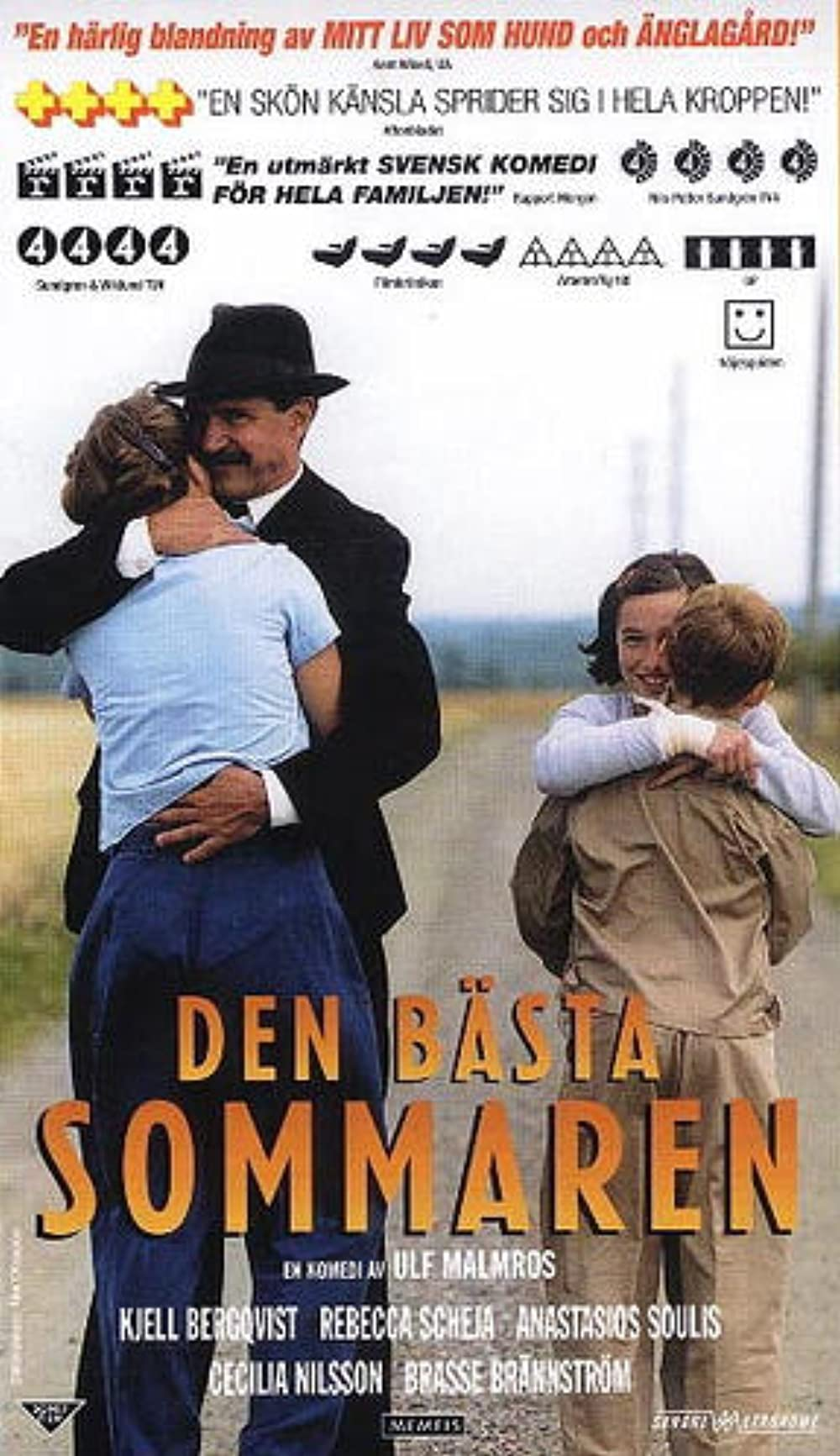
There are some films that may not have the strongest story or most original ideas, but instead inspire nothing but joy through their exuberance and love for the world that surrounds them. One of the most exceptional examples of this is in A Summer Tale (Swedish: Den bästa sommaren), the lovely comedy written and directed by Ulf Malmros, who tells the story of two orphans that are sent to spend their summer in the countryside with their “summer father”, a prickly mortician who presides over a group of country folk, most of whom are excited to have these new visitors, others far more hostile to their presence. Not to be mistaken for the film by Éric Rohmer, which shares both the same title and incredibly poignant joie de vivre that we see here, A Summer Tale is an absolute delight, a charming and endearing comedy that never takes life too seriously, even when asking some of its most challenging questions. The director is engaging in a spirited game of cat-and-mouse between the characters as they come to know one another, taking this film further than the aimless comedy many may assume it would be based on a cursory glance at the premise and style of the film, which may be simple but carries a depth that might take certain viewers by surprise, since few of us would expect to run into a film nearly as complex as this one, especially when it comes to exploring certain themes that do not normally find their home in such stories, but yet feel like they easily fit into this world. Rarely do we find films so committed to both making us laugh and evoking very deep feelings of melancholy, often in tandem – but A Summer Tale is frequently pulling apart various ideas and using them as the foundation for increasingly captivating conversations that lead to a film that is far more profound than we may expect.
There is such beauty in simplicity, especially when it becomes part of a film’s narrative. A Summer Tale is one of the most beautiful films of its era, solely on the merits of how the director captures the world in which these characters live. Considering how this film focuses on a pair of children as its protagonists, it’s logical for us to assume that the main propellant of the narrative was to view the world through the eyes of a child, which render our surroundings as not only more simple when it comes to the specific details, but also far more colourful and absurd, the limitless imaginations of the younger generation working in tandem with the more sobering aspects of the narrative. There’s something about seeing the world as a child does that has made the coming-of-age narrative so compelling – and while A Summer Tale logically only covers a single summer of the lives of these characters, they undergo various forms of education. This extends beyond the children and their literal efforts to attend specific lessons, but rather every single character, each one of them bringing their own perspective to the story, and as a result seeing their own perspective change. It’s almost a narrative miracle that absolutely every character in this film is subjected to some kind of progress, whether it be a minor change in personality, or an enormous shift in their behaviour – and it leads to a spirited series of discussions that are both very funny and consistently insightful, which works with the charming nature of the story to tell this wonderfully bizarre pastoral parable that may be predictable, but still manages to establish a few well-placed surprises where they were most necessary.
A Summer Tale is a film primarily built from its characters and how the story develops them from just mere ideas into fully-formed individuals who carry very real human qualities, as well as the gifted actors tasked with bringing them to life. At the heart of the film are two wonderful child actors, Anastasios Soulis and Rebecca Scheja, who play the innocent children forced to become close friends after they’re both assigned the same foster parent for the summer. Unlike many other performances by younger actors, both are quite genuine, never leaning into their inherently adorable charms as a way of fooling us into thinking that a bundle of cute quirks equates to a great performance. They’re the heart and soul of the film, and both turn in very strong work that feels authentic from beginning to end. The best performance, however, comes from veteran actor Kjell Bergqvist, who is both hilarious and heartbreaking as the pernickety Yngve, a man whose outwardly prickly appearance and demeanour conceals the fact that he is a very sweet soul, and someone who is dedicated to giving orphaned children the life they weren’t able to get in the city, focusing on appreciating the smallest moments, rather than being lost in the hustle and bustle of the urban landscapes. It’s a masterful performance that defines the entire film – oscillating between endearing and antagonistic, Bergqvist manages to set the tone for the film, taking an otherwise archetypal character and turning it into something special, which is quite a difficult achievement when one has to be both the hero and villain of a story, often at the exact same time.
Not since Hal Ashby made Harold and Maude has there been a more genuinely funny and heartwarming comedy made about someone who deals in death, with the contrast between the happy-go-lucky childhood innocence of the two main characters, and the morbid dourness of their temporary guardian making for a very moving film that carries an abundance of meaning. Most of this comes through in the emotional content of the film – after all, the translation of the original title of the film is “the best summer”, so clearly Malmros was focused on capturing a very specific kind of tone that hearkens back to the beautiful dog day afternoons of our childhood. It’s rarely anything but strikingly beautiful in how it follows these characters navigating this strange world – the comedy is strong but tender, and the moments of heartfelt melancholy come across as entirely genuine, rather than being heavy-handed, which is often a fatal quality of such films, which don’t often feature such authentic approaches to looking at the major issues. Each frame of A Summer Tale reverberates with the kind of deep sincerity that we’d find from a well-written novel, telling the story of a childhood that may have been filled with tumultuous moments, but where each one is valuable. The director weaves together a variety of moments in the lives of these children, whose experiences working through the world are sure to resonate with most viewers, who will likely find something to grasp onto with this story, which is far more complex than we’d think, based on a cursory glance, the nuances and the intricate details compounding to form this achingly beautiful portrait of the human condition.
A Summer Tale could legitimately be the most joyful and compassionate film ever made – this is a story that genuinely adores its characters, providing each one of them with depth, nuance and a heartful set of qualities that make them so profoundly moving and interesting, far beyond mere archetypes. It’s a film driven mainly by the warmth that comes from a director relentlessly dedicated to telling stories in his own way, and ensuring that everything that this film says, for better or worse, has some deeper meaning to it. It works through some challenging commentary with a strong dedication to conveying a particular message, and the heartful humour and effervescent tone only assist in giving us this uninterrupted glimpse into the world that surrounds us. It’s a beautiful and poetic film, filled to the brim with heart, humour and humanity, anchored by extraordinary performances and made with the ferocious dedication of a group of artists who disregard any allegations of conventional storytelling to put together this strikingly gorgeous manifesto on the simple pleasures of life. It’s always compelling, making up for its more cliched moments with those of earnest charm, which sustain the film and almost single-handedly allow it to become this extraordinary testament to our world, and the various people who populate it, following their stories as they learn the deeper meanings behind everyday life.
 The Postmodern Pelican