
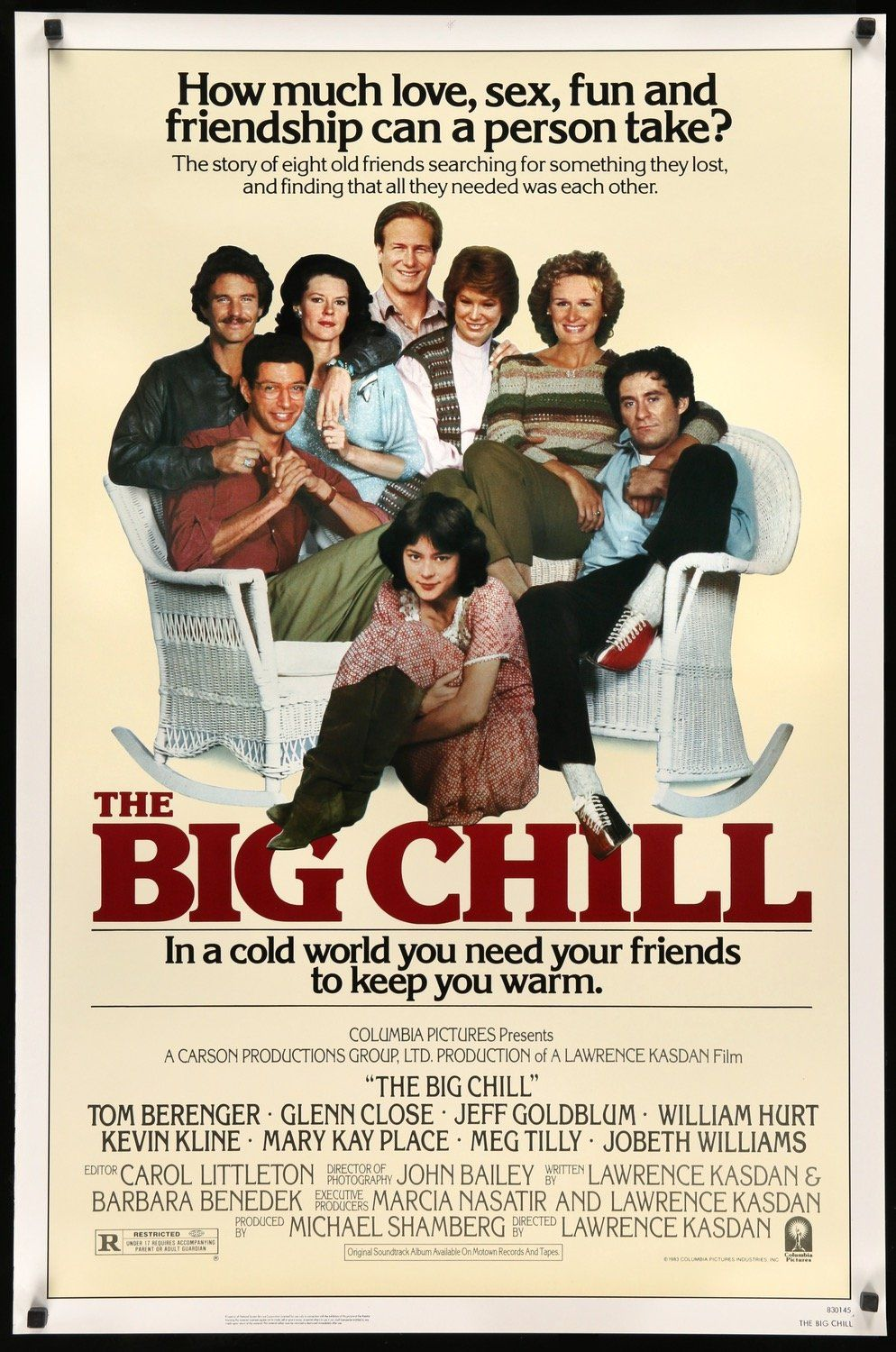
They say absence makes the heart grow fonder – but when this absence is broken by tragedy, it can unleash conversations that many would consider better having been left unspoken. This is where we first meet the characters at the heart of The Big Chill, a ragtag group of young people who previously went to college together, before dispersing to various places across the United States, each one of them following a different path, but which ultimately leads them together again after the suicide of one of their friends. Lawrence Kasdan’s remarkably poignant and deeply sentimental story of friendship in the face of tragedy plumbs the emotional depths that would be considered treacherous for many of his contemporaries. An incredibly influential work in a number of ways, inadvertently launching an entire sub-genre of adult-oriented films that focus on a group of people with a shared history bonding over a particular event, and in the process learning more about one another, as well as themselves, leading to almost revelatory realizations. Beautifully poetic, but also incredibly funny in a way that only someone who is genuinely committed to the material could ever hope to create as a result of a deep connection to the subjects being discussed, The Big Chill stands as one of the finest films of its era, a very meaningful and charming work that draws our attention to issues that may seem trivial from a distance, but turn out to be extraordinarily resonant once we are immersed in this world – and coming from a director whose entire career has been about finding new ways to discuss important themes, it’s difficult to see this film as anything but a brilliantly effective work of both concept and execution.
The Big Chill seamlessly blends comedy and drama to form an unforgettable film that is centred around nothing more than conversation – while we have grown accustomed to films in which dialogue is the main propellant, at the time, it was increasingly rare to find works that focused almost entirely on the effectiveness of placing a few great actors in a room and watching as they discuss a range of issues. This film does expand slightly beyond simply a single location, but it all orbits around a house somewhere in South Carolina, which serves as the stage for Kasdan’s deeply thoughtful account of life and death, as seen through the eyes of half a dozen individuals that are forced to reconcile their own insecurities that come packaged alongside middle-age with a deeply sentimental sadness that arrives in the form of their friend’s untimely demise. Undeniably, The Big Chill is not the easiest film to watch at times – firstly, any story that begins with a character committing suicide is going to be somewhat challenging, especially one that makes it very clear that it is positioning itself as something of a comedy, rather than a hard-hitting drama. It was imperative that this film be filled with humour, since the themes that it explores would become far too bleak had it taken a more serious approach. However, this doesn’t mean that the director is in any way flippant about the discussions he is having. The depth with which Kasdan delivers these very deep and sentimental conversations is not to be underestimated – it’s not only a film that questions the act of saying goodbye to someone who has departed, but reconnecting with the people who have also been left behind, many of whom find themselves questioning their own place in the world as a result of the sombre surroundings, and being able to find humour in these challenging situations only reaffirms what a deeply important film Kasdan made, not necessarily for the subjects it explores, but the manner in which it does it.
The appeal of The Big Chill is undeniably the cast – Kasdan, who had a relatively formidable standing in the industry, manages to use his connections to cast a group of actors who may not have been the biggest stars at that time, but would certainly come to be definitive of the decade in the subsequent years. Part of the brilliance is how well-composed the ensemble is – the director refuses to cast one kind of actor, and instead goes for a much wider range, which logically results in a group that is as varied in reality as they are in the film. The contrast between the more serious characters played by Kevin Kline, Glenn Close, JoBeth Williams and William Hurt, and the comedic relief delivered by Jeff Goldblum, Tom Berenger, Meg Tilly and Mary Kay Place is the key to the success of this film – suddenly, we’re presented with a group of individuals who all share the fact that they attended college together, but have deviated so widely in life, the act of getting together for a social event almost feels like a reintroduction, since they have all essentially morphed into extremely different people, which is the impetus for much of the film’s tension and the eventual catharsis. Choosing a standout is nearly impossible, not only because the entire cast is brilliant, but also due to the very simple fact that they are all playing to a very different kind of sensibility, it would be foolish to judge them using the same criteria. Instead, we can look at the entire group as indicative of one of cinema’s great ensembles, an instance where a group of actors are brought together and given distinct characters that seem almost counterproductive to each other, but through their extraordinary chemistry and undeniable determination to finding the truth beneath every character, there is a valuable sense of sentimentality that can be drawn out from each and every one of them, which is where the film is certainly at its strongest.
Ultimately, while the story may be framed around death, the actual event that brings these characters together eventually becomes secondary – the story isn’t so much about Alex’s suicide as it is about the events that preceded it, not necessarily in his life, but in the lives of the people who surround him. What appears to be a deep exploration of death actually turns out to be a steadfast celebration of life and love, as told through the perspective of a group of people who venture down to South Carolina expecting a funeral, but actually discover that they’re all undergoing a mass excavation of the past, where tears and laughter run in an abundance through this house, which suddenly finds itself being transformed into a home with these bellowing voices, each one of them carrying a lifetime of memories that are shared amongst the group. They may have thought they would have to work through their grief over this weekend, but they’re all stunned to discover that their friend’s death opened the doors for conversations around decades of trauma, insecurity and inner turmoil, all of which has been compressed into these individuals, and finally let out in a beautifully cathartic series of moments in which they are all confronted with an inescapable reality, forced to face the past or leave it permanently unresolved. It becomes less of an exercise in looking at the mourning process, and more aligned with the idea of using a tragedy as an opportunity to take stock of the past, and in working together with friends who have experienced similar concerns and confusions, they find themselves walking away more refreshed and energized than ever before, the weight of the past finally easing off their shoulders, allowing them to look forward to a much brighter future – and all of this is tied together so beautifully by the director, who always goes for the more complex conversations over those that may be considered far more easy and accessible.
Comedy is a tricky concept to get right, since most of the time, it is designed to bring joy and laughter. In rarer instances, a director may utilize it as a tool for provoking deep and meaningful discussions – this is where The Big Chill resides, since it is not a particularly funny film (although there are moments of genuine humour scattered throughout it), but it has its moments of pathos that would simply not exist without the lighter approach in some points. The balance between a very serious subject that borders on outright tragic at some point (especially as we learn more about what possibly led the unseen character to commit suicide, which becomes one of the main themes of the film, in terms of how each character reconsiders their relationship in the hopes of finding some answers), and the more lighthearted execution, which never allows the dour tone to linger for too long, makes for a truly compelling film. The Big Chill is a very well-constructed film about friendship, featuring a uniformly strong ensemble, and the story touches on themes that will undoubtedly resonate for most viewers, many of whom will unfortunately be able to relate to some of the sadder content, since even if we have not had the feeling of losing a close friend, we do know the sensation of an aimless future. This film aims to show a weekend in the lives of ordinary people who come together to form a momentary commune governed by a combination of trauma for their lost friend, and relief at being able to work through their past in order to unearth the secrets that have evaded them for years. Well-crafted, hilariously funny and heartwarming in the ways we’ve come to expect from these delicately-woven comedies about serious issues, The Big Chill is an absolute triumph, and proof that emotion is not something a film needs to avoid, since when it is well-utilized, very little can surpass it in terms of holding an audience’s attention.
 The Postmodern Pelican