
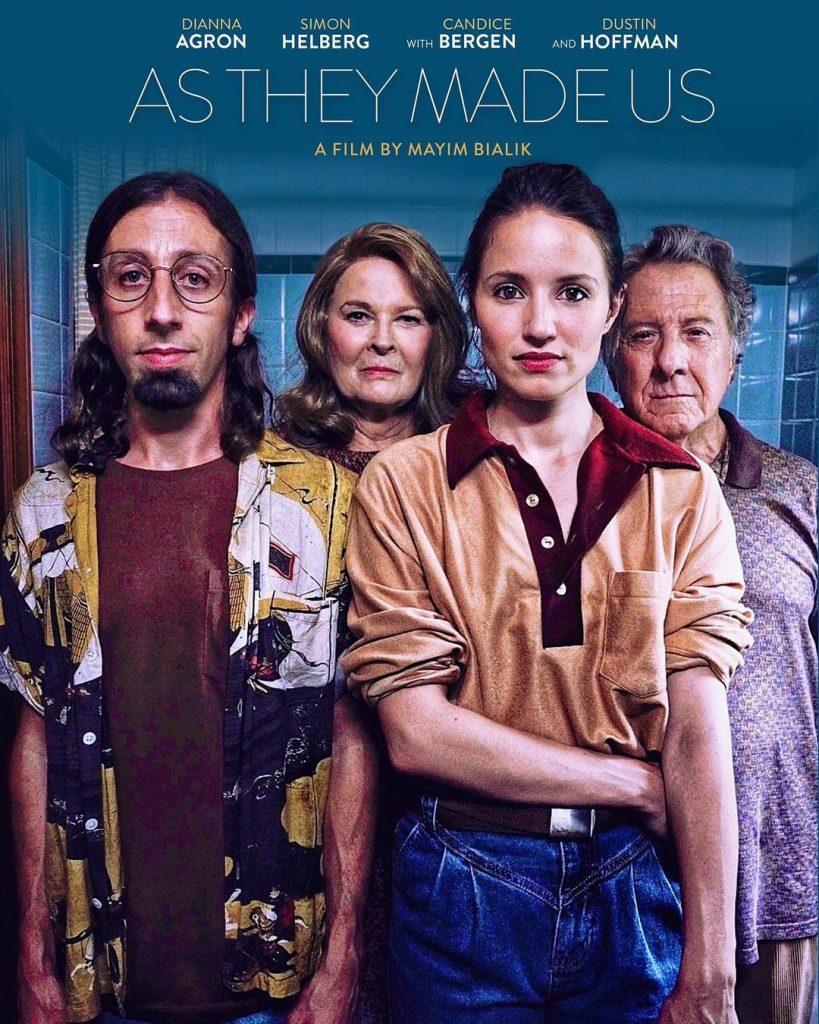
Saying goodbye is never easy. Whether or not we find it tragic or cathartic (or both, which is often the case with losing a loved one), there’s something profoundly challenging about uttering those final words, granted one even has the power to say something so absolute. This is the foundation for As They Made Us, the beautiful directorial debut by Mayim Bialik, who tells the story of a Jewish-American family going through the motions of bidding farewell to their dying father, whose degenerative condition has meant that they all know that he is living on borrowed time. Assembling a stellar cast, and writing a screenplay that makes excellent use of every one of them, Bialik proves herself to be an excellent filmmaker, someone who is capable of plumbing the emotional depths of a family dealing with the concept of death, both in the days leading up to it, and the moments that immediately follow it, which many of us know can be the most challenging moments of them all. The film is remarkably simple, and is not necessarily revolutionary in any discernible way – but through the measured use of humour to face some extraordinarily bleak conversations surrounding themes such as family, psychological issues and the great inevitability of death, Bialik puts together a very simple but evocative film that feels genuinely complex in the moments that matter, as well as gently endearing when it needed to remind us of the beauty that is inherent to life. She establishes herself as a promising young filmmaker, and while it may be slightly rough around the edges, As They Made Us gives us remarkable insights into a familial relationship that facilitates many compelling, and sometimes deeply upsetting, conversations.
When it comes to making a drama about a very serious issue, it would appear that death is one of the most undeniably omnipresent themes for just about as long as cinema has existed – whether the kind of tragic demise that befalls a dashing hero or their paramour, or a more intimate glimpse into the prolonged journey to the grave by someone who is informed that they do not have time left, film has often taken an active interest in these themes. As They Made Us is not a particularly complex film in this regard, but it is one that understands how to explore the theme of death without needing to become overwrought. Undeniably, some of the content may be considered heavy-handed (and it doesn’t help that Bialik is still slightly too dependent on almost cliched representations of the dying process, one drawn from nearly every modern film on the subject), and the film doesn’t venture too far from convention to be entirely convincing about every idea that it seems intent on exploring. However, this is a case of a film not so much being about death as it is focused on the journey towards it, not only in terms of the person whose mortality becomes the focal point of the story, but also the people that surround them, and who have to get used to the idea of cherishing every moment, knowing that each one of them is precious, as time is finite, which has never been more true than in times when we know that a loved one is approaching their final breaths. This certainly isn’t the first film to interrogate these ideas, nor is it the best – but it starts the conversation in a way that means something, which helps it tremendously in developing a consistent and meaningful series of discussions on the nature of love and death.
Bialik’s process in telling this story involves creating characters that are more than just stock archetypes, and her attention to detail in the development of each individual in the film is admirable, with her status as a relatively well-regarded actress being put to good use in wrangling an unexpectedly excellent cast. Veterans of the film industry Dustin Hoffman and Candice Bergen hold court as the parents of the central family, turning in some of their best work in years. Hoffman, who has seemingly grown into playing the roles of these prickly but soft-hearted patriarchal figures who are existing in the last stages of their life, does more to develop the archetype of the dying father than most actors who have played similar roles. Contrastive to him is Bergen, who is the comic relief of the film, playing the loud-mouth matriarch whose self-centred nature means she borders on villainous most of the time she is on screen, but in a way that is constructive – every moment of antagonism involving her character is purposeful and meaningful. Bialik’s former co-star Simon Helberg has a smaller role as the estranged oldest child, and proves that he is a capable dramatic actor, much more than many of his former colleagues from his days of television. However, it is almost undeniable that As They Made Us belongs unequivocally to Dianna Agron, who is simply devastating as the beating heart of the film. Her role as the daughter who has to act as the adhesive used to hold this dysfunctional family together is absolutely heartbreaking – her expressive style of acting is put to exceptional use here, and she plays the role with an earnest sense of complexity that would be missing had it not been so important for Bialik to have her protagonist be a fiercely independent young woman who begins to question her place in the world as a result of enormous changes to her life. The film uses each of these actors perfectly, Bialik proving that she is incredibly adept at extracting meaningful performances from her entire cast.
The film certainly does feel like a debut, insofar as Bialik does depend on a few specific qualities that we normally find in a director’s early work. Whether it be relying on a very distinct narrative structure, or the oscillation between tones (one of the most common quirks of a directorial debut is a film that focuses on very serious issues through a more lighthearted lens, almost as if levity is used as a tool to soften the emotional impact), Bialik is drawing from other novice filmmakers. Mercifully, she has the guidance of a gifted cast (some of which are former colleagues from previous projects) and the support of a crew willing to help her realize her vision. Ultimately, like any good debut, the focus is less on bombastic, groundbreaking filmmaking, but rather on a more intimate, quietly ruminating approach that allows for important conversations to emerge, albeit in the form of a more intimate set of surroundings. Considering the themes being explored in As They Made Us, this seemed almost inevitable – it is impossible to tell a story of this nature in a way that is excessive, and Bialik knows where to draw our attention, placing the emphasis on the moments that may not seem the most important at the outset, but actually prove to be remarkably important when we are reflecting back on the events of the story, which is essentially what the entire purpose of the film actually is. It doesn’t shatter boundaries, but it offers reliable and insightful discourse around the process of watching a parent gradually fade away into the ether – and the director’s sensitive touch is absolutely integral in bringing these ideas to life.
We find ourselves gradually becoming more immersed in the lives of these characters as a result of the extremely simple narrative technique, and coupled with the tremendous performances, As They Made Us is a very effective drama about deeply grave issues. As They Made Us may not venture too far out of the realm of your garden-variety family drama, but it does have a sense of optimism that we often miss in more self-serious fare. With the exception of a few moments, this film isn’t particularly funny, but it does not neglect to point our gaze in the direction of the more lighthearted moments that occur in between the major events – this is where the most meaning is found, and we’re as likely to be beaming with joy as we are weeping with unbridled sadness. Finding the balance between the two is the key to success for this film, which understands and appreciates that the audience is going to have differing interpretations of how the material is handled, which leads to the film being quite a passionate but simple story of a family going through the grieving process, anchored by discussions of the unbearable weight of the past, as well as the realization that the perfect past we all wish we had simply does not exist – each of us has experienced a blend of happiness and tragedy, which is the primary thesis statement of this film, which aims to deliver a poignant story of life as it is, told through the perspective of someone questioning much more than the meaning of life, only to come to the definitive conclusion that life simply does not have an answer, and that these philosophical ramblings that distract from the fact that life is short, and that every single moment, regardless of the past, should be cherished.
 The Postmodern Pelican