
There is nothing quite as entertaining as a good murder mystery, and someone whose name immediately evokes the idea of quality in this regard is the incredible Agatha Christie, whose works have not only captivated audiences for generations, but actually made history (with The Mousetrap remaining the longest-running play in history, its staggering 70-year run unlikely to be matched anytime soon). Whether on stage, on television, over the radio or in film, Christie’s work has held an enduring legacy, one that has continuously been revisited over the years. She is one of the rare writers whose stories are easily adapted to absolutely any medium, with the strength of her writing, and ability to create fascinating characters and thrilling scenarios making her one of the most cherished writers in the history of English-language literature. Evil Under the Sun is not often referenced as one of her canonical works, but is relatively well-regarded, especially amongst those that find the same perverse pleasure in seeing the contrasting between the beautiful Devon coastline and cold-blooded murder. It was adapted into a fantastic film by Anthony Shaffer (returning to Christie’s world after working on both of the previous high-profile adaptations of her work, Murder on the Orient Express and Death on the Nile), and directed by Guy Hamilton, whose work as one of the regular directors of early James Bond films made him quite a strong filmmaker, capable of effortlessly immersing himself in Christie’s story, producing something absolutely exceptional. Evil Under the Sun is a terrific film, a complex and often quite hilarious mystery that reminds us exactly why this genre has remained so popular over the decades.
We all love a good mystery here and there – whether it be the chilling details of a true crime story, or a work of conjecture, many of us enjoy fashioning ourselves into amateur detectives, accompanying the professionals in their investigations of a crime. This has been the primary reason behind the enduring legacy of Christie’s work, particularly in regards to her recurring characters, many of whom have been staples of the genre. Hercule Poirot is arguably the most famous and beloved – the portly Belgian detective with a penchant for œufs de coq and ability to spot even the smallest details as a result of his “small grey cells” has made him a figure that has resonated with audiences. The proverbial everyman who is both brilliant and relatable, he is possibly the finest invention in detective literature outside of the famous creation of Sir Arthur Conan Doyle, whose Sherlock Holmes is so well-loved, many genuinely believe that he was a real person. We love Poirot because he isn’t particularly outwardly intelligent or brilliant, but rather an ordinary man who is blessed with the rare quality of simply being able to pay attention. Evil Under the Sun positions him in a precarious situation, since it is one of the instances where his final resolution ultimately has to do with a leap of faith, rather than having much solid proof – and even when the killer is revealed, and he is seemingly allowing them to walk away, there is something simmering beneath the surface that keeps us engaged. Shaffer was a writer with a good eye for detail, so his adaptation of Evil Under the Sun remains remarkably close to the novel, but with key changes that add nuance, handing his screenplay over to Hamilton, who makes it profoundly cinematic, with the help of a few strong collaborators.
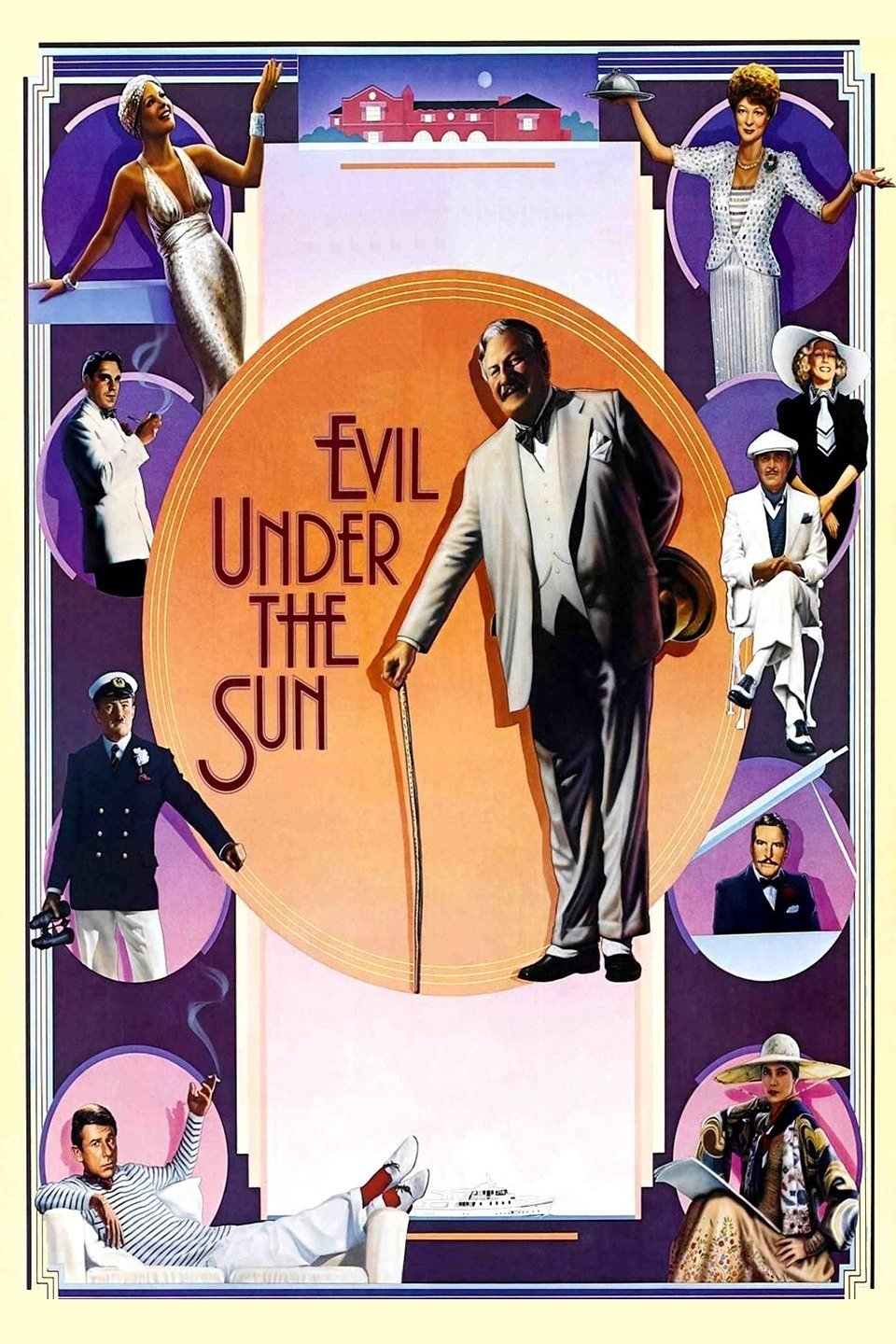
A great detective story is only as strong as the characters, and Evil Under the Sun is not an exception. Christie’s stories often contained large casts of characters, and therefore were often an opportunity to assemble some incredible and eclectic ensembles, many actors considering Christie’s work to be something of a rite of passage, and thus needed very little persuasion to enter into the writer’s world, especially since most of the roles are not particularly large, but are still incredibly important. Peter Ustinov reprises his role as Poirot from Death on the Nile, where he took over the part from Albert Finney – and while Ustinov may not have the dynamic personality of his younger counterpart, he was something of a better fit for Poirot, his almost meandering geniality making him a perfect candidate to bring the Belgian detective to life. Interestingly, one of the frequently occurring qualities of these ensemble-based murder mysteries is that the detective has to be a fascinating character, but not the focal point, which would in turn have to be the actual suspects – Ustinov, as an incredible character actor, has very few qualms in stepping away from the spotlight when it is necessary, as a means to give other actors the chance to steal the show – and they certainly do. Maggie Smith and Diana Rigg (two of the finest grande dames of the art of acting) are fantastic as sparring partners, the former the pernickety, gossip-loving hotel manager, the latter the viciously vain actress who meets her fate at the hands of a disgruntled fellow guest. James Mason is a riot as the peculiar theatre producer, while Sylvia Miles is his discerning wife. From top to bottom, Evil Under the Sun has a tremendous cast, each one of them being given very precise characters that, when placed together, create a remarkable tapestry that brings life to Christie’s already electrifying works, with Ustinov being the thread that ties them all together.
Yet, it’s not only the characters that make for a thrilling murder mystery – the storytelling is just as important, since not only do we have to watch these events unravel before us (through the eyes of the brilliant detective at the heart of the story), but we want to become involved in the investigation ourselves. Part of the experience is inserting small clues into the film that eagle-eyed viewers may be able to pick up on – without some creative storytelling that allows us to try and solve the mystery from the comfort of our armchairs, a film like Evil Under the Sun would simply not be effective. Hamilton had much experience directing genre-based work, so it was unlikely that his voyage into Christie’s writings would be anything less than impressive, and working alongside the profoundly gifted screenwriter tasked with adapting the text, he makes an immersive and unforgettable piece of filmmaking that is as riveting to watch as any other mystery film. It helps that Shaffer ensured that there was some genuine humour embedded in the film – the entire first act is dedicated to introducing us to these characters and their peculiar personalities, moving at a glacial but effective pace that allows each one of them to develop into interesting individuals. The contrast between the sun-baked splendour, and the murder that places a dark cloud over the vacationing guests makes for a thrilling and often quite moving film, and the key is that Hamilton is very much invested in giving audiences the chance to follow along, never being too far ahead of us – it makes the eventual revelation incredibly thrilling, since we ourselves start to put all the pieces together, almost as if we were accompanying Poirot on this investigation. This kind of dedication to allowing audiences to become active participants in the viewing experience is precisely the reason behind the success of the genre, which is perfectly captured here.
Evil Under the Sun is a tremendous film – it is filled with a delightful complexity that manages to make something as dreadful as murder entertaining (especially when the victim is deeply despicable herself), and the circumstances around the investigation thrilling and done with an old-fashioned, earnest sense of humour that is distinctive to Christie’s work, as well as some of her contemporaries in the genre. It has far too many charms to mention, and the entire production is done with such a genuine fondness for both its characters and the situations in which they find themselves, its honestly quite surprising that it is not better-known, at least in contrast to the two previous acclaimed adaptations of the author’s work that were brought to the screen and became enormous successes. Whether it be in the spirited performances, interesting storyline or the deconstruction of conventions to the point where it becomes almost overwhelmingly fascinating, Evil Under the Sun is a firm reminder of how, even when they follow a very strict formula, there is considerable merit in tradition, especially when it produces works as consistently thrilling and enticing as this one. It has very little issue with taking its time, and the audience doesn’t have too much concern with the fact that it draws attention to the most trivial details, since we are well-aware of the fact that each line of dialogue and narrative motif is going to play a vital role in the eventual solution – so we just embrace the spirit of the unknown, and follow this film as it ventures through the sunny Adriatic Coast, and presents us with a compelling, endearing murder mystery that offers both thrills and laughs in an absolute abundance.
 The Postmodern Pelican