
Crime doesn’t pay, but it certainly doesn’t seem to help pay the rent on occasion. This is the fundamental conversation being conducted throughout King of New York, the ambitious crime drama by Abel Ferrara, who has made something of a career out of telling stories of individuals that may engage in activities that are somewhat crooked, but have motivations for doing so, which form the basis for his films. As one of his most celebrated works, King of New York feels like the quintessential Ferrara motion picture – it has an abundance of violence (all of which is very carefully curated to maximize on the shock value, rather than just being excessive for the sake of it), driven by a few magnificent performances, and told with the kind of intensely zealous wit that conceals very bleak motivations for the actions of various individuals who populate the film. It is understandable why this remains one of the director’s most impactful works – it was made during a transitionary period in his career, where he was moving from an underground filmmaker with a penchant for over-the-top violence, but coupled with a growing sense of awareness to the world around him, one where unhinged, vaguely surreal stories of bad people and their terrifying actions were simply not enough to propel these stories forward. In its most honest form, King of New York may be Ferrara’s most well-formed film, perhaps not being as memorable as some of his more audacious productions, but rather having the most precise and consistent point of view. Like every filmmaker, Ferrara had to start working towards challenging his style, and this film represents the touch of a more mature, but still very creative and daring, filmmaker who used his own perspective to create one of the bleakest crime films of the era.
All the quintessential elements of a solid Ferrara film are found spread throughout King of New York, which is distinctly a work of someone who had spent the last decade carefully developing his craft, emerging from the creator of hideous but powerful exploitation films like Ms. 45 and The Driller Killer to make films that are more sophisticated in their point of view, but still somehow retaining that rambunctious complexity that made his earlier works produced as someone occurring at the intersection between the underground and the mainstream, so compelling. This film in particular is of note, since it has a relatively simple story – a crime lord is released from prison, and his immediate actions are to firstly take revenge on absolutely everyone who had wronged him in the past, as well as setting his sights on something much bigger than his current position, aspiring to become the Mayor of New York City, thus cementing his status as the de facto king of the city of which he always knew he had control, even if those on the other side of the law would never care to admit the influence those in the world of crime have on the day-to-day operations of the city. It’s a daring film, but one that feels very natural to the director’s sensibilities, mainly because Ferrara has never been one to shy away from telling stories that take the form of complex character studies of malignant individuals, where his aim isn’t necessarily to force the audience to sympathize with insidious people and their criminal actions, but rather to dive deep into their psyche, exploring what drives certain people to commit the crimes that they did – for some, its the search for wealth or power. For others, it’s a way of exerting revenge on those who they feel need to be the victim of ruthless retribution for any number of reasons. For Frank White and the rest of his cronies in this film, it’s a blend of both – and that’s precisely the reason behind the enormous success of King of New York, which takes an unexpectedly complex glimpse at the criminal mind.
There are countless conversations being conducted throughout King of New York, and Ferrara is certainly never at a loss for subject matter, using this relatively short film (running at an unexpectedly paltry 100 minutes, which is quite compact for a fully-formed crime epic) as the foundation for a series of deep and insightful conversations. The premise might lead you to think that its a very conventional, unoriginal crime drama about gang warfare and the pursuit of power – but this is really only the foundation of the film, and is an aspect that isn’t necessarily secondary, but rather is just used as the starting point for the director’s more nuanced explorations of the lives of these characters. The simplicity of the film is one of its primary merits – it starts as a relatively straightforward story of a crime lord being released from prison, and then gradually evolves into a deep and disconcerting character study, where he weaves his way into the lives of all of his enemies, who eventually turn out to be victims of his games of manipulation. For the character of Frank, revenge isn’t only done through murdering his adversaries in cold blood – it’s doing so in a way that reminds them, and the rest of the world, of his motivations. Ferrara is navigating a narrow, dangerous boundary between being overly compassionate to the main character, who is by all accounts a despicable awful human being, and looking at the world through his perspective, which has been jaded by years behind bars, where that time was used to carefully plot his revenge. The more traditional aspects of the story are certainly present, and for those looking for a riveting crime thriller, King of New York certainly offers some of the best that the genre has to offer. However, it’s in the areas where it is slightly more experimental that it makes the biggest impression, and there is rarely a moment in this film where we feel like Ferrara isn’t actively working towards some deeper message, which only draws us in further as we attempt to uncover the numerous mysteries lingering beneath the surface of this film.
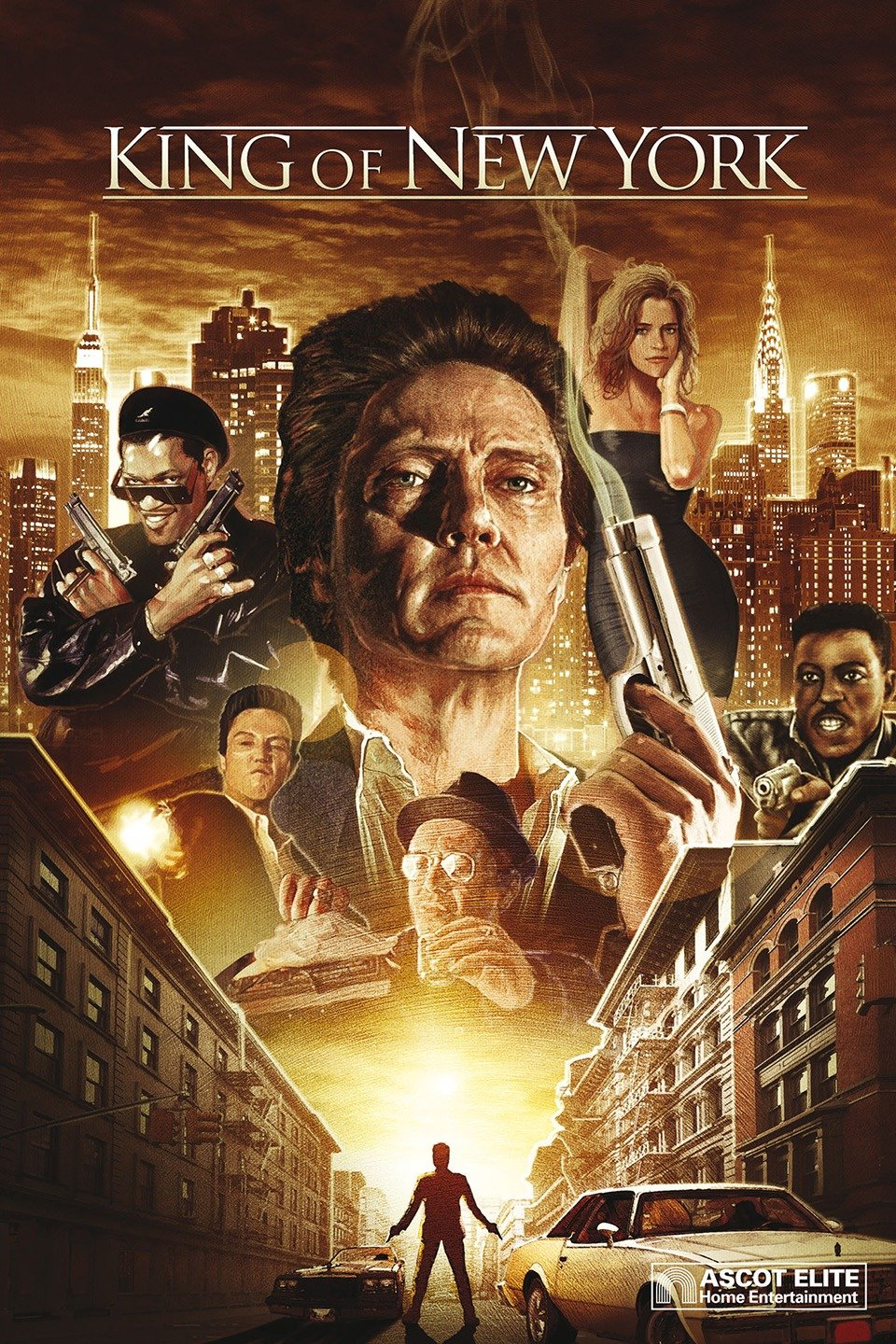
The aspect of King of New York that has most consistently lingered over time is the performance given by Christopher Walken. The shot of him standing, peering out onto the world outside his hotel room, while the New York City skyline is reflected on the window, obscuring most of his face, is an iconic image, and sets the standard for this film, which is a neon-soaked contemporary noir that, much like other entries into the genre, pays more careful attention to the lives of the characters and their inner psychological states as it does their various actions, which are still very interesting, but not nearly as much as the internal quandaries many of them face throughout the film. Walken is a fascinating choice for the role of Frank White – he’s not someone who ever struggles to play sinister characters, and has certainly tried his hand at the occasional crime drama throughout his prolific career. Yet, there is something off-kilter about him that makes him such a peculiar choice for the part, albeit one that does fit once we understand where Ferrara is heading with the character. Frank is supposed to be a bloodthirsty, maniacal criminal who we are forced to respect, and by having someone who can easily play a more unlikeable individual, but in a way that gives him depth and nuance, Walken finds the underlying realities of the character, while playing him as if he were in another dimension entirely – surprisingly, Ferrara allows Walken to have fun with the character, making use of the actor’s gangling frame and very distinct appearance to create an intimidating anti-hero, which is sharply contrasted with Walken’s unique swagger and penchant for rhythmic movement, such as in moments where he dances, which isn’t something we’d expect from such a film. It’s one of Walken’s finest performances, and Ferrara proves to be quite a formidable talent in managing to harness such a unique portrayal from an actor that many directors often struggle to fully utilize to his full potential.
Ending this discussion with praise for Walken seems entirely appropriate, since King of New York is a film built around Walken. He is the heart of the film, and the primary reason the story works so well – Ferrara allows him to command the screen in his own unique way, and in the process proves to make the film quite an extraordinary experience, each moment feeling more insightful and genuine than the last, which isn’t always something that we’d expect from run-of-the-mill crime thrillers. There are many moments in this film where it feels like Ferrara is doing exactly what we’ve seen him do before – the story itself doesn’t seem particularly striking at first, and the tone is almost identical to every other neo-noir produced from the movement’s beginning at the start of the 1980s. However, it’s in the small details that King of New York manages to flourish – from the smallest details to the broadest, most intricately-woven plot points, there is something profoundly disquieting about a film that seems to be so invested in showing us a different side of the criminal mindset, it borders on empathetic. As a result, we need to actively follow this film’s line of thinking, continuously questioning some of the shrewd narrative choices made by the director in the creation of a film that is sometimes quite unsettling, not only in its excessive violence, but also in the implication of the darker side of humanity, which it suggests cannot be fully eradicated, especially not when those tasked with bringing these criminals to justice employ methods that place them right alongside their prey in terms of immorality and unnecessary malice, only differing by their final intention. King of New York is a brilliant film, a daring and unsettling psychological drama, and anchored by the phenomenal performances and a strong filmmaking style, it manages to be one of the most deeply complex crime films of its era, and one due for even more praise from contemporary audiences.
 The Postmodern Pelican