
The Longest Yard is a strange film for a number of reasons, many of them having to do with how imbalanced it feels. Helmed by the ever-reliable Robert Aldrich (a chameleon of filmmaking, having worked in every conceivable genre, particularly in studio fare that were based on the supposed interests of the general public), and written by Tracy Keenan Wynn, based on an idea by producer Albert S. Ruddy, who is very likely the main authorial voice behind the film’s creation, it’s a peculiar comedy that is as soulful as it is cynical, which it is in an abundance. How else can we explain a film that is so hilarious, but also as mean-spirited as this? Not necessarily a complaint and more of an observation, the film is a masterful attempt to take two wildly different genres, throwing them together and hoping for ideal results. One can argue whether the film ultimately achieves its goals – any critically-thinking viewer will notice the inconsistencies, while those with an open mind will understand how Aldrich and his cohorts were going for the biggest swings, which they acknowledge could not necessarily lead to the most balanced filmmaking. As a whole, its a tremendously entertaining film that takes its time to get to a discernible point of contention, and with Aldrich’s assured direction, some great performances and a story that would be difficult to fumble, The Longest Yard is a decent offering that may be overshadowed by later adaptations, but remains relatively captivating, even several decades later.
From the outset, we can immediately tell that The Longest Yard is aiming to combine two incredibly popular genres into a single coherent storyline – the prison film had always resided at the outskirts of mainstream popularity (but still had many fans, especially amongst those who had an interest in hardboiled crime films), while the sports comedy was openly-appreciated, especially amongst those who had a penchant for the real-life activities of their favourite athletes, many of whom were worshipped as goods. By situating the audience in a Georgia prison and having the main character be the All-American hero that many perceive their favourite sportsmen to be, the film immediately evokes a very challenging discourse about how we appreciate sport and the people who consume it. As a result of combining the two kinds of conventions, the film has double the responsibility to not only tell the core story, but also honour the specific details of the genres from which it is derived, which are often in contention with one another. However, they’re not nearly as oppositional as it would appear, since the transition between the two is smooth and well-made, which is undeniably a result of Aldrich’s well-regarded tendency to juggle multiple genres at once without showing many signs of fatigue. It’s the primary reason behind the film’s ability to be as thrilling as any prison film, and as entertaining as your garden-variety sports film – and to add humour to the equation and still have something successful is even more impressive, especially from a film that was clearly not aiming to redefine any of these genres, but rather just offer the viewers two hours of entertainment.
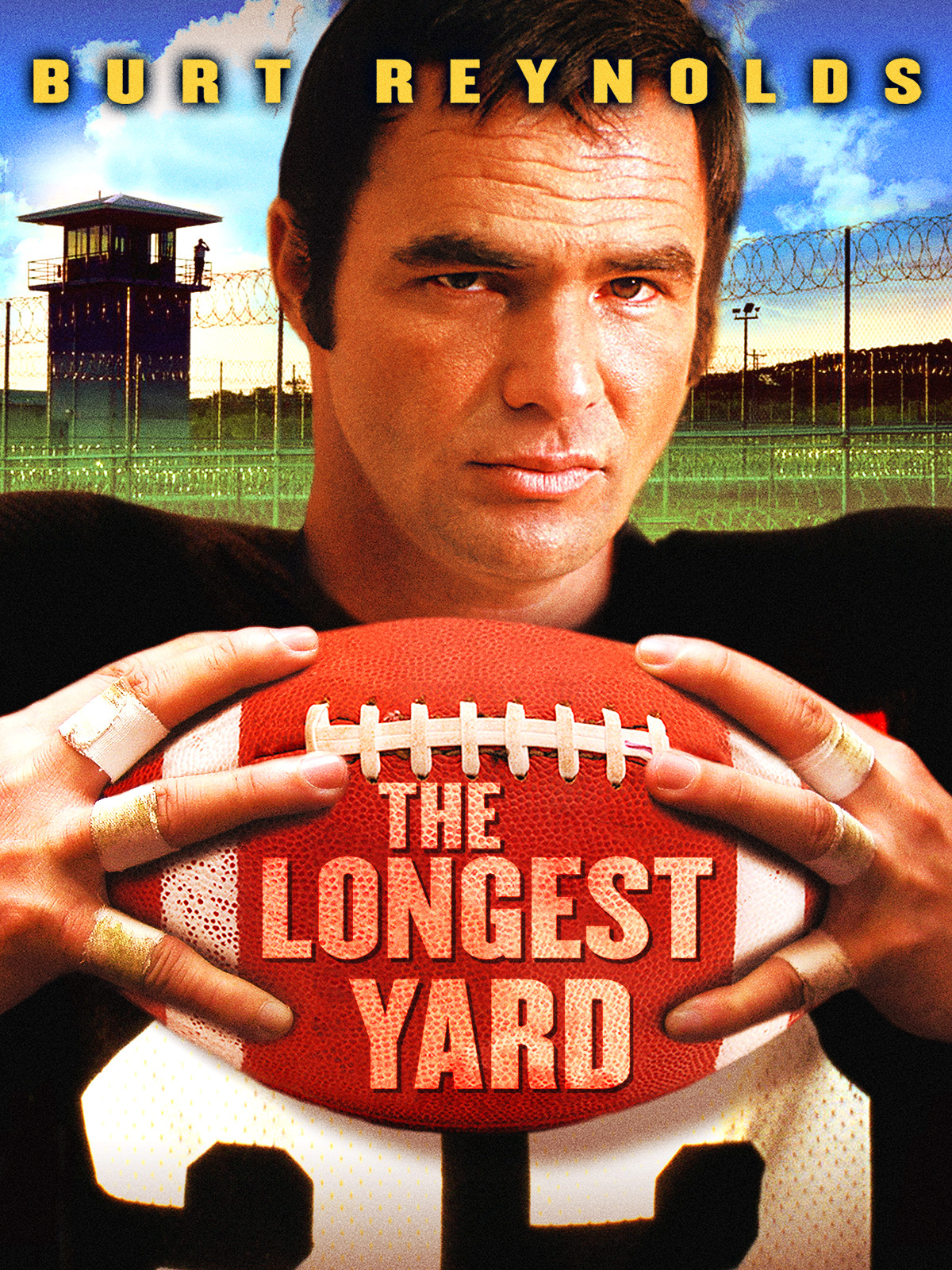
Much of what makes The Longest Yard so successful is based around the work being done by Burt Reynolds, who was at the peak of his stardom around this time. Sarcastic, wise-cracking and supposedly the ideal for the average American male, he was the embodiment of what everyone either aspired to be, or wanted to have as their companion. From a contemporary perspective, this is slightly inexplicable, especially since most of his characters were rascals that had the gift of the gab, but lacked the moral grounding to get themselves out of trouble in decent ways. Oddly enough, it was a film in which Reynolds played a criminal that found him at his most genuinely moralistic – Paul Crewe is a man who acknowledges his wrongdoings and just wants to pay the consequences by quietly doing his time and moving on with his life, only to be forced into a position where he has to take on many responsibilities just to earn his eventual freedom, which he comes to learn is not guaranteed. Many have cited this as Reynolds’ best performance, and it is difficult to argue with such an idea – it may not be the most complex work that he had done in his long career, nor is it the most challenging, but it is certainly the one that best demonstrates his appeal as an actor, while still giving him a strong character that he can develop. The cast that surrounds him is really good – Eddie Albert goes toe-to-toe with Reynolds, playing the sadistic warden (and he is arguably the most memorable part of the film, portraying one of cinema’s most unexpectedly great villains), and the ensemble is uniformly strong, making The Longest Yard a much more interesting piece than it would appear at first glance.
There is an argument that we can do a deeper reading around The Longest Yard, especially in its portrayal of masculinity, which is oddly more complex than many similar films. It almost seemed as if Aldrich was actively mocking the bravado that is shared between the prison film and sports comedy genres, in which sexism and debauchery is not only commonplace, but it is somewhat condoned, almost as if they perceived the only kind of humour being that which punches downwards. Thankfully, The Longest Yard is astronomically different – the heroes are the underdogs, while the villains are the sadistic and maniacal members of the institution. Considering who the target audience of this film would supposedly be, it seems strange that the film would so actively take a stance against the supposedly hard-working civil servants, while portraying hardened criminals as the heroes. This just points to the fact that beneath its relatively conventional surface, The Longest Yard is as rebellious as its main character a man who is willing to take a few calculated risks, even though immense consequences linger over him. We can easily unpack the entire film and look at it from this perspective, but that would only serve to strip it of some of the carefree, easygoing charm that propels it and makes it so entertaining. While there is an abundance of discourse that could come from this film, we’re more likely going to find enjoyment in just taking the film at face value and surrendering to its unconventional charms.
The Longest Yard is not revolutionary filmmaking, and it is rightly considered a relatively minor offering in both the prison and sports film genres, occurring at the intersection between the two. Instead, it offers solid entertainment that will be enough to deliver exactly what audiences expect. It may be tonally very inconsistent, with some tragic moments being rendered as almost vaguely comedic, the intention of which we never quite can understand, and the action sequences, while few and far between, are not entirely well-constructed and don’t contribute much to the film. Large portions of the film may be polarizing to some viewers – for those who enjoy watching sport, The Longest Yard is very likely going to be riveting, since the entire third act consists of the centrepiece football game, and it is never made all that accessible to those who don’t understand the sport. Yet, this isn’t all that the film aims to be – in between these moments, it manages to be quite an interesting character study, a brutal indictment of the crooked institutionalized system that many films produced under the banner of the New Hollywood movement infused into their films. It’s hardly a surprise that this film occurred concurrently to a period of immense social unease, where the idea of “sticking it to the man” was spreading widely throughout the western world. It may not be the definitive work in relation to any of its ideas, but it is one that feels authentic in its viewpoint, as well as in its ambitions to add nuance to a story that appears simple at the start, but grows gradually more interesting the further we allow ourselves to be immersed in his environment, leading to a fascinating series of moments that are genuinely quite interesting, much more than we’d expect at a cursory glance.
 The Postmodern Pelican