
You liked Rashomon
“That’s not how I remember it”
The Simpsons, “Thirty Minutes Over Tokyo” (1999)
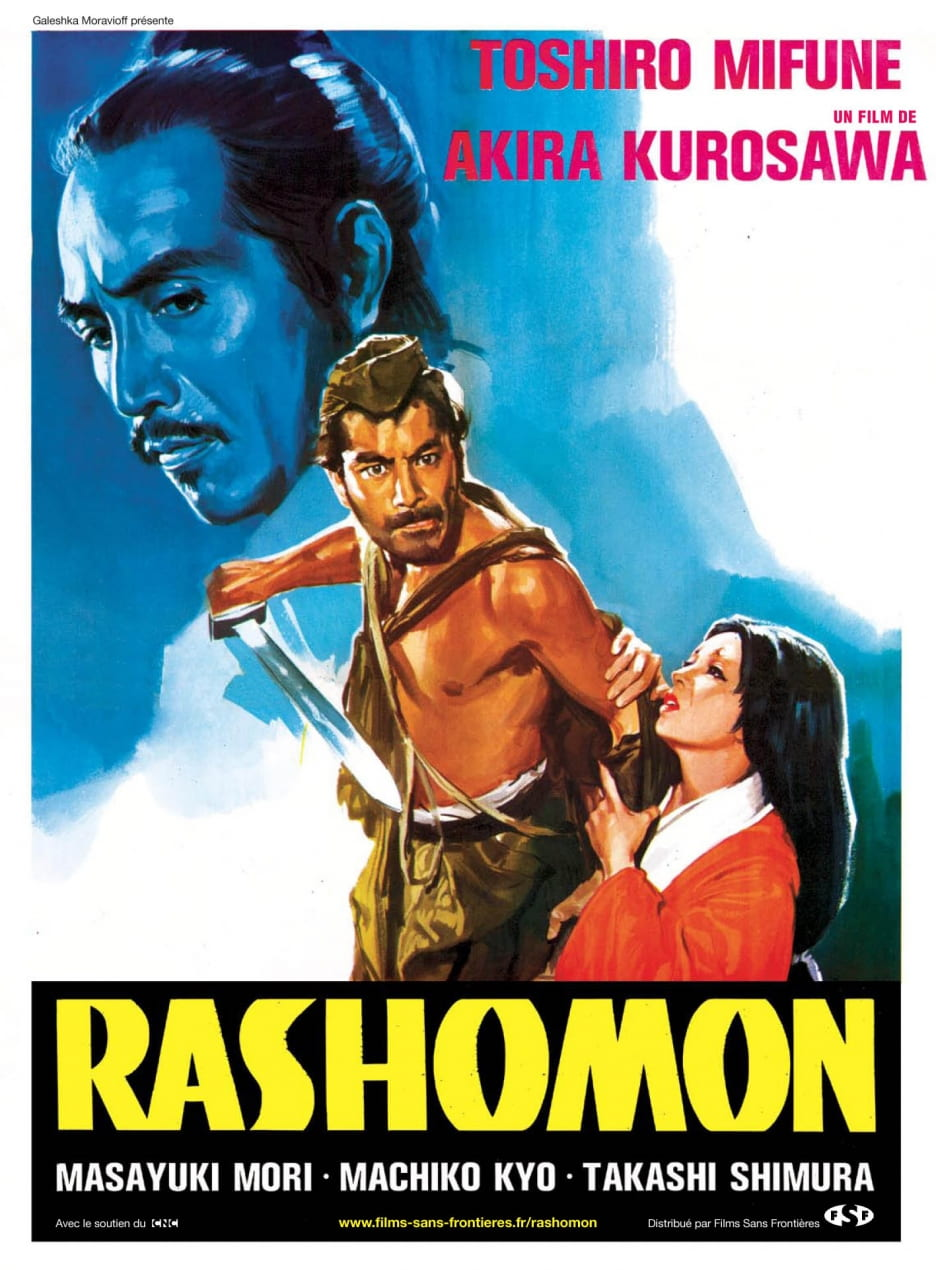
Not only is Akira Kurosawa’s Rashomon (Japanese: 羅生門) the basis for arguably the most elegant and unexpectedly funny joke in sitcom history, it is quite simply one of the most important films ever made. It wasn’t Kurosawa’s first film (it wasn’t even the first film he made that year, as he had made Scandal a few months prior), nor is it his most ambitious in terms of scale and scope. Yet, it’s widely considered the film that officially put the esteemed director on the creative map, proving that he wasn’t only a vitally important figure in terms of Japanese cinema, but someone whose work extended far beyond the confines of his home country, emerging into a global market that was always readily accepting of his diverse stories, of which Rashomon is one of his finest. There are many reasons behind the reputation this film holds – it is a wonderfully compact film, running only 88 minutes, which is exceptionally short for a film this philosophically deep. It has a strong story (or rather, several strong stories, by the nature of the premise), and some terrific performances that anchor the film and make it such a wonderfully interesting exercise in narrative storytelling, a perfect marriage of style and substance that Kurosawa somehow managed to consistently perfect throughout his iconic career. The reasons behind its success are plentiful and easy to discern – but it’s the actual experience itself, witnessing a master at work as he crafts something memorable, that keeps us engaged and interested, and immediately establishes Rashomon as a work of incredible importance in the history of world cinema.
It’s always a wonderful sensation when a canonical classic not only lives up to the impossibly high expectations that have been asserted on it over the years, but somehow manages to exceed them, being far more endearing and complex than even the most effusive praise would suggest. Rashomon has always been one of those films that is remembered less for the specific story, and more for the devices used in its creation, serving as a point of reference for future filmmakers to fashion their own work. It’s an undeniably influential piece, particularly due to the notable plot element, where the audience is presented with a few versions of the same story, each one of them adding information that conflicts with the ones that surround it, while complicating the truth in ways that were not commonly found before, revealing deeper theories and details. It’s risky to refer to this as the first time such a device had been used, since we’ve been witness to millennia of artistic expression, so there is bound to be some previous artists that used a similar device – however, Kurosawa undeniably brought it to the mainstream, and turned it into something memorable, to the point where any work that uses the concept of conflicting versions of the same story is inevitably compared to this film. Not too many films can attest to be as artistically resonant as this, insofar as it has inspired countless other works to follow it, adapting similar narrative strategies – but there are reasons behind the god-like reverence we hold for Kurosawa needs to be somehow explained, and very few films do it much better than this one, which manages to be just as masterful as its reputation would have you believe.
It’s not even a matter of the fact that Rashomon has a great concept, but that it is made by someone who knows exactly how to use it well. The narrative structure of the film is one that doesn’t always make sense, but it never intends to – Kurosawa understands that not everything needs to follow a coherent and logical flow, and that intentional confusion can result in some fascinating narrative potential, which he consistently manages to touch on here. Rashomon almost seems like an underground, experimental horror more than it does an iconic cornerstone of world cinema, particularly because it just pushes boundaries that didn’t even exist in their fullest form at the time – how else can someone warrant pulling apart so many different conventions long before they were even considered part-and-parcel of the filmmaking process? He may regularly be pitted against his fellow contemporaries in the form of Ozu, Naruse and Mizoguchi (all of whom did work that warrants the same amount of acclaim), but it was Kurosawa who consistently took his craft in unexpected directions, seemingly never content to just settle into one way of storytelling, nor did he particularly enjoy working within one technique, changing and challenging his style in ways that made him one of the most varied and interesting directors of any generation – and right at the heart of his iconic career is Rashomon, that ties together these wildly disparate threads of artistic potential and presents us with something that bewilders, but in a way that is constructive, meaningful and always interesting, and sets the foundations for over half a century of experimental work that would draw inspiration from the sheer audacity that went into the creation of this film, which proved that narratives are not always static.
Kurosawa proved that a director didn’t need to play by the rules to tell a compelling story – and not only did he challenge the confines of the sacrosanct narrative structure, where the truth is always revealed by the end, but he did so with poise and nuance, putting together a film that is as elegant as it is provocative. Visually, there is something so unique about the director’s work, and even before he managed to acquire bigger budgets and more extensive resources, there was a skillfulness to his artistry that is difficult to ignore. Rashomon contains some of the director’s most breathtaking shots – and interestingly, most of them are not of sweeping landscapes or locations, but rather of the characters themselves. By the nature of the film, each actor is framed in a way where they are often speaking directly to the camera, and the director ensures that this is done creatively – the haunting image of Noriko Honma as the medium through whom the spirit of the dead samurai is channelled, the empathy reflected in the face of Takashi Shimura as perhaps the only good character in the film, or the unforgettably maniacal eccentricity of Toshiro Mifune, who is absolutely spellbinding as the bandit whose story kicks off the film and casts the first doubt into the viewer’s mind. Kurosawa’s camera presents these characters in stark, direct detail, and he ensures that every frame is positively bursting with life, and casts actors that he knows will reflect the same incredible intensity. It’s resourceful direction that may not be particularly extravagant, but is just as stunning as anything else the director did, further proof that even when making something relatively simple, Kurosawa brought so much nuance to his work.
There are many reasons one could give for the success of Rashomon, and why it has retained such cultural cache, not only in the medium of cinema, but in contemporary art as a whole. The inventive plot device, distinct visual palette and earnest sense of humane curiosity into the psychological state of ordinary people are all fascinating components that make for profoundly rivetting viewing. However, we can really condense it down into the fact that Rashomon is just a really terrific film, a complex and brilliantly-constructed psychological thriller that set the groundwork for later entries into a genre that was still in its infancy at the time. Praising Kurosawa is often redundant, since his status as one of the giants of cinema isn’t only well-known, it’s essentially a ratified fact, and it is certain deserved, since every film he made carried some meaning, which is remarkable considering his prolific career and the sheer volume of his output, which has consistently been the source of a lot of interesting conversation over the years, especially through his work continuously being revisited and discussed. Ultimately, Rashomon is an incredible film that enthrals and entertains, while provoking deep thought, the likes of which are not very commonly seen, especially not in years when such conventions weren’t only rare, but seemingly entirely non-existent, making this film both fascinating and utterly revolutionary.
 The Postmodern Pelican