
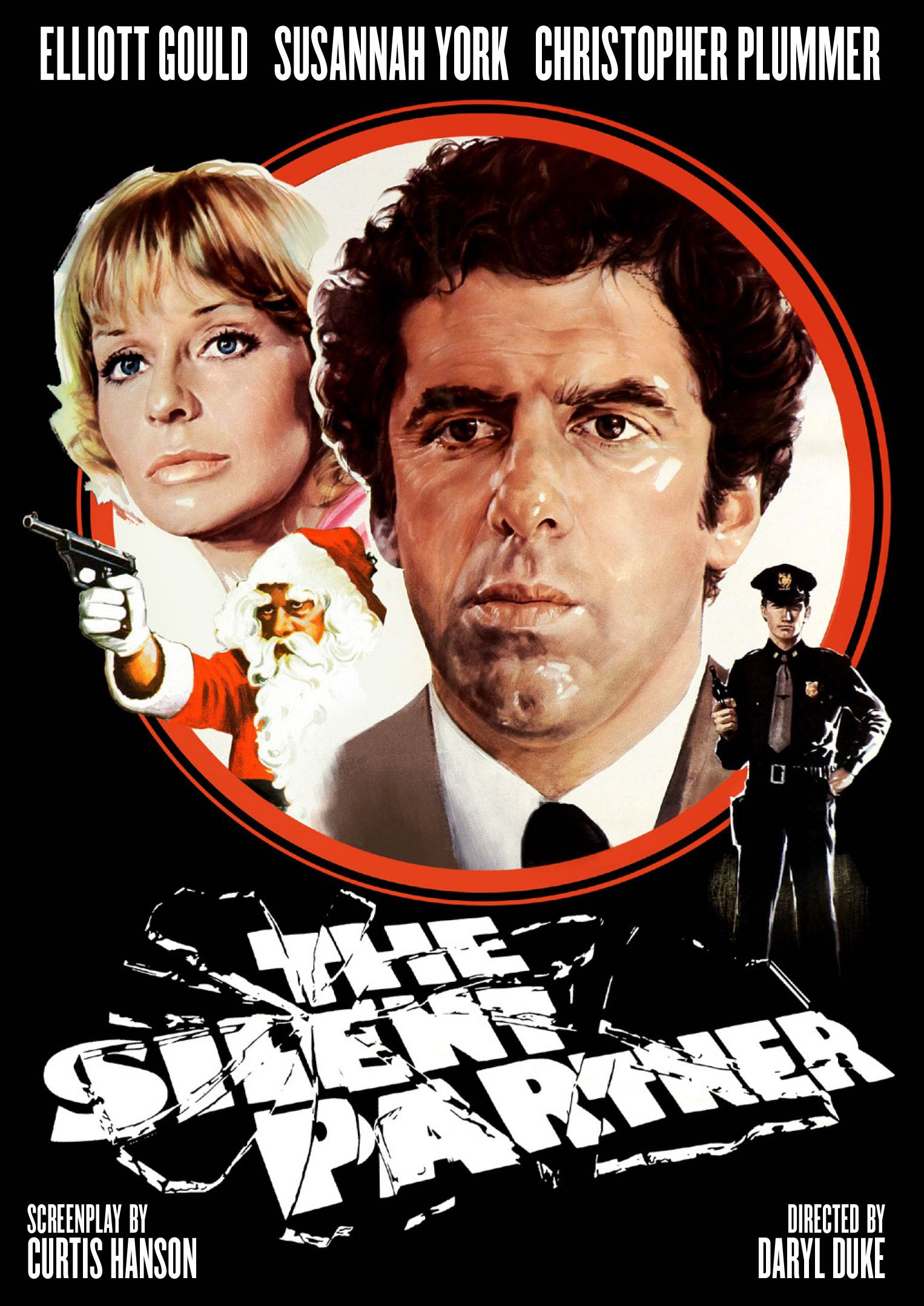
Where does one start with The Silent Partner? There have been quite a few trusted voices that have drawn my attention to this film, an independent Canadian psychological thriller from the late 1970s, which (despite boasting some major actors in the central roles) seemed like a relatively minor work, and never found its way into my orbit all that often. However, I am the first to readily admit when I was wrong, and the apathy I felt towards this film proves that one should never judge a book by its cover, or a film by its premise, since I can confirm that this film is indeed as close to a masterpiece as one can get. The film’s director, Daryl Duke, is not a name that many will recognize, and even though he didn’t make any film that was nearly as prominent as this one (which is already quite obscure by the standards of the genre), the fact that he worked on bringing this film to life, adapted by a young Curtis Hanson from the Danish film Think of a Number, which was in turn taken from a novel by Anders Bodelsen, is more than enough to draw our attention to the fact that he was a very capable director, and someone whose skilful control of the material is responsible for creating arguably the most entertaining crime thriller of its era. This is an even more staggering achievement considering how the genre’s greatest works were confined to this particular period of time, where numerous filmmakers took the thriller genre in new directions – and yet, it’s a small Canadian production that somehow does it better than absolutely any other that one can think of, which may seem hyperbolic until you actually see the extent to which this film managed to tell such an enthralling story.
The main reason behind the success of this film is easy to pinpoint – from the outset, Duke and Hanson keep this narrative as simple as possible. Thrillers often rely too heavily on overly convoluted plots and stories that just ultimately are doing too much by way of plot devices, and twists and turns that don’t need to be there. The Silent Partner is an extraordinary simple film, where even the most intense sequences remain straightforward and economical, the director approaching this story in a way that was sparing, using only the most essential components in its construction, which ultimately works brilliantly in the favour of a narrative that needed such an unfurnished approach to reveal its bleak inner secrets. This is far from the over-produced, sensationalistic genre filmmaking that was being produced downstream in the United States at the time – Duke and Hanson didn’t have the resources to mount an elaborate production, and while it may not have been exactly produced on a shoestring budget, The Silent Partner didn’t have the benefit of an excessive amount of resources at its disposal – but as independent cinema has taught us, all one needs to make a compelling film is a strong script, a working camera and a few dedicated actors willing to turn in good work, and The Silent Partner has all of those in abundance. Duke clearly weaponised his years of working on television in pulling together a remarkably competent and rivetting psychological thriller, which is perhaps a lot better than it ought to have been, considering the obstacles that stood in the way of this film, particularly those that have to deal with a narrative that could be mistaken for gauche in the wrong hands.
Most of the praise surrounding The Silent Partner has gone to the actors, with the presence of Elliott Gould and Christopher Plummer, the former a massively popular movie star, the latter someone who had conquered stage and screen and amassed an incredibly impressive reputation in the process, in the central roles, as well as Susannah York (who was a well-regarded performer in her own right in both the United States and her native Europe). The presence of these major actors almost betrays the small size of the film, which we’d expect to be populated by more unknown performers. However, if there is anything both Gould and Plummer have proven through their extraordinarily long and prolific careers, it would be that they consistently turned up for any project that they felt was worth their time, often seeking out the most interesting opportunities, and frequently rising to the occasion in ways that proved their mettle as some of the finest actors to ever work in the medium. It’s not difficult to see why they’d be drawn to these characters and the role they play in the narrative – Gould was able to play yet another conflicted hero caught between doing what is easy and what is right when confronted with a difficult decision that could change the trajectory of his entire life, while Plummer is the hilarious, eccentric and queer-coded villain that dominates the film and keeps us invested, scaring us in the way that only the most entertaining and well-formed antagonists could. Both actors are terrific, bringing vastly different skills to the proceedings, and working together incredibly well, finding a balance between the frightening moments, and those that are more humorous, anchoring the film and single-handedly elevating it far beyond pulp, turning The Silent Partner into one of the more captivating films of its era.
The narrative isn’t what draws us into The Silent Partner, since by all accounts, the surface-level premise isn’t nearly enough to drum up enough excitement. It seems all rather straightforward and run-of-the-mill, a conventional heist film with a bleak edge, which isn’t enough to warrant inclusion in any canonical list, whether it be for the genre or era in which it was made. The difference between The Silent Partner and other similar films comes in the more peculiar aspects of the story, the intimate and detailed components that are not present at the start, but rather begin to infiltrate the story as it moves along, gradually becoming quite impressively complex by the end, while never veering towards needlessly convoluted techniques that we’d often expect from such a film. There wasn’t much need to contain this film within a particular narrative space, since it is very much a case of trial-and-error, a work in progress that managed to be absolutely spellbinding when it was given the opportunity – and while he may not be someone whose name evokes much of a reaction when it comes to an authorial voice, Duke had a distinct style and very interesting approach to the filmmaking process that continuously pushed the boundaries that most similar films would rely on. In short, The Silent Partner has an abundance of heart lurking beneath its vitriolic and scathing social commentary, a daring and provocative sense of humour that adds a few well-placed moments of levity in an otherwise hopelessly bleak story, and yet it never seems to be entirely willing to play it safe, constantly taking these characters and the situations they find themselves in to a profoundly strange but fascinating place, one that is as striking as it is absolutely terrifying – and purely for its ability to both repulse and enthral, The Silent Partner is an easy candidate for one of the finest entries into this extensive genre.
The Silent Partner doesn’t ever play it safe, and instead dares to shock and provoke in ways that many films would actively avoid. How often do we see works of mainstream cinema that have a villain that nearly gets away with it, and a protagonist that is willing to enable these actions? It’s a wonderfully bizarre film, but one that works extremely well in the context of the story, which lends itself to the more deranged. It is only helped by Hanson’s impeccable screenplay, which is smart and witty, while still conveying an abundance of meaning, and the two central performances, where Gould and Plummer commit entirely to this demented narrative, playing these parts with the same spirited dedication and enthusiastic compassion to their craft as they did with their more prominent roles. It’s difficult to imagine any list of these actors’ best work not including The Silent Partner in some capacity, since their work single-handedly supports this film and helps it from becoming entirely absurd or low-brow, which is often a threat when it comes to smaller psychological thrillers, most of which prioritize cheap moments of shock, rather than fully-formed narratives that hint at deeper conversations to be had about society and its more harrowing recesses that tend to harbour such deranged minds, capable of the extent of manipulation we see in this film. It’s a unique, hauntingly fascinating character study about the depths of depravity that even the most decent individuals may fall victim to in times when their morality is put to the test – and the refusal to provide a traditionally happy ending (at least not one that can convincingly be called a satisfying resolution for these characters) only proves that The Silent Partner is an absolutely stunning, complex thriller with an endless amount of spirit, and a wicked sense of humour that allows this absurdist fable to hit even harder than we’d expect.
 The Postmodern Pelican