
Regardless of the story he’s telling, or the characters that occupy it, Mike Leigh’s films are always captivating, grabbing the audience’s attention through his engaging approach to looking at a range of subjects. Interestingly, we can divide the esteemed director’s work into two broad categories – there are the contemporary films, set in modern-day England, telling the story of ordinary folk living their lives and doing their best to survive (essentially how his career started, being heavily indebted to the kitchen-sink realism movement that dominated Britain at the time of his ascension). Then there are the historical dramas, films that feel both intimate and epic, striking and beautifully poetic. Mr. Turner certainly belongs to the latter group, being a biographical account of the final few years in the life of J.M.W. Turner, inarguably one of the greatest painters to ever work in the medium. A story that clearly interested Leigh (why else would he spend so much time making a film on the subject?), and made with the collaboration of some of his finest artistic colleagues, Mr. Turner is an absolute triumph, a daring and compelling drama that draws out many fascinating ideas in its endeavour to be a well-conceived, beautifully simple film about a man who may be an indelible part of Britain’s artistic history, but who was just as ordinary as his subjects, the people and places that he spent his entire life pursuing, if only to throw on a canvas to document the world that surrounded him. It’s a tremendous film, a measured but enthralling glimpse into the life of a true artistic stalwart, and someone whose influence remains as strong today as it did at his peak, all of which is explored with dedication and forthright humour by Leigh, a director who knows exactly how to plumb the emotional depths of any story for the sake of his curiosities.
Do not make any mistake – Mr. Turner is not the most exciting film at first glance. Leigh’s approach to historical dramas is one that matches with his more contemporary works, keeping the narrative simple and focusing on the small details, rather than the bold and extravagant moments, a position he rarely wavers from unless it has some artistic merit (as is the case of something like Topsy Turvy, which was delightfully excessive while still carrying a very deep meaning). This isn’t abandoned at all for this film, which presents us with an episodic view into the final 25 years in the life of the titular character, as he pursues all of his desires – artistic, philosophical and carnal. It’s neither the definitive introductory text to who Turner was a highly influential artist, nor is it the most accessible historical drama – yet, it has a certain elusive quality that keeps us interested, each new scene adding another piece into this extensive puzzle that Leigh is constructing, each one being an invaluable entry into our overall understanding of who Turner was, and how his life transpired. Every tragedy and triumph is reflected in the fabric of the film, which keeps a consistent tone (staying somewhere being sobering and sarcastic), maintaining the same mood, one that is as aloof and mysterious, but also deeply fascinating, as that of the subject himself, someone who was notoriously known for having quite a distant personality, which some consider to be the reason behind some of his greatest works, since his critical eye and refusal to assimilate into society in the same way as his peers allowed him to push the boundaries of his art, all the while capturing the world that surrounded him in vivid detail. Whatever the motivation behind this frank representation of the artist may have been, the result is something quite spectacular.
Films about artists are often very special in how they approach their subjects with a critical perspective. Not always the epitome of candour and decorum in everyday life, some of history’s greatest artists have been individuals detached from reality, preferring the company of their tools of creation and their limitless imaginations. This is the starting point for Mr. Turner, which pulls apart the layers of its titular character, frequently and without any hesitation managing to look deep into his life, which is sharply contrasted with the individual experiences that inspired his art. Living a life of an artist cannot be easy – not only does every waking moment contain the potential to become material for their next work, their perspective on the world is often very difficult to understand, which makes films like Mr. Turner all the more interesting, since what it lacks in clarity in the conversations behind the character’s motivations to conduct himself in the way he does, it makes up for in showing how these moments transition into his artistic process. Every day yielded new opportunities, and Leigh does well in showing how even the smallest detail could be repurposed into the subject of one of Turner’s greatest paintings. The film finds the perfect balance between artistry and what life would have been like for a relatively impoverished artist in the 19th century, drawing similarities and differences in both regards, which leads to a truly captivating series of conversations that give us unique insights into the life of the artist, showing that even someone as famous as Turner (who was already quite well-known and respected at the time) was someone who went through the same existential challenges – the only difference is, his outlet became his art, which he continued to create until he was too frail to hold his brushes, at which point one of the great creative minds of his generation ceased to exist, at least artistically.
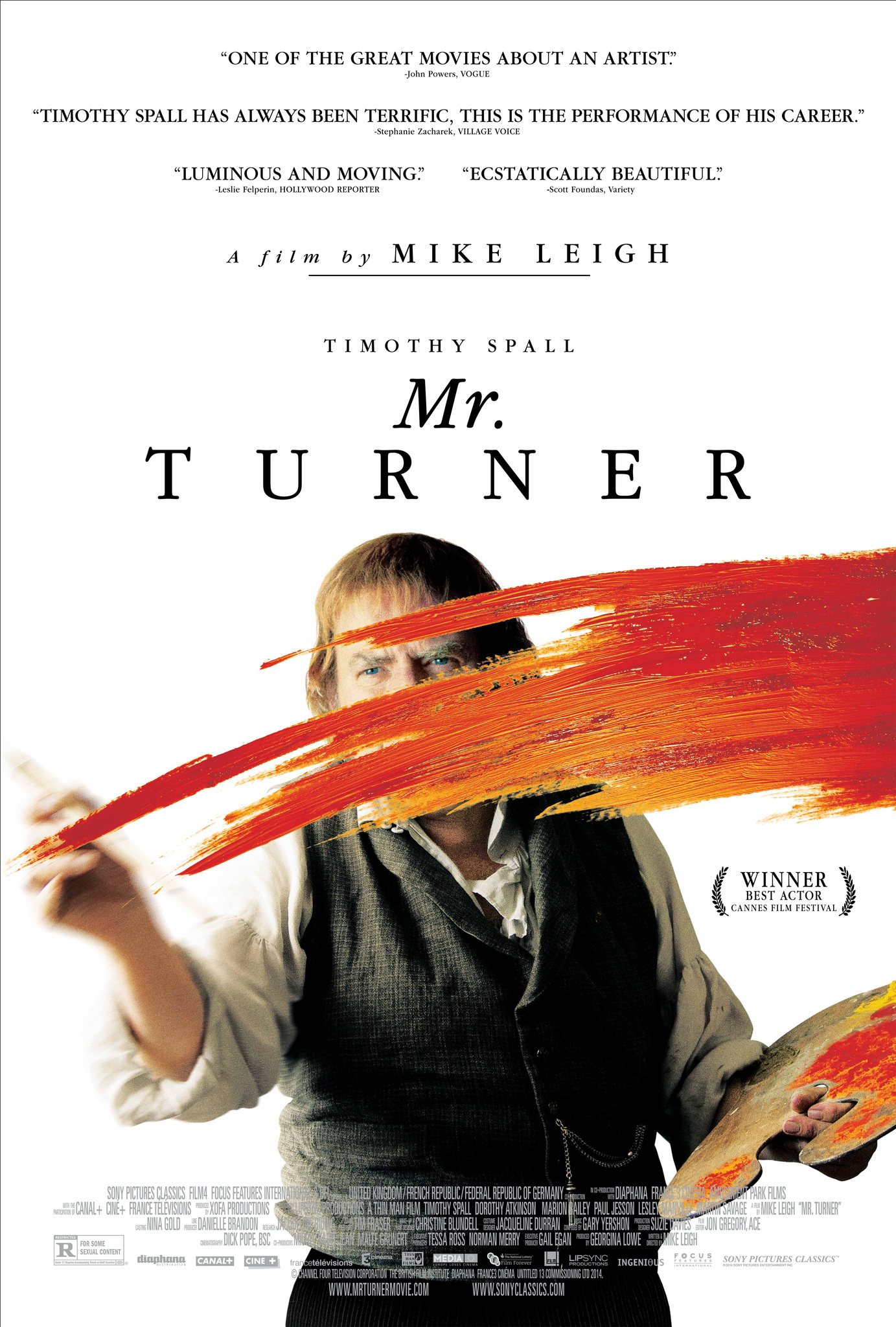
Mr. Turner also presented Leigh with the opportunity to place one of his most familiar collaborators in the central role. Timothy Spall had played major characters in a number of the director’s films, like Secrets & Lies and All or Nothing, but it took many decades for Leigh finally to give Spall the role of a lifetime, designing Mr. Turner as a vehicle for the actor’s talents. There seems to be few people that could have played this role better than Spall – while a normally personable and charming individual, few actors have made a career on playing the most despicable individuals as him. To extend this to Turner may be too harsh, since he was a perfectly decent many, just one who was notoriously quite prickly and aloof – and Spall captures all of these nuances in his wonderful performance, portraying Turner as an absolute genius, someone whose artistic process may have entailed some degree of obsession and slight madness, but all for the sake of his artistic process. This is the role he was born to play, and while Leigh could have easily have buckled to conventions and cast someone more well-known as a leading star in the role, his devotion to giving a platform to one of the most interesting actors working today worked to his supreme benefit. It’s a performance that is both heartbreaking and funny, Spall’s ability to play the character at various stages of his life being absolutely phenomenal. His gradual decline is shocking but melancholic, and his relationship with the various characters that weave in and out of his life at various points leads to an absolutely stunning series of interactions that prove that Spall is one of the most profoundly brilliant actors of his generation, a fact that Mr. Turner only furthers amplifies with every stunning moment.
Perhaps what stands out the most about Mr. Turner is how simple it is – despite the grandiose setting and complex subject matter, Leigh wasn’t invested in some overwrought exploration of the character’s life in contrast to the social and cultural situation he found himself in throughout the later years of his life. This film is a profoundly moving character study, so naturally the main attraction is Spall’s performance, which is a behemoth of acting all on its own. The cinematography by Dick Pope captures this world beautifully, each frame being so gorgeous, that it could have easily have been composed by Turner himself. Tonally, the film can seem quite languid and meandering, since Leigh keeps it quite sober most of the time (with a few well-placed moments of humour which help break the monotyny), and it can sometimes be a bit too impenetrable – but what it lacks in upbeat energy, it more than makes up for in the electrifying nature of the narrative and its visual manifestation, which is more than enough to sustain this film and its striking journey into the life and times of a truly brilliant artist, a man whose career was defined by a variety of fascinating moments, all of which are explored beautifully by a director who has the utmost respect for the subject, so much that he isn’t ever afraid to explore his darker side, which ultimately leads to a stunningly beautiful, intricately-composed character study that is essentially nothing more than two artists in dialogue, one inspiring the other in the creation of this sweeping odyssey into the mind of someone whose drive to create superceded every other aspect of his life, which ultimately lead to Turner easily becoming one of the most important artistic minds to ever cross the beautiful landscapes and bustling urban centres of Great Britain, describing her with his paintbrush, and producing some of the most gorgeous works of art ever produced.
 The Postmodern Pelican