
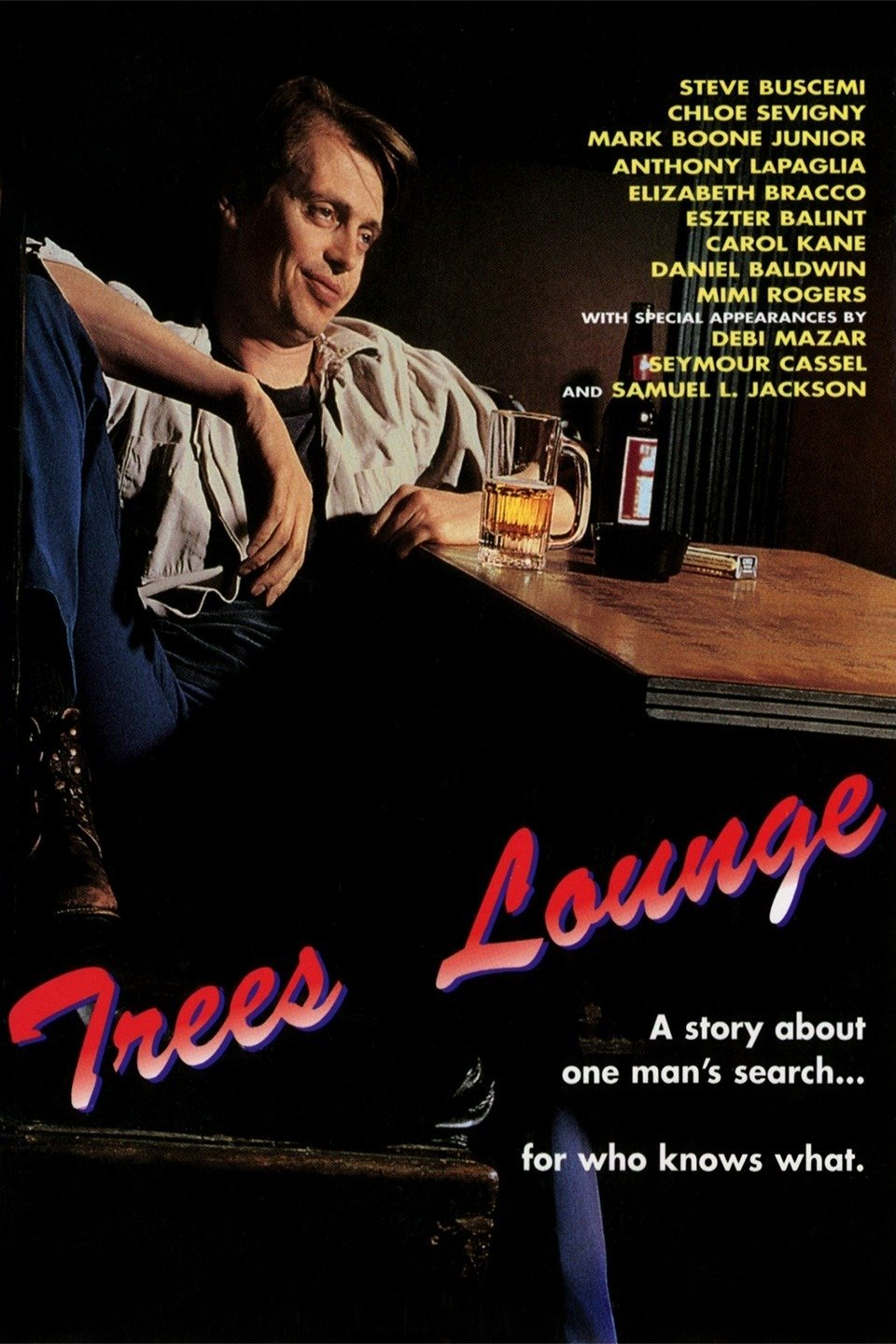
As arguably one of the most distinctive faces in the history of independent cinema, to the point where his name is synonymous with a particular era and style of filmmaking as a result of his prolific career and role in the movement, Steve Buscemi certainly is someone we could expect to have learned a great deal about the inner workings of the industry, having been privy to many of its more interesting productions over the course of his career as a working actor. It only makes sense that when he inevitably stepped behind the camera, it would be something quite special, and he certainly did not disappoint. Trees Lounge is one of the actor’s finest performances, and serving as his directorial debut, it’s even more impressive that he was able to make something so wonderfully significant on his first attempt. He certainly had the experience, having worked with many of the greatest directors of the time, which he has continued to do, well into his later years. Trees Lounge is the first of a few fantastic directorial efforts by the actor, who has proven to be quite a masterful filmmaker, each one of his films being quite unique in their point of view, bringing with them a sense of curiosity that can only come from an artist interested in pushing the boundaries of his craft. Undeniably, this isn’t a revolutionary work in the traditional sense – it adheres very closely to the rules of independent filmmaking at the time, using a strong script and a good cast to tell a very simple but affecting story that doesn’t shatter boundaries, but rather carries a sentimentality and earnestness that couldn’t be found in more mainstream fare. In short, Trees Lounge is an absolute delight, a small but unforgettable comedy with a lot of heart and a genuine sense of humour that helps solidify the fact that Buscemi is as gifted behind the camera as he is in front of it, which is extremely high praise, considering he’s one of our finest actors.
Many writers have pointed to the fact that the central character of this film seems to be a more contemporary analogue for the kind of rugged, repressed masculine figure that populated the works of Charles Bukowski and Norman Mailer, artists who were born as part of the so-called “Greatest Generation”, but were more intent on expressing their psychological anguish through erratic behaviour than they were focused on living up to the standard expected of men at the time. This is a good place to start when it comes to looking at Trees Lounge, which often plays like a Bukowski novel, a meandering series of moments in the life of one particularly self-destructive man who is isolated from a world that he simultaneously rejects and yearns to be a part of, being consistently shunned because of his supposed failures, which he blames on the rest of the world, and which those around him peg squarely on his own ineptitude to look within himself. It’s a story that we would certainly expect to find within the world of independent filmmaking, whereby it centres on a group of characters who aren’t particularly likeable (in fact, many of them are quite despicable), but who form the foundation for an exceptionally moving and often quite intensely complex glimpse into an urban landscape, and the various people that occupy it. Buscemi certainly had an interesting set of ideas that he put into motion when it came to making his debut, and while it may seem relatively small and inconsequential, often being cited as a minor work that exists more as a curious footnote in the career of a great actor than a film that is celebrated on its own terms, there is a simmering passion burning beneath the surface of the film, a complexity that almost betrays the seemingly easygoing nature of the film that occurs around it, leading to a multidimensional film that is as entertaining as it is thought-provoking.
One of the advantages of being such a prolific character actor (who also has a reputation for being very personable and hard-working) is that one makes many friends within the industry along the way, which is certainly a benefit that Buscemi takes into account when casting the film. Trees Lounge is filled with familiar faces, several incredibly recognizable actors making their way through the film and contributing to the urban landscape the director is creating here. It’s not likely that he’d have been able to assemble such a strong cast without having been such a notably hardworking actor, but whether it be calling in favours from some of his former colleagues and friends, or just being ambitious enough to get some of these actors on-board, Buscemi manages to pull together quite a brilliant cast. Interestingly, nearly all of these actors come from within the world of independent cinema themselves – Chloë Sevigny and Anthony LaPaglia were up-and-coming actors known for some small but memorable work prior to this, and Eszter Balint was a regular of Jim Jarmusch, who first discovered the obscure Hungarian musician and cast her in his first masterpiece, Stranger than Paradise. There are appearances by two of the most iconic actors in the history of independent cinema, Seymour Cassel (who has a small but pivotal role to play in the story, and who is reuniting with Buscemi after their incredible collaboration in In the Soup a few years prior) and Carol Kane, who has been one of the most consistently excellent performers of her generation. Samuel L. Jackson (whose career was in a meteoric upswing as a result of the previous few years of work with the likes of Quentin Tarantino and Spike Lee, both of whom made him a star), and a range of other reliable actors appear throughout the film. Buscemi has his work cut out for him in terms of having to both turn in a very strong performance (possibly his finest), while drawing out excellent performances from his cast – but once again, you don’t make your way through the industry with the furious passion that Buscemi did without learning a few valuable skills that makes this look like quite an effortless experience.
It’s easy to mistake the easygoing nature of Trees Lounge for something that doesn’t have much depth – but if there was ever a film that relishes in its ability to be surprisingly profound, it would be this one. There is a lot of commentary simmering below the surface – Buscemi seems to be taking some guidance from the films of Robert Altman, insofar as this film may focus on one central character, but it really is a story about a particular time and place. Each character introduced throughout this film is living their own unique life, but are related to the titular bar in some way, whether they are a regular patron, or have some involvement with the establishment. Setting the film mostly in a bar was an interesting choice, since not only does it evoke the idea of camaraderie and fraternity (undoubtedly an after-effect of Cheers and it’s “a place where everybody knows your name” rhetoric), but also allows the film to look into issues of health and substance abuse, but in a way that doesn’t disparage the establishment (since doing so would blame these issues on the substance, rather than on the people who struggle to show moderation, which is the real trouble), but rather puts the emphasis on the individual journey each one of these people are undergoing. On the surface, it seems like a very charming comedy – but the more time we spend with these characters, the clearer it becomes that Trees Lounge is a deeply melancholy, heartbreaking work about people doing their best to survive in a hostile world. There is a lot of subtext lurking beneath the charming comedy – each humorous moment is contrasted with one that is more challenging, and Buscemi doesn’t ever avoid having some of the difficult conversations. You could even argue that Trees Lounge actively avoids having a happy ending, choosing to instead keep everything realistic and genuinely affecting, rather than being deluded enough to lead these characters to a conclusion that may be pleasant, but isn’t nearly realistic enough to be warranted, an interesting component to an otherwise beautiful film.
As a directorial debut, Trees Lounge certainly did prove what a talented and audacious filmmaker Buscemi can be, and would be the first of a few notable efforts in which the actor stepped behind the camera (he also directed what is widely considered one of the finest episodes of The Sopranos, this film apparently being the reason he was head-hunted to helm that particular episode). It’s not a particularly complex film in theory – Buscemi isn’t doing anything here that is entirely unique or unheard of, outside of a few interesting themes that indicate that he retained the spirit of fierce independence that gave him a start in the industry in the first place. It finds its footing instead with its intentions – it presents us with a raw, complex portrait of a man trying to make his way through a world that continues to underestimate him, but struggles to find the motivation to prove everyone else wrong, instead choosing to succumb to the very vice that placed him in that current position. This film has some very deep conversations, and frequently leaps between comedy and drama in a way that feels extremely natural, and proves that Buscemi is more than just an over-zealous actor who tried his hand at directing. It’s striking, funny and heartfelt, and persistently hints towards some deeper meaning lurking just behind the narrative, which only makes Trees Lounge an even more ambitious and complex little film, one that is so much more than the quaint independent comedy it appears to be on the surface.
 The Postmodern Pelican