
In An Ideal Husband, Oscar Wilde quipped that “in the old days men had the rack. Now they have the press”. This piece of sardonic humour is oddly resonant, especially since the media has shown very little sign of not being the source of torture for many individuals. Over the years, we’ve seen how the press can either be the general public’s greatest ally, or our biggest enemy – and on occasion, there will be a film like Ace in the Hole that dives deep into the relationship between the media and the people who consume it, showing the exact ways in which it is incredibly flawed and far from as honest as we’d like to assume. If anyone was going to tell such a story, why not arguably the greatest writer of the Golden Age of Hollywood? Billy Wilder collaborates with Walter Newman and Lesser Samuels (in his first film as a director not collaborating with his partner Charles Brackett) in writing this film, which proves to be quite a harsh and unforgiving deconstruction of the media and the role they play in shaping certain mentalities amongst ordinary folk, who would otherwise not be privy to such brutal explorations of our world had it not been for the immoral actions of those working to get the freshest scoop. Ace in the Hole was not an immediate success, and the road to it being considered an important one was long and arduous – but with Wilder at the helm, and a cast led by Kirk Douglas at his peak, this story was in good hands, being the subject of a dark and brooding character study that aims (and succeeds) to be the kind of satire that doesn’t evoke laughter, but rather incites deep existential despair and panic, amongst other emotions.
At the time, Ace in the Hole was not particularly well-regarded, being considered something of a failure, especially after Wilder’s impeccable run with films like The Lost Weekend, Double Indemnity and Sunset Boulevard (and not to mention his delightful comedies serving as a writer for Ernst Lubitsch), which were enormously popular films that cemented him as one of Hollywood’s preeminent writers and directors. However, it does make sense – when even the darkest films produced by mainstream studios had to have some kind of happy ending (or at least a satisfying resolution), Ace in the Hole opted to be an unforgiving, bleak experience that only pushes us further into the proverbial pit of despair and depression that overtakes this film. It’s not an entertaining story by any means, and actually serves to be quite a dour affair, which seems only appropriate, since while there are moments when we’d imagine the director would take the opportunity to include some wry, acerbic humour to amplify the absurdity of the story and its various players, doing it with complete sobriety and freedom from the temptation to turn it into a darkly comical satire, which would undercut the unfortunate reality that sits at the heart of the story. As a writing and directorial achievement, perhaps Ace in the Hole falls slightly behind much of Wilder’s other work, but it’s definitely not without merit, especially in the components that are extremely unique to this film, and see the esteemed director trying a few new techniques, both narratively and in terms of the form the film takes, which are just as interesting as anything he’d do later on, especially in building on some of these themes.
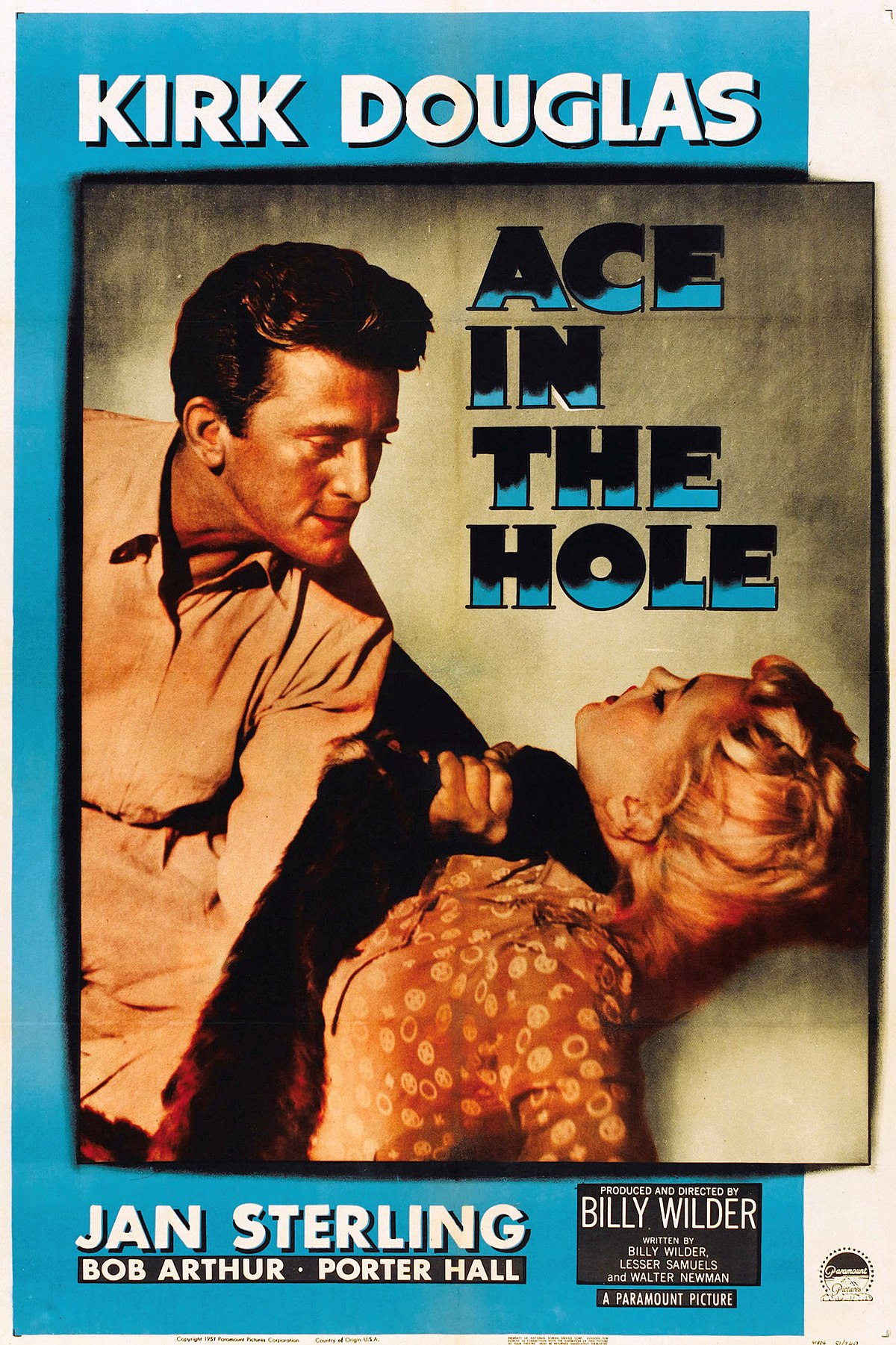
Kirk Douglas sits front-and-centre when it comes to Ace in the Hole, which was made while he was steadily on his upswing to fame – he had made his debut only a few years earlier, but was immediately catapulted to stardom through a combination of his good looks and ability to play both the most valiant heroes and morally reprehensible individuals one could imagine. His performance here is one of his finest precisely because it blends aspects of the latter, whereby his character of Chuck Tatum is the most dangerous kind of person: he’s a villain who genuinely believes he is a hero, someone whose moral compass is so dysfunctional, he is convinced that what he is doing is not only ethical, but worthy of celebration. From the first moment we meet him, we can’t help but despise him – his arrogant demeanour and manipulative approach to interacting with others immediately makes him an unlikeable figure, and Douglas is turning in a very strong performance, following the character as he sinks even deeper into this neverending spiral of moral ambiguity. The actor had a talent for using his charms to establish very complex characters, and while this wasn’t the only time he played a more malicious individual, it did feature him using his skills to create someone whose morals were beyond murky, a daring choice for a relatively young actor whose career was steadily rising. It’s a miracle that Douglas didn’t get typecast in these kinds of roles, since he clearly had a real penchant for playing such layered characters – and while it may not stand as one of his most popular in comparison to other roles, Ace in the Hole is a perfect opportunity for the actor to showcase his skills under the careful curation of a very gifted director who always brought out the best in his actors.
Ace in the Hole is a brutal indictment of the media, but it’s not one that is wholly undeserving. In recent decades, there has been a steadily-growing dissent felt towards the press, with the rise of the term “fake news” and the terrifying growth of biased media on the polar ends of the political spectrum causing a lot of panic. This film was produced prior to the regular practice of discrediting the media, which I’d assume only made it more terrifying, since audiences were suddenly presented with a stark backstage drama about how something as supposedly reliable as the news media was actually just as susceptible to manipulation as anything else. By modern standards, Wilder’s harsh deconstruction of the press may seem relatively tame – but taken as a product of its time, one has to wonder whether the divisive response to the film was less the result of audiences not responding to the story (which is incredibly well-constructed and executed), and more disdain at how it would dare to confront the sacrosanct world of the news media and the countless dedicated journalists that committed their lives to keeping us informed. Ultimately, Ace in the Hole is not about those people, since it does demonstrate that there are still very moral, earnest people in the profession – instead it uses the character of Tatum as a figurehead for the small minority that abuse their power to get ahead – and this is where the film is at its most merciless, since there are many moments where we have to wonder whether Tatum is going to get away with his misdeeds, or if he’ll actually pull ahead. The sense of uncertainty, leading to the final shocking moments, is possibly another reason why original responses to the film were muted, as well as an explanation for how it struck a chord in later decades, especially after the advent of the New Hollywood movement, which often looked at the darker side of certain professions.
There is a legitimate argument to be made that Ace in the Hole is simply too ahead of its time, the various different narrative strands relating to the flaws embedded within the media and their pursuit of the most up-to-date truths, even if it means fabricating some of it. It’s a cautionary tale that warns us against complacency, constantly urging us to realize that, as reliable as the press may be, there is always the chance that there is a brief moment of opportunity for them to take advantage – and when this begins to spiral out of control, it’s not likely to yield any particularly positive results. Billy Wilder had a lot of interesting perspectives as a writer and director, much of which is brought to this film, which is carefully constructed out of some fascinating conversations relating to the importance of honesty in the media, and the concurrent discretion required on the part of the consumer to ensure that they know that not everything they encounter is necessarily as factual as it would appear. Anchored by one of the most complex performances ever given by Kirk Douglas, who makes for a suitable antagonist in this terrifying social drama, and told with a very bare, forthright precision that allows it to be as honest as it needed to be, Ace in the Hole is a triumph, a disquieting odyssey into the deceptive world of the mainstream media and its various methods of captivating audiences with the most enthralling news stories, even if it means a few well-placed fabrications tend to help them along in the process.
 The Postmodern Pelican