
“Qu’est-ce que cela fait? Tout est grâce”
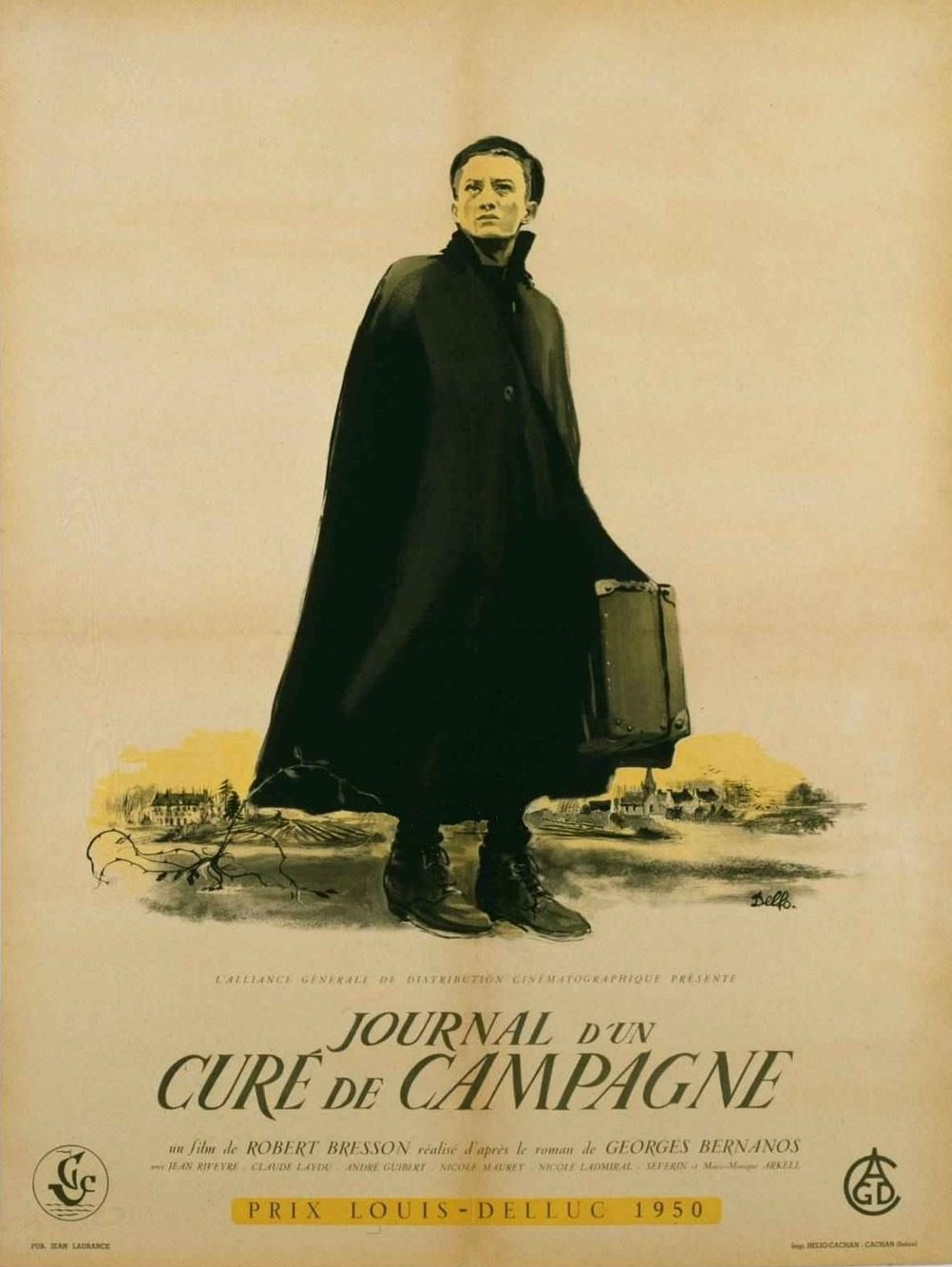
These are the chilling final words that appear in Diary of a Country Priest (French: Journal d’un curé de campagne), the beautiful but shattering adaptation of the novel by Georges Bernanos, carefully brought to the screen by esteemed French realist Robert Bresson, who utilizes his ability to capture the most raw elements of the human condition to tell the story of a young priest who is tasked with venturing to a rural village, where his alternative practices and relative inexperience in the world of the clergy makes him a subject of ridicule at best, outright derision at worst. These words roughly translate to “What does it matter? All is grace”, an ordinary man’s exasperated plea for salvation after his life is about to be cut short, despite his time alive being considerably shorter than most would anticipate. There is something so deeply moving about a film that can wade through the most convoluted subject matter, and get to the very heart of something as deeply personal as religious belief, looking at it through the perspective of the people who not only are known to be the most fervent believers, but have the responsibility of spreading the message, the film ultimately asking the most difficult question: how does someone whose entire existence revolves around ensuring that those around him are given the opportunity to engage with God, while he himself begins to question his own faith? It’s not a revolutionary concept, but its one that Bresson repurposes through his distinctly bare but emotionally-charged style, telling a gripping and poetic story about the limits of belief, and the acceptance of both fate and grace when confronted with a grim but inevitable reality, each moment being one of incredible insight into the life of someone struggling with his own place in the world.
Religion is a challenging topic, but it’s one that literature seems to absolutely adore, especially when it comes to the subject of the priesthood – there is something about works that aim to look behind the proverbial curtain into the lives of the people who are often considered the ultimate authorities in many communities (often being more revered and respected than the most powerful politicians and lawmakers in some cases), extracting fascinating insights into the private lives of these servants that are supposed to live very simple, open lives. Bresson was a filmmaker who was always drawn to stories of ordinary people, especially those that are not often given the attention they deserve – and as one of the pioneering entries into a small but fascinating canon of films that dive into the psychological state of the clergy, Diary of a Country Priest is a very special film, and one that would go on to inspire countless others. If there is a film centred entirely on a member of the clergy, it’s very likely that Bresson’s film was something of an inspiration, even if only indirectly. The idea of a priest finding his faith slowly eroding seems almost absurd, since we have been conditioned to believe they represent the ultimate demonstration of unconditional belief – but Bresson was primarily interested in the human element of these stories, and as a result, Diary of a Country Priest takes a slightly more atypical approach to deconstructing the main character and following his journey, observing the ebb and flow of his undying devotion to a higher power, especially at moments when he realizes that he is a mere mortal, someone whose existence is defined by the same inevitable cycle of life, and that whether or not one holds believe in some kind of omnipotent deity, there’s a sense of acceptance that emerges in our final moments.
Many of Bresson’s most distinct directorial traits are found throughout this film, starting with the use of non-professional actors for nearly all the major roles. The cast of Diary of a Country Priest is quite small, and is led mainly by Claude Laydu, who plays the titular nameless priest, who is only referred to as “Monsieur Curé” for the duration of the film – and this is truly one of the most staggering performances of its era, a portrayal of an ordinary man that feels genuinely insightful and moving, particularly through the actor’s relative inexperience, which brought a level of authenticity to the film. The story focuses on a young priest feeling hopelessly lost in a world he fails to recognize, rejected from society, despite occupying a vital role in his community. Laydu brings so much genuine complexity to the character, while never venturing towards excess, continuously finding the truth that would underpin such a conflicted individual. Bresson’s frequent use of newcomers or non-professional performers in his film always lent them a degree of deeper humanity, since there isn’t the obstacle of a renowned actor being tasked with delivering yet another calculated and methodical performance. Instead, there is only the story and the actor, the interplay between them being far more interesting than the nuanced details that would come through had a more seasoned performer occupied the role. The most raw elements of the human condition are what drive Bresson’s film, and Diary of a Country Priest is not any different – in fact, this was the first time that Bresson had actually taken the risk in working with non-professional actors, and is therefore something of a defining work in his career, showing how one can easily put together something beautiful and intricately-woven without depending on the refined talents of actors whose presence may have been distracting in the context of this film.
Despite their bare appearance, Bresson’s films are absolutely riveting. This is mainly a result of the director understanding how to draw emotion from even the most simple scenario. He demonstrated consistently that a strong story is more than enough to keep the audience interested, so by putting aside all temptations to default to melodrama or hysterics, and keeping everything contained to the most fundamental components, Diary of a Country Priest manages to be a profoundly moving text with an abundance of heart. It’s not always the most positive text – after all, it seems to be following in the well-known parable of Job, who had to endure the most harrowing conditions in order to prove his faith. The only difference is that this priest’s suffering does not have a positive resolution or meaningful message at the end of it, since his life comes to an end far too early, and in conditions that are far from joyful, all the while holding onto his faith as if he could find some salvation in the beliefs that he has cherished and preached to others, but struggles to embrace himself in these difficult moments. Diary of a Country Priest is the rare kind of film that both looks at the mystifying beauty of religious belief, while still being quite critical of it, which is done through the titular character’s internal monologue (which is effectively his entries into the namesake diary), as he questions not only his own path in life and whether he belongs in this vocation, but his entire existence, constantly asking the almighty for some sign that he is willing to intervene and save him – and whether or not the priest receives this is entirely up to the individual viewer’s interpretation. It’s a stark and unforgiving film, but there’s an elegance and grace at its heart that prevents it from being overly cynical, constantly proving that it is willing to have a series of complex conversations – but in some instances, they can be quite one-sided, especially when the responses don’t manifest exactly as we’d expect.
They say the most effective realist texts are the ones that make you forget that you’re watching or reading something, and rather are witnessing a slice of reality in its purest form. Bresson is arguably the most well-regarded of the pure realists, often being considered something of a stalwart of a cinematic movement, especially in relation to European filmmaking, where he has remained an iconic and cherished figure. Diary of a Country Priest was the first time he adopted some of his most notable directorial tendencies, so it can sometimes feel less polished than his later films – but when it comes to heartwrenching immersions into the real world, one shouldn’t expect the most flawless, smooth experiences. This film is a challenging exploration of the human condition, an arid but profoundly moving glimpse into the journey of an ordinary man questioning his faith after a series of obstacles present themselves to him. It’s often very harsh, and it can leave the viewer quite disheartened at times – but it also fills us with a sense of hope, since even when the main character is very close to death, he retains a degree of optimism and faith in a higher power, even if it isn’t in the way one would expect from a man who has dedicated his life to religion. It’s a metaphysical odyssey that ventures deep into the life of a man who frequently struggled to come to terms with reality, and the brutal honesty with which Bresson tackles the source material, and his concise but stunning filmmaking process all converge into creating an absolutely unforgettable, meaningful journey into the life and times of a country priest, told from his own first-hand perspective.
 The Postmodern Pelican