
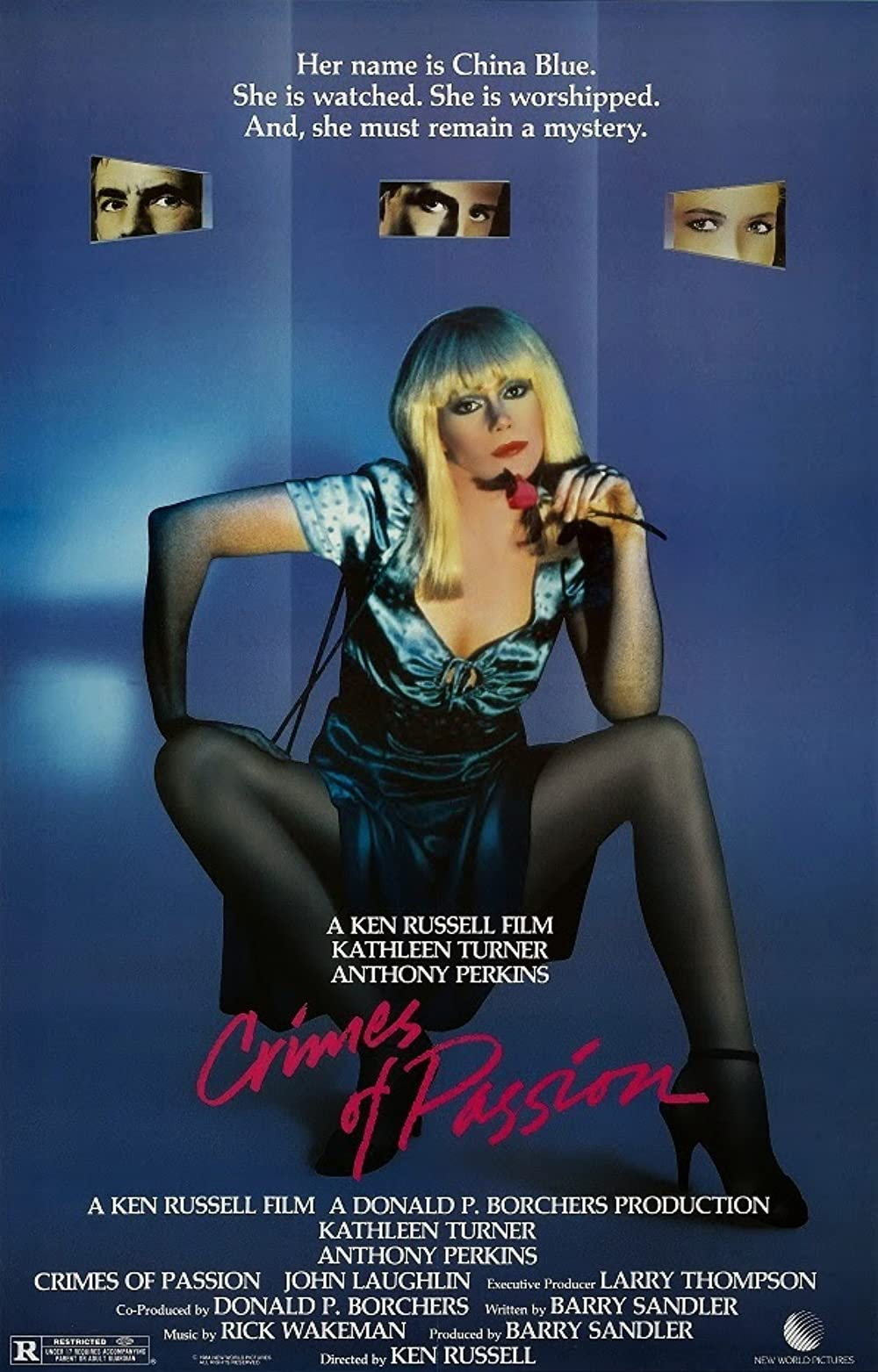
There aren’t many filmmakers whose work regularly, and often without fail, leave the viewer absolutely speechless. Ken Russell is one such filmmaker – throughout his prolific career that found him working on both sides of the Atlantic, the director managed to showcase a perverse set of talents that could bewilder even the most deranged artists. Yet, he is still quite rightly celebrated as one of cinema’s most interesting visionaries, a director who frequently threw caution to the wind, rarely being afraid to take even the boldest risks in favour of his artistic curiosities. Failure was not a word used in Russell’s working vocabulary – either the viewer appreciated his perspective, or they didn’t, with all criticism asserted on him merely fuelling whatever bizarre film he made afterwards (and sometimes, his attempts at more elegant or subdued films were his form of rallying back at his detractors – there’s often very little more provocative than intentional decorum, after all). Crimes of Passion is one of his more divisive works, which is certainly not a rare occurrence for a director who made an entire career out of polarizing audiences – and while this film may not have been the product of his own invention, being conceived by Sandler, who shopped the screenplay around to a number of studios and directors before Russell was brought on, his distinctive style is present in absolutely every scene. He takes the screenplay (which doesn’t deserve much credit – it’s not at all well-written), and transforms these words into a bizarre and often quite concerning psychosexual drama, one that constantly seems to be on the verge of saying something of value, before sharply deviating into even more debauchery and shocking imagery – and it becomes something that truly has to be seen to be believed.
There are constant questions around whether Russell was a bad director who capitalized on his fervent adoration for provocation, or if he was a massively intelligent artist who noticed an enormous gap in the cinematic market, and spent decades pushing boundaries through the lens of bad taste. Unlike provocative filmmakers like John Waters and Kenneth Anger, Russell’s artistic ambitions were far from transparent, and we never quite knew whether or not he was in on the joke. In all honesty, Crimes of Passion is an absolutely dreadful film, if we look at it completely objectively – it’s a poorly-written, overlong attempt at both a psychological thriller and erotic romantic drama that never really gets a grasp on anything of note, and overstays its welcome in ways that would frustrate even the most patient of viewers. Had any other director made this exact film, there’s no doubt it would’ve been unequivocally dismissed as pure garbage. Yet, the mystique surrounding Russell forces us to stop and pay attention, questioning whether or not this film is intentionally bad, or simply the product of a poor screenplay and overwrought direction – and the fact that we can never find a solution for this is part of what makes Crimes of Passion such a rivetting film, because there is an atmosphere of complete bewilderment that not only underpins the film, but entirely defines it. Often, the most entertaining comedies are those that were not designed to be even vaguely funny, and throughout this film, we’re presented with a story that only increases in absurdity as it unfolds, and we are often at a complete loss for what to think, never knowing whether to laugh or cower away in revulsion – and this is precisely the kind of reaction that Russell relished in inspiring in viewers.
Russell is constantly defiling the very concept of good taste with Crimes of Passion – how he managed to take a relatively simple story of double identities and deception, and turn it into this bizarre, melodramatic dark comedy, without losing the raw spark of energy that has made his work so captivating, is one of the reasons he is worth celebrating long before any logical viewer should dare accuse him of being a bad filmmaker. What this film lacks in subtlety and elegance, it more than makes up for in sheer ambition – Russell often didn’t make films, but rather produced spectacles, and Crimes of Passion is certainly one of the most interesting examples, at least in terms of how the director (who is frequently experimenting with form and content) questions, prods and provokes in ways that are increasingly odd, and always deeply engaging. How else can we possibly explain the pure chaos that informed most of this film, other than comparing it to the absolute madness that consistently flows through Russell’s work? It’s tough to determine where Sandler’s screenplay ends and the director’s unique vision begins, but one has to question whether some of the plot components (such as a drug-snorting priest, or murderous sex toys) were the product of a director who simply refused to embrace restraint – he certainly understood it, without any doubt – but when it came time to putting it into practice, Russell was far more interested in subverting expectations and taking us on a journey that is aligned less with logic, and more with a feeling of complete disorientation – and considering the narrative, this was perhaps the best approach for a film like Crimes of Passion, which doesn’t ever even try to make sense of the world it is inhabiting.
Surprisingly, Russell managed to gather quite a cast for this film, despite the subject matter. The film’s central character is a security expert hired to put his investigative skills to the test, played by John Laughlin, who (despite being the film’s lead) is almost entirely unmemorable, merely functioning as the audience surrogate to this bizarre world. The people we have come to see are Kathleen Turner, still riding a wave of acclaim and adoration from Body Heat a few years earlier, capitalizing on her status as one of the most enigmatic and sought-after actresses of the 1980s, and the iconic Anthony Perkins, who once again proves how he flourished best in roles that allowed him to take on some very strange qualities, especially those that worked with his status as one of the more interesting character actors in Hollywood history. Both Turner and Perkins are absolutely stellar, turning in performances that are perhaps a lot better than the film they’re appearing in, but somehow still manage to be perfectly fitting for the narrative that surrounds them. Turner is everything this film needed to be a success – she’s simultaneously feisty and sensual, balancing the two sides of the character (Joanna and China Blue) with a kind of tact that one wishes Russell had adopted, proving that one can surrender to the madness without being in poor taste. Perkins is similarly engaging with one of the most horrifying villains of the era – a man who most likely started out as a good person, but rapidly descended into becoming a demented shadow of his former self, to the point where the only way to find freedom is through death. The two actors are absolutely incredible, and anchor the film in ways that the director was often struggling with, which only proves how Crimes of Passion is a film that may be remembered for the director’s mad style, but is wholeheartedly indebted to the actors for making it bearable.
For those accustomed to Russell’s style, Crimes of Passion is an absolute delight, since it offers essentially everything we have come to expect from the director – over-the-top imagery, excessive violence and controversial depictions of human sexuality, including putting some extremely talented actors in vaguely exploitative situations that most would outright refuse to take part in. Russell wasn’t someone who seemed to pay any real attention to whether or not his work offends anyone (and it certainly did – very few filmmakers made a career out of causing a commotion than him). In many ways, what makes this film so captivating is precisely how he refuses to bow down to conventions, telling this story in the only way he knows how. It ultimately leads to quite a unique and unforgettably entertaining dark comedy (even if it wasn’t intended to be), that keeps us invested, even when we lose any hope of this story making much sense, and it lives up to the expectations of simply not being logical in any coherent or meaningful way. Nothing is ever explained to us, and the director is often enjoying toying with our emotions, thrusting us into this hideous, gaudy version of the world, and refusing to give us any help in understanding it. I’m not entirely sure whether Crimes of Passion is a masterpiece or the embodiment of trash cinema – but it’s certainly never boring, and it makes sure that every minute we spend with the film is memorable, even if it is for the entirely wrong reason.
 The Postmodern Pelican