
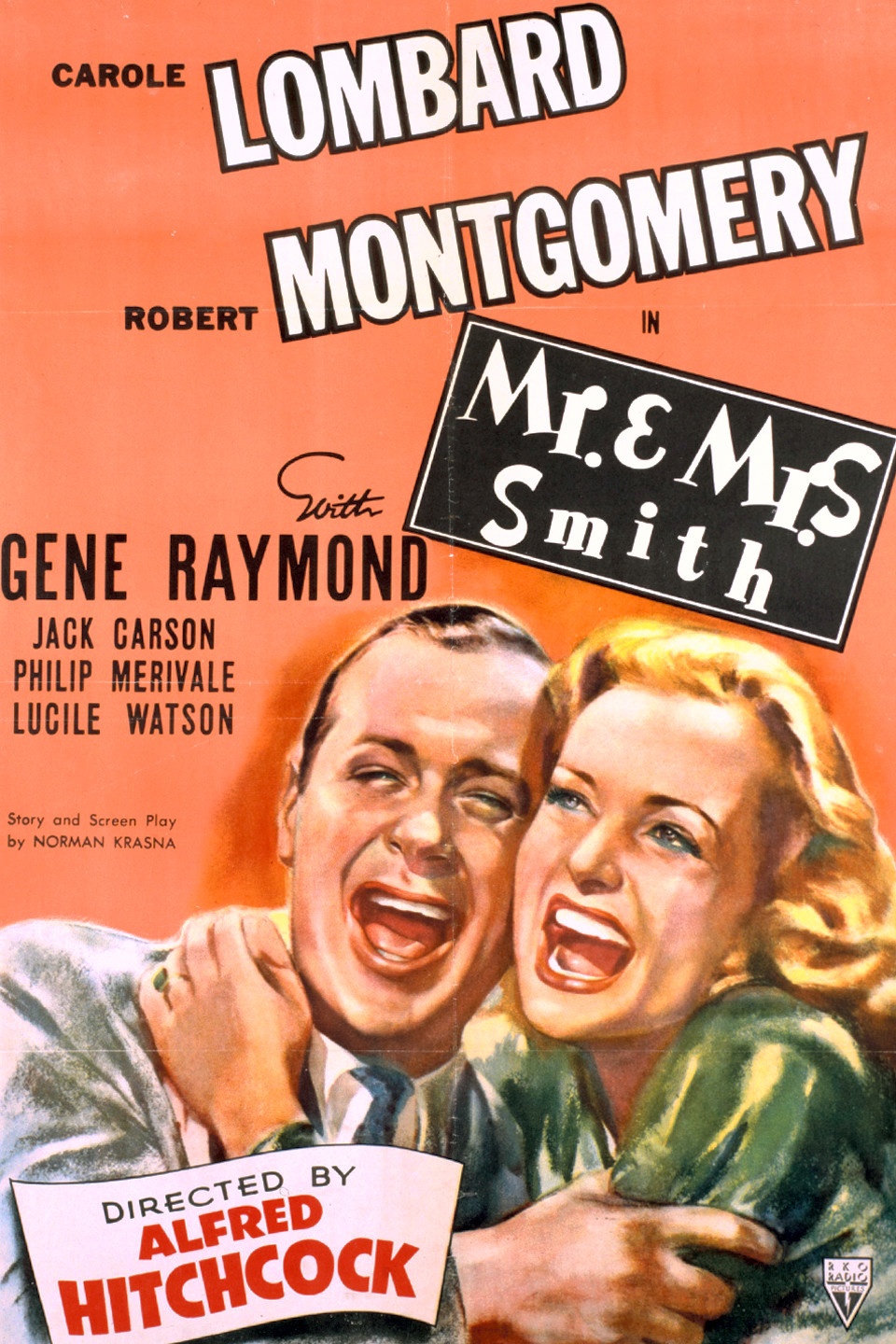
While we can easily see the roots of his distinctive traits in even the earliest works in his career, Alfred Hitchcock was not immediately the Master of Suspense, spending some time as a director-for-hire on a number of projects that we now know are fortunate to bear his name, even after having made a few well-regarded films that launched him to the very apex of his craft. As wonderful as it is to deconstruct his iconic method relating to the projects that bear his signature style, there’s a certain joy that comes from discussing his deviations from his conventional methods of filmmaking. Mr. & Mrs. Smith is one of his lesser-known films, a strangely captivating screwball comedy that not many of us would have expected someone who was so fervently dedicated to unsettling and challenging audiences to have made, especially not sandwiched between Rebecca and Suspicion, two of his most complex films. However, as different as this film may be, it does prove the unimpeachable fact that, regardless of the genre in which he was working, Hitchcock could command his craft, delivering nothing short of the most exhilarating, entertaining content imaginable, so much that even a relatively minor screwball comedy can be considered something of an achievement. Allegedly the product of both a favour owed to one of the film’s stars, and Hitchcock’s own interest in making a straightforward comedy, the film is a fascinating example of the director venturing into a different genre and still managing to pull together something thoroughly captivating, at least enough to consider the film something of a success, even if it rarely comes close to the more famous work he would go on to produce.
Make no mistake, this review isn’t aiming to position this film as some unheralded masterpiece, or imply that there is anything remotely complex lurking below the surface. Hitchcock was known to experiment with the form, as we saw in many instances with films like The Wrong Man and The Trouble with Harry, works that take the esteemed director’s most notable qualities and turn them on their head, whether in terms of the narrative or the tone associated with the story. By all accounts, Mr. & Mrs. Smith is exactly what it promises to be, insofar as it’s a reliable, entertaining screwball comedy that, much like every notable entry into the genre, is filled to the brim with irreverent humour and soaring romance. It’s inherent to associate the name of the director with subversive cinema that challenges as much as it entertains, but when it comes to something like Mr. & Mrs. Smith, it’s more important to take the film on face value, looking at it as just an experiment in seeing if the director could helm a very traditional comedy. The story focuses on a couple who discover that their marriage (which both would consider to be fuelled by a mutual love, even with the occasional spat) is actually invalid due to a clerical error, and when it comes time to rectify the mistake, they aren’t sure if they ever wanted to be married in the first place. It’s a simple and straightforward premise that is very conventional by the standards of the genre – but when we unpack it and look slightly deeper, we can see that this is a really special gem of a film, one that may not always be massively unique, but has an abundance of heart, which means more than anything else, considering the nature of the story.
Mr. & Mrs. Smith is such a simple film, it could’ve been directed by any director who is even partially competent – especially since much of what makes the film work is the screenplay by the notoriously prolific but sadly underrated Norman Krasna, who once again infuses the dialogue with the sparkling wit and genuine emotions that made screwball comedies such a viable sub-genre at the time – so attributing any of the success to Hitchcock’s genius seems strange, even if he does make some interesting choices in terms of telling the story on a visual level. This is a film driven by the performers and their interpretation of the script, which Hitchcock is merely instructed to capture in a constructive and interesting way – and rather than undermining the director’s contributions here, we can use it to propose the idea that, even when dealing with relatively simple material, he could weave together something entertaining. The film moves at a rapid pace, keeping time with the screenplay in the way that only a genuinely well-made screwball comedy could (and which has been the primary reason these kinds of films are restricted to this era, as no one has been able to evoke that same electricity ever since), and it never lingers too long on a particular idea, which just contributes to the spirit of the story, which is all about progress and not dwelling on the details unless they’re entirely necessary. His authorial voice may get lost in the shuffle, but Hitchcock still does his best to shepherd the numerous different narrative concepts into something logical and easy to understand, a quality we don’t often find reflected quite as keenly in a lot of comedies from this era.
Rumour has it that Hitchcock was convinced into directing Mr. & Mrs. Smith as a personal favour to Carole Lombard who was actively trying to get an esteemed filmmaker to helm the project, in which she saw a lot of promise. This was clearly a film that the actress was dedicated to seeing realized, which is evident even in the performance she gives – as good as her screen partner Robert Montgomery may be (especially when it comes to portraying his character as a product of the lazily debonair bourgeoisie), this is a film that orbits around Lombard and her effortlessly charming screen presence, which she often showcased in a range of endearing comedies that were built almost entirely on the strength of her talents, her ability to make us laugh with as little as a subtle expression and her irresistible charms that set her apart from many of her contemporaries. Her performance here is some of her strongest work, despite the film not necessarily being of the quality that would warrant her talents. She reigns over the film, playing the character of Anne with such ferocious dedication and upbeat humour, that it’s impossible to not be entirely beguiled by her work here. This was unfortunately the film released in Lombard’s lifetime, as she would soon tragically meet her demise in an accident, so seeing how vibrant and compelling she was as a performer in a film as pedestrian as Mr. & Mrs. Smith only convinces us that the industry lost one of its most shining stars, someone who could get to the root of even the most derivative character and turn them into something special.
Mr. & Mrs. Smith doesn’t offer the audience much in terms of a particularly complex story, or anything that could be considered all that original. Viewers should manage their expectations, since not only does the fact that Hitchcock directed the film imply that it’ll be some subversive and challenging thriller, the more recent film that bears the same title might lead one to assume this is in some way related. However, if one can get past these assumptions and just look at this film on its own merits, it’s easy to see precisely why it’s such a cherished work in small but dedicated groups. It has an easygoing charm that propels the story forward, which is built on nothing but a vivid and endearing story of love, working backwards from a pair of individuals falling out of love, and then trying to find a way to rekindle the spark that existed between them. It may be derivative, and it’s a story that has been done many times since with more interesting results – but taken for what it is, rather than for what others may have expected it to be, Mr. & Mrs. Smith is a lovely piece of storytelling, an endearing and captivating voyage into an ordinary marriage which is undergoing some trouble, all of which converges into this absolutely delightful, and always very funny, comedy-of-errors that manages to make us laugh in addition to genuinely moving us with its clear heartfulness, making this a delightful film that may be a minor entry into the careers of everyone involved, but is still very much worth the time it takes to experience this charming farce.
 The Postmodern Pelican