
In a time when his contemporaries were more concerned with “serious” cinema that had a deeper message, John Huston was committed to occasionally taking a break just to have some fun, which resulted in him sporadically producing some of the most entertaining films to ever be made during the Golden Age of Hollywood. Undeniably, he was a master of his craft and made many very artistically-resonant films – but it’s often his more diverting works that have made Huston such a beloved figure. The African Queen is often considered his masterpiece, precisely because it occurs at the perfect intersection between the director’s most prominent gifts – on one hand, it is a bold and daring action adventure with unforgettable performances from two of the biggest movie stars of their generation. On the other, it’s a scathing, intelligent satire that pokes fun at some very serious issues, which are especially pertinent considering the United States had just emerged out of the Second World War a few years prior to Huston making this film. Both work in tandem to create The African Queen, which pays sufficient homage to the original source material by Cecil Scott “C. S.” Forester, whose work guided Huston’s assured directorial vision to a place where everything about this film was remarkable, from the broadest artistic flourish to the smallest character-based detail. As the proverbial jewel in Huston’s directorial crown (few directors warrant as regal a metaphor as this more than him), The African Queen is absolutely remarkable, and earns every bit of acclaim it has received in the past several decades.
As one of the most riveting, genuine blockbusters of the classical era, The African Queen had many expectations, and as we’ve seen several times before, a film having a very strong reputation for being a masterpiece doesn’t always result in the most effective experience for those viewing it decades later, as its status as a classic can sometimes be a hindrance if we’re expected to view it through the lens of being some unimpeachable, highly-influential masterwork. The joy in realizing that this film is just as refreshing and exciting today as it was at the time of its original release can’t be understated, especially considering how it is one of the rare instances where the reputation equals the actual quality of the production, not being overblown or exaggerated in any discernible way. Huston was a very versatile director (to which his long career can easily attest – how many directors can claim they effectively worked through both the Golden Age and New Hollywood, consistently producing work of an incredibly high-calibre along the way?), so it only made sense that The African Queen would employ his method of jumping between genres without any laborious effort, leaping from enthralling adventure to glorious melodrama to outrageously funny comedy, all with the same conviction and genuine pathos present throughout. The stakes are high, and the quality of the film matches it beat for beat, telling this enthralling story with the devil-may-care approach that made Huston such a captivating filmmaker in the first place. From beginning to end, this film grabs the attention of the viewer and never quite abates – and considering how it has been cherished by audiences for generations, this is barely a revolutionary opinion, especially not for a film as well-regarded as this one.
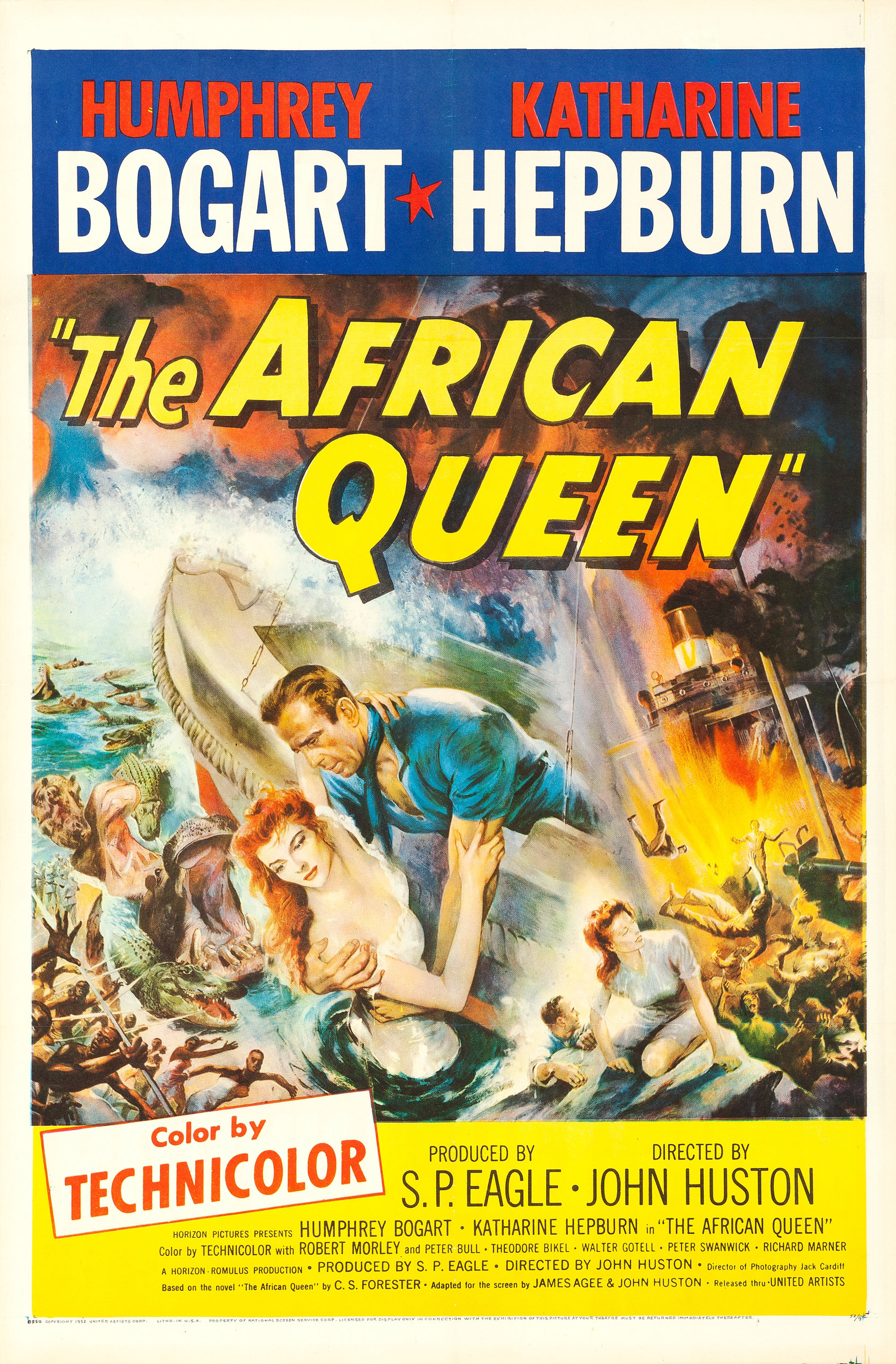
As ambitious and beautifully made as The African Queen may be, it is highly unlikely anyone ventures into this film based on the premise, at least ahead of the two names that are most associated with this project, aside from Huston. Undeniably, this film is built on the talents of Humphrey Bogart and Katharine Hepburn, both of which were inarguably among the most beloved stars working in Hollywood at the time. In all honesty, it’s neither actor’s finest performance, but its certainly still excellent work from both of them – and working with Huston was clearly a fruitful experience, since they’re turning in a couple of very strong performances that showcase exactly why they were so widely embraced, and remain some of the most iconic stars of the period. Bogart is the person who benefitted most from the success of the film, his grizzled, drunken sailor being one of the highlights of his career (and considering he would die only a few short years later, many consider this to be one of his final peaks as an actor) – and standing as one of his most entertaining performances, it’s difficult to argue with the admiration many have felt towards his work here. He has astonishing chemistry with Katharine Hepburn, a formidable performer in her own right, but someone who could step aside and easily share the screen with another actor, allowing both to create an unforgettable rapport that drives a film forward. Every bit of excitement, romance and humour present throughout The African Queen is filtered through these two characters, the dual perspective making this film a varied and fascinating character study, rather than just a straightforward adventure film – but it would be entirely foolish to expect Huston to make anything that adhered strictly to conventions after all.
The African Queen is part of a genre not normally known for its performances, so the fact that Huston was able to extract such excellent performances from his actors, while still making a film that is filled with exciting moments, is a monumental testament to his skills as a filmmaker. This is the rare kind of film that actually took several risks for the sake of its craft – the decision to film the majority of the film on-location in various parts of Africa was a bold decision that was naturally seen as unnecessary (especially since the mainstream film industry had become strong enough to reconstruct the most distant lands – look at how An American in Paris essentially replicated Paris in the 1950s), but added to the authenticity of a film that genuinely required it to be taken seriously. The story itself isn’t particularly strong – the character motivations are vague and come too quickly, and the plot mechanics sometimes don’t make sense, so it only stands to reason that the film would compensate for these slight shortcomings with some truly impressive set-pieces. The difference between the scenes filmed in Africa, and those on film sets (which was done not for convenience, but rather for the safety of the actors – some of those scenes were far too dangerous for the unexplored jungles in which the film takes place) is clear but not distracting – we’re too enamoured with Huston’s frequent oscillation between the two characters, who manage to fall in love despite the very clear and present danger that surrounds them, and their thrilling adventures, to pay too much attention to the specific details. Huston was a journeyman director who was capable of extracting nothing but the most enchanting content from his stories, so it’s easy to see why The African Queen has remained so cherished after all these years.
The African Queen is entertainment distilled into its most pure form, which should be entirely expected from someone with as interesting a perspective as Huston. It wasn’t his first foray into the adventure genre, but it’s certainly his best – far from his most serious-minded work, The African Queen is instead a rollicking, entertaining voyage into the heart of a continent that was often seen through a very myopic lens in art at the time, and while the director doesn’t do too much to bolster the image of Africa, it’s wonderful to see the beautiful locations used as the setting for this fascinating film, as well as local actors that are interwoven into scenes with two of the biggest stars of their generation. To be quite frank, The African Queen is a film that is almost impossible to not absolutely adore, since everything about it, from its mercilessly brilliant execution, fantastic performances and sense of genuine enthusiasm making for a thrilling two hours of riveting storytelling, which is filtered through the lens of the camera of a filmmaker who never neglected to approach his work without the most authentic dedication that he could’ve mustered. Seventy years since its release, The African Queen is an astonishing and important work of fiction that continues to stand as the gold standard for adventure filmmaking and shows that there is always a way to enthral audiences as long as there is a sense of genuine commitment from all involved to bring a story to the screen in a way that is both exciting and meaningful, which is one of the most appropriate descriptions for a film that aims merely to entertain, but ends up doing even more than was expected.
 The Postmodern Pelican