
They say it takes a village to raise a child – and this has rarely been more clear than in Steel Magnolias, playwright Robert Harling’s tender love letter to his late sister, and the women in his community that orbited around his family in the years surrounding her untimely death. The film adaptation of the play has come to be seen as one of the classic examples of the southern-fried melodrama with healthy doses of humour to help alleviate the tension and heartbreak, and has persisted as one of the most endearing films produced during its time. Adapted by Herbert Ross, who was not a stranger to stories that blend comedy and tragedy, Steel Magnolias is a masterful example of the fact that filmmaking does not need to be economical to be considered practical – instead, they simply need to tell a story worth watching, regardless of the form in which it comes. This is the most likely reason behind the film being such a cherished work, one that has occupied the position of a widely-embraced classic of a genre that is divisive but still adored enough to have merit all on its own. Steel Magnolias is not a film that necessarily requests the viewer to do much in terms of rationalizing the story – it is bold and beautiful in its own way, ornamented but never excessive. More importantly, it feels like a very personal achievement, a film that allows a gifted writer to work through his own trauma through the lens of humour, leading to a film that encourages us to take a seat at the table with these women as they discuss every topic from life to death and everything in between – and you’d struggle to find a more wonderful exploration of these themes, especially in a form as delightfully endearing as we encounter here.
The emotional content of Steel Magnolias is its primary selling point, since it is a film that truly embodies the idea of luxuriating in the wide range of themes that are found at the fundamental level. It is direct and forthright in what it intends to do – whether the viewer is supposed to laugh or weep, the film guides us there with its strong control of emotion, taking us to a particular place in the story where those sensations are palpable and earnest. It has led to slightly polarized reactions over the decades – for some, it represents the most overwrought example of storytelling, where the viewer is often quite literally fed the emotion we’re supposed to feel, while for others, it is a work that invites us to abandon our preconceived notions of how involved a viewer must be in a film’s story to work, and just allows us to be enveloped by the endless range of pure, undistilled sentiment that inspired it. Ultimately, this film entails the combination of the reliability of Ross’ direction and the sincerity of Harling’s writing, which work together in tandem to tell this increasingly deep story about very real issues. There’s a respectability in any work of art that wears its heart on its sleeve, and Steel Magnolias never conceals what it is trying to convey, making it exceptionally clear from the first moments that this is going to be a film that entails both humour and sadness, and that it would not hesitate to change course the moment it felt that another subject needed to be discussed. It often borders on being overripe, but it continuously evades being too immoderate through making sure that we are fully invested in the story, so much that the details are ultimately not all that significant.
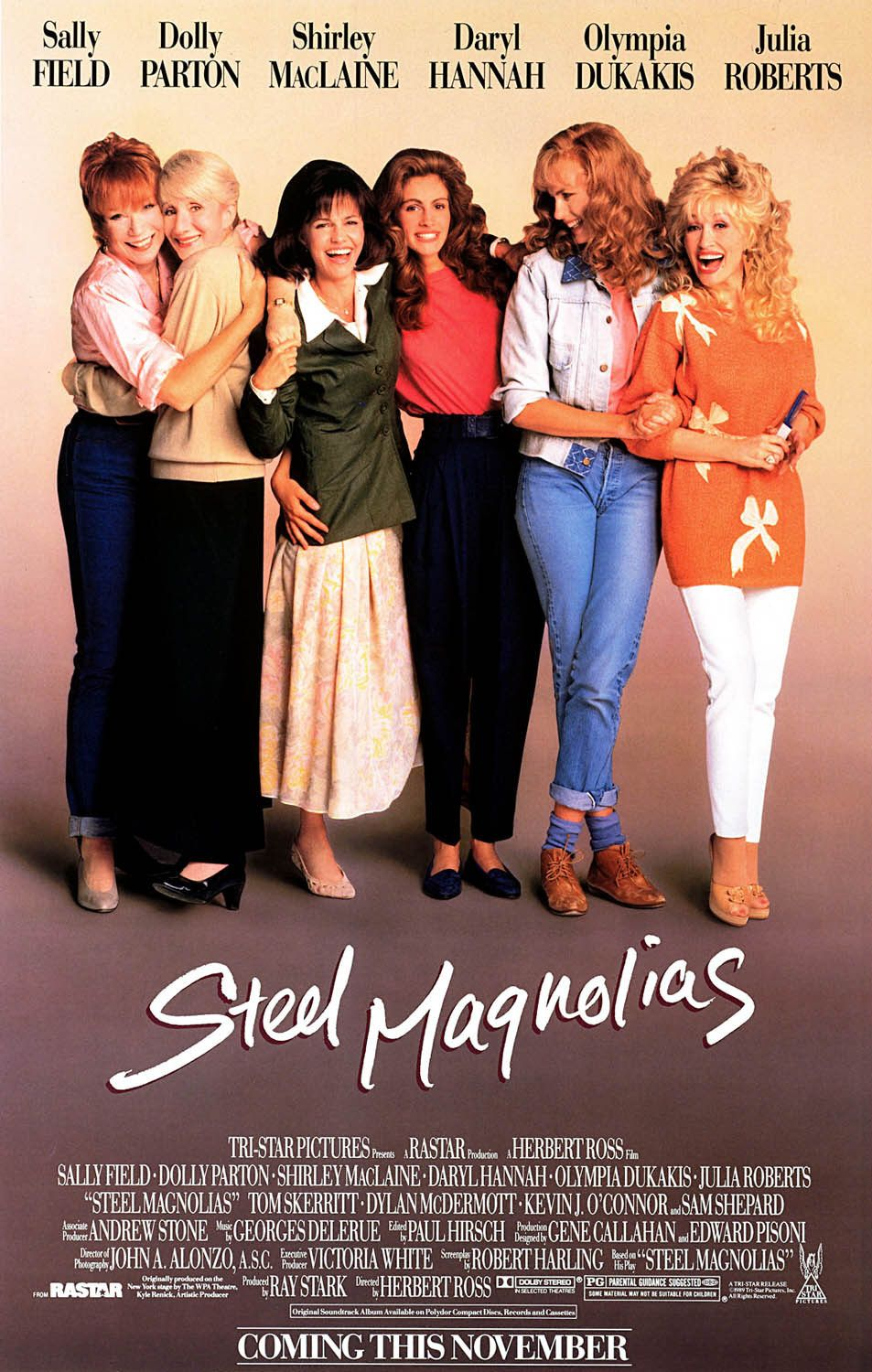
In constructing this story of a gaggle of hilarious and eccentric women living and working in pastoral Louisiana, Ross uses his status as a distinctly well-connected filmmaker to put together a terrific cast. Steel Magnolias is one of the few ensemble-based films where everyone is excellent (at least in terms of its central cast – the male characters are intentionally kept mostly in the periphery, since they were not part of the original play, and serve very little purpose outside of being supplementary to the core group of women that we mostly remember). Choosing a standout from this film is nearly impossible – Sally Field gives possibly her best performance as M’Lynn, a woman trained to help others with their problems, but finds herself at a loss when confronted with her own tragedy, turning towards her support system, which just happens to come in the form of the friends and neighbours she has surrounded herself with. Dolly Parton, Olympia Dukakis and Shirley MacLaine are all as tremendous as always, Parton in particular proving that she is as gifted an actress as she is a musician (not to say that this has ever been in doubt – she’s such a natural performer, and brings so much warmth to the film), and the latter two once again prove why they reigned supreme for many years as beloved industry veterans that enriched every project in which they appeared. Even the younger actors in the form of Daryl Hannah and Julia Roberts were exceptional, holding their own against their formidable co-stars. It’s an absolutely terrific ensemble that adds so much nuance and elegance to a story that could have been far from this effective had these roles been placed in the hands of less-gifted performers. They are the reason to watch this film, and each and every one of them delivers in expectedly brilliant ways.
What has made Steel Magnolias such a beloved work is how easy it is to fall in love with this film. Some may be shocked when they realize the story was based on Harling’s own experiences, not because it seems implausible or too over-the-top, but rather since it touches on some very universal themes. One of the most powerful artistic endeavours is to take one’s own experiences, whether joyous or traumatic, and reconfigure them in a way to be resonant to a much wider group. The story was obviously drawn from a place of very personal grief, almost as if Harling was writing it as a way of working through his emotions, using his experiences as the foundation for both the happiness and tragedy that underpin the film. Yet, it never feels restricted to only his point of view – instead, it becomes a gorgeously profound work that is ultimately about nothing more than human connection. It is hardly a mistake that Steel Magnolias is considered one of the great ensemble-based films of its time – not only are each of these characters well-composed and meaningful, but they each serve a particular purpose, and the interactions between them point to the immense humanity of the film. Ross has often been drawn to these kinds of stories, and whether broadly comedic, or more subdued in how they balance melancholia and humour, he has always had a formidable control over his craft – perhaps not the only choice to bring this story to life, but rather someone whose experience made him a good fit for the material, he brings out the compassionate humour integral to the narrative, and turns it into a truly wonderful film.
Steel Magnolias has many detractors, but far more dedicated supporters, and it is not difficult to figure out precisely why it has remained such an endearing film, despite the presence of works that are perhaps more distinct in how it tackles these issues. There’s a warmth that underpins this film that feels like it is drawn from a place of the most sincere and forthright compassion, which is a result of the masterful collaboration between a group of exceptional artists on both sides of the camera. It’s difficult to not feel something while watching the film – humour is sharp and filled to the brim with the kind of charming country-based sass that has always made these kinds of films so endearing, and the more emotionally-complex material is executed with precision, Ross knowing how to explore the more challenging moments without turning it into a heavy-handed, overwrought bundle of misplaced sentimentality. Everything in this film is essential, even if it is far more theatrical than a more realistic work would be, especially since it never promised to be some socially-conscious fable drawn from the school of realism, but rather a lush and upbeat human odyssey that seamlessly combines warm comedy and heartwrenching melodrama to form a wonderfully sweet and moving story of friendship, family and self-actualization, all of which are neatly tied together in this charming, uplifting voyage into the life of a group of women who may not be particularly special when looked at from a distance, but prove to be the most endearing protagonists when we get to know them – and for that reason alone, Steel Magnolias is an absolute triumph, a warm and soft-hearted glimpse into the fragility of life, and the joyous moments that can be found in nearly any situation.
 The Postmodern Pelican