
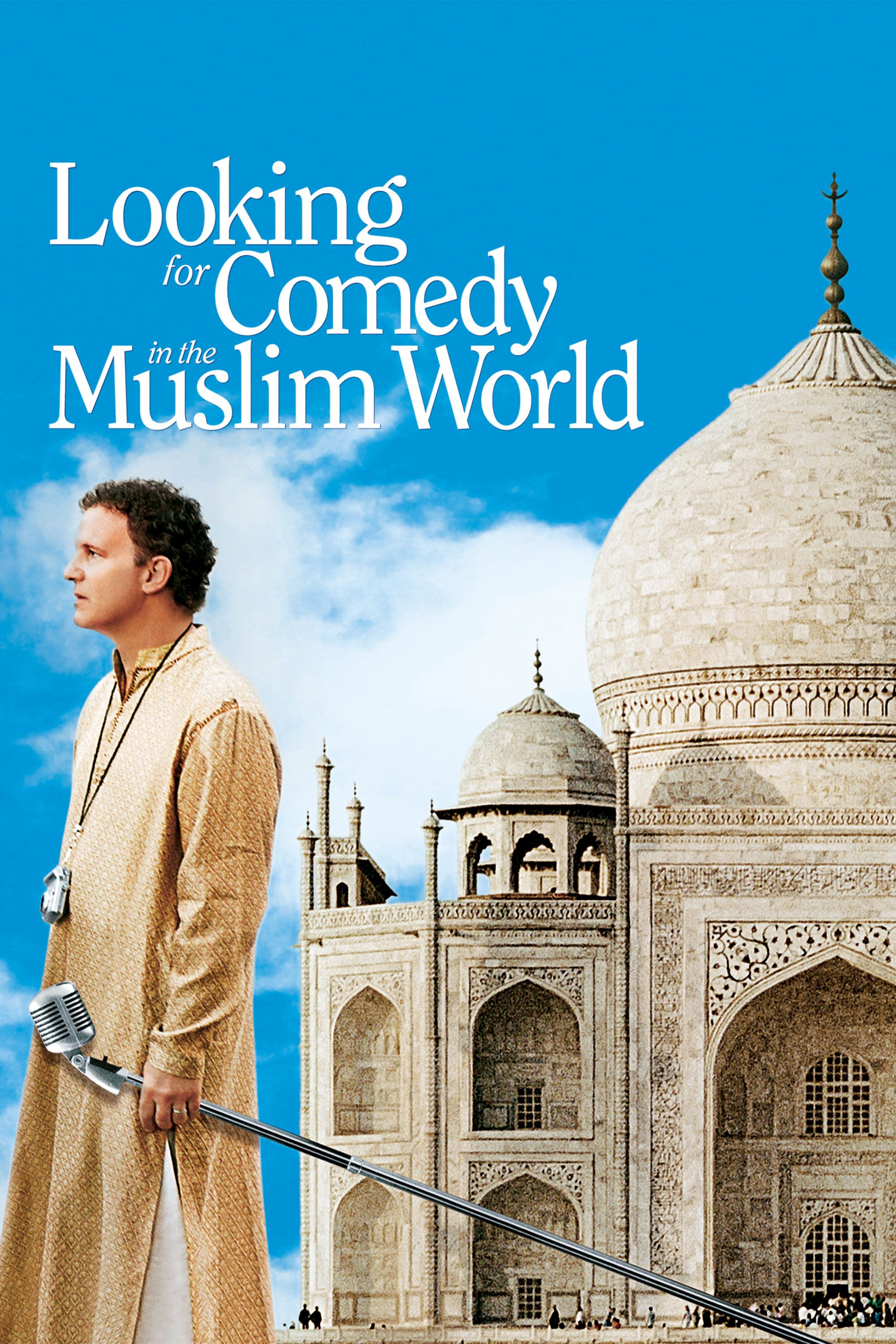
Surprisingly, it took Albert Brooks several decades of casting himself in roles that were really thinly-veiled versions of his own life to finally play himself in one of his directorial efforts, which seemed like something that was an enormous inevitability, since even though he’s a remarkably gifted actor with a considerable amount of range, he often seemed to prefer falling back into roles that entailed him using some of his experience in the industry. Looking for Comedy in the Muslim World is his most recent (and possibly final) time stepping behind the camera as a director, and while it is important to note from the outset that this is certainly nothing close to masterpieces like Modern Romance or Defending Your Life, it is still certainly a wonderfully entertaining film with a lot of heart and the scathing wit that we’ve come to expect from Brooks. Perhaps my viewpoint is biased – I admire the director considerably, and find him to be one of the greatest comedic minds to have ever worked in any medium, so I’ll logically be enamoured with nearly everything he has done, on either side of the camera. However, even the most ardent devotee has to admit that there are some considerable flaws in Looking for Comedy in the Muslim World, a film that skirts controversy in a way that perhaps wasn’t entirely necessary – but despite some shortcomings that threaten to tarnish the film as a whole, Brooks made something truly entertaining, a film that may not always be operating at peak conditions, but consistently is trying to do something different. Whether or not it works is entirely up to the individual viewer and their interpretation, especially when dealing with a subject as tricky as the intersection between faith and comedy, which we’ve seen be the cause of some serious conversations in the past.
The idea of comedy being universal has always been a subject that has immensely fascinated many aficionados, several of us looking towards different cultures as a way of finding the origin of what makes different people laugh. Brooks certainly does have a deep interest in the topic, since he crafted an entire film around a character, who is portrayed here as a washed-up comedian desperate for validation, venturing into a distant, exotic location, all for the purpose of determining what it is that incites laughter in people from other cultures. It is structured as a government-mandated mission that requires him to return with a 500-page dossier that outlines (in immense detail) all his findings. The premise itself can’t be faulted at all – Looking for Comedy in the Muslim World is a film that has a strong set of ideas spread throughout the conceptual stage, and had Brooks been slightly less self-aware, or passed it along to another director who he knew could manage the material, it’s likely the film would’ve improved considerably. Much like his directorial debut, Real Life, Brooks is struggling with some of the more high-concept details from which most of the subversive comedy and interesting social commentary is derived, proving that when he is given something of value, or conceives of a story that doesn’t require too much in terms of outright ambition at an early stage, he is capable of pure magic. This isn’t to discredit the film we got in the end – there are many moments in Looking for Comedy in the Muslim World that carry tremendous value, but they’re few and far between, and sometimes aren’t worth the investment required to finally reach them, many of the more interesting ideas being concealed by layers of slightly mediocre comedy that doesn’t seem to serve any other purpose than just filled up the empty spaces between the more bold, ambitious moments.
On a purely conceptual level, it isn’t difficult to understand why Looking for Comedy in the Muslim World seemed like such a great idea – it was produced in the early 2000s, when issues relating to the tension between different religions were at their peak as a result of the violent conflict occurring around the world as a result of the religious divide. One can almost hear Brooks pitching the idea: a Jewish-American comedian ventures into the Muslim world to try and find out what makes them laugh. Comedy is a universal concept, and regardless of where we are from, there is always delight in finding something funny. However, a great idea in theory doesn’t necessarily work in practice, and Looking for Comedy in the Muslim World does begin to fall apart relatively early, mainly because it doesn’t seem to have developed too far beyond this supposed concept, Brooks seemingly having come up with the idea on a whim, and then deciding to make it before actually thinking it through entirely. There is an aimlessness to the film that doesn’t really work all that well, and as interesting as it may be in premise, it ultimately doesn’t carry much weight outside of the surface-level premise, which isn’t enough to sustain an entire film. It almost feels as if this film is only half-baked, the premise being strong, but the details causing the ultimate downfall – the humour is funny, but far from the director’s best work, and the cultural nuances could have been starkly improved with just slight alterations. One could even wonder why, despite the film including the term “Muslim World” in its title, it is set almost entirely within India, where Hinduism is the prominent religion, with only a brief excursion into Pakistan (the likely reason being that tensions between the United States and the Middle Eastern nations at the time may have been too much of a risk for such a film to have been possible) – but unfortunately, there is an excuse for every strange choice made in this film, which does dampen what is an otherwise very charming experience.
Comedy is an interesting subject, and it’s something that Brooks does try and explore through his films. There is an argument to be made that Looking for Comedy in the Muslim World could’ve been a much better as a documentary, since the central concept is good enough to warrant the effort, and it would’ve likely resulted in a much better film. Iconoclastic filmmaker and similarly-acclaimed comedian and director Larry Charles ventured into different parts of the world over a decade later to produce Larry Charles’ Dangerous World of Comedy that stands as one of the most interesting and startling depictions of the impact comedy has on different societies, especially those in war-torn nations (carrying the subtitle “it takes brave people to make dangerous comedy”) – and as incredible as that show is in exploring these themes, Brooks’ could’ve easily have done similar work, had there been a concerted effort to actually demonstrate these conversations. Comedy has always been a uniting factor – while we may differ in cultural nuances, the experience of laughing along with another person has always been something that comedians have been intent on exploring, which is why some of the most beloved cultural exports are sitcoms and comedy films, and the reason behind some of the most recognizable film stars being those who worked in the genre. Brooks had a terrific idea, but his execution was lacking. It’s a clear case of taking an idea and stretching it to its full extent, or just not doing it at all, since trying to make it without taking a few risks or daring to ruffle a few feathers is ultimately going to negatively impact any hope someone has of saying something that we haven’t heard before, which is the primary reason behind Looking for Comedy in the Muslim World failing to reach its full potential, even when it is at its most insightful.
I’m hesitant to be too critical of Brooks, since Looking for Comedy in the Muslim World was produced during a slightly different period, and could be considered something of an attempt to reach some kind of common ground with the people that were often perceived as threats under the irrational and paranoid socio-political landscape. The problem with this film isn’t that it was inappropriate or flippant about serious issues, but that it was made by someone who was playing it far too safe – Brooks has taken his fair share of risks throughout his career, and he isn’t someone that we can consider to be reliable when it comes to toeing the party line in terms of innocuous, inoffensive comedy. Therefore, it almost seems as if the comedian, who is normally as subversive as he is intelligent, was being restrained by factors beyond his control, whether it be the studio forcing him to play down the more controversial elements, or his own self-imposed refusal to go too far. My theory is that when it comes to comedy, there is very little chance of going too far, granted someone isn’t actively spreading hate speech or harming another, and Brooks has had a long history of successfully punching up in terms of his comedy – so ultimately, the decision to make something that has such a strong premise, but in a way that doesn’t live up to its potential, is an enormous disappointment. Unfortunately, this is also the most recent film that Brooks has made, and considering that it is going on nearly two decades since this film was produced, it is looking increasingly unlikely that he is going to step behind the camera anytime soon, which is an enormous shame, since he deserved to conclude his directorial legacy with a stronger film. However, there is undoubtedly still some merit within Looking for Comedy in the Muslim World, whether it be some of the very funny jokes, eccentric characters or heartful message – so while it may not be particularly great, it is far from a waste of time, which is at least one of the more positive comments that can be said about this otherwise minor effort from one of comedy’s greatest creative minds.
 The Postmodern Pelican