
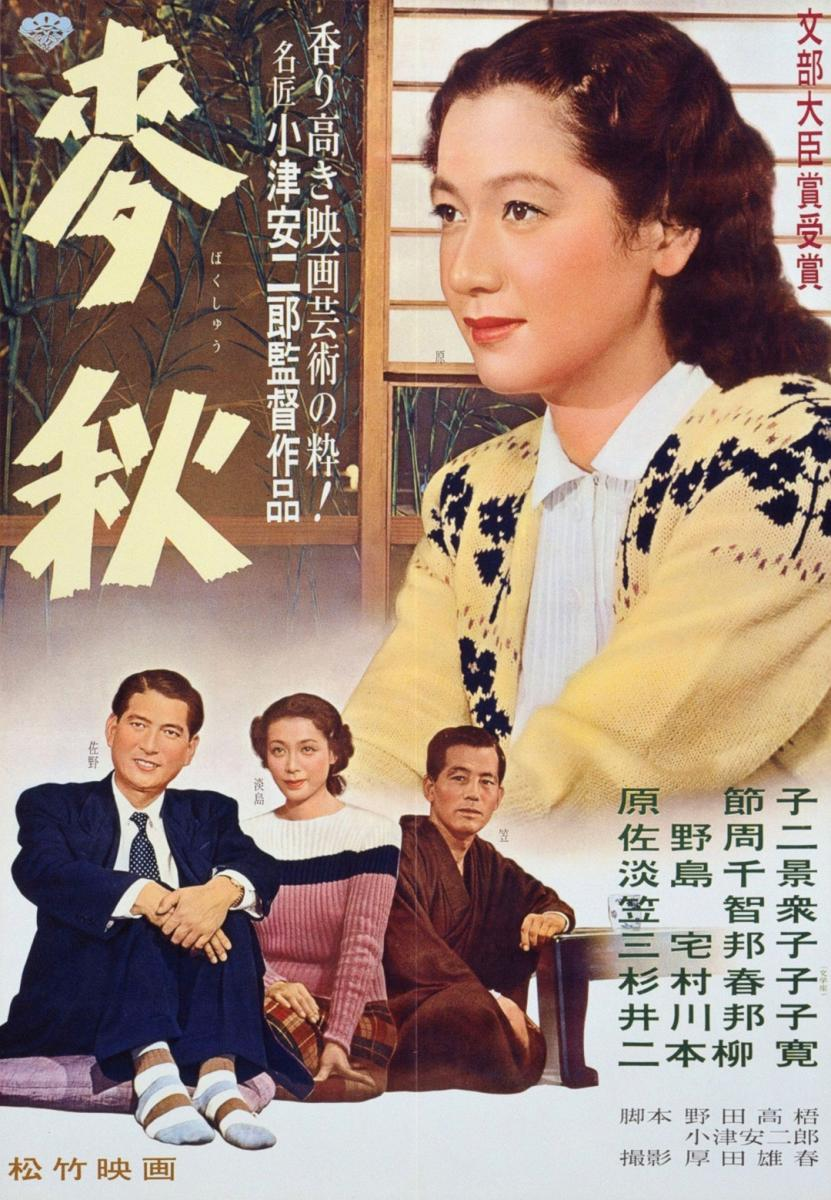
After having seen several of his films, it’s not surprising if viewers start to find the work of Yasujirō Ozu blurring together. This isn’t nearly as disparaging as it sounds – as a filmmaker who often stuck to the same set of thematic principles, and a particular directorial approach, Ozu’s films are distinct and similar to the untrained eye, with only the most keen observers managing to find the most significant differences between them. I personally like to view each of his films as segments in a much longer, continuous stream of stories that look at the evolution of Japanese society in the decades immediately before and after the Second World War. On occasion, one of these films will be different enough for us to stop and pay attention to it in isolation. In this case, Early Summer (Japanese: 麦秋) is one of the director’s most fascinating projects, a moving story of a young woman trying to reconcile her own proud independence with her desire to honour her family and their wishes, placing her right in the middle of a proverbial tug-of-war between traditional values and progressive matters, which are integral to many of Ozu’s greatest works, but somehow most effective in this film. Calling Early Summer his finest film seems both presumptuous and misguided (especially considering how he’d follow it only two years later with the definitive masterpiece of his career), but it stands as one of his most poignant works, and a film that embodies everything that made Ozu such a brilliant filmmaker, whose influence has been resonating through the world of cinema ever since he crafted these beautiful stories.
On the surface, this film doesn’t appear to be much of a deviation from what we know to expect from Ozu – it’s a small, quiet family drama about the ways in which Japan changes in the post-war era, with themes embedded in the conflict between tradition and modernity, and slight smatterings of feminist theory, all of which are predictable aspects of the director’s work. Yet, there is something so profoundly different about Early Summer, a quality that is difficult to discern at the outset, but which becomes clearer as the film progresses. Perhaps it’s the humour that resides at the heart of the film – while it isn’t a comedy by any means (at least not in comparison to the actual outrageous films he made earlier in his career, as well as one of his other masterworks, the wonderful Good Morning), there’s a levity to Early Summer that is often not explored in his more straightforward dramas. It touches on some very deep themes relating to identity and the role of women in post-war Japan, but it’s done in a way that is always very light, resisting the urge to surrender to the weight of the heavier subject matter that is lingering just out of frame. Facilitating these serious conversations through a more positive, lighthearted lens at first allows the emotional impact that comes in the third act to be even more powerful, the melancholy arriving like a ferocious wave that sweeps over the film and washes away the veneer of social pleasantries that Ozu is often elegantly aiming to expose through these quiet and meditative dramas about the inevitable march of progress causing old traditions to fade into obscurity as new generations make their voices heard – and yet it’s all so sophisticated and beautifully-constructed by Ozu.
As hyperbolic as it may seem, Setsuko Hara was one of the greatest actresses to ever work in the medium. It doesn’t take too much work for audiences to find a reason to agree with this statement, since she was someone who produced work of an incredible quality at a rapid pace during her peak, which qualified her to be considered one of the most important performers in the history of Japanese cinema. Considering how talented she was, as well as her clearly striking work ethic, every devotee will have a different opinion on what her best performance is, which isn’t an easy task. She worked with most of the major Japanese directors of her generation, but it was Ozu who arguably brought out the best in the actress – his camera absolutely adored her, and she implicitly understood the various nuances of the director’s craft. Early Summer is possibly her finest performance, which isn’t an opinion that is necessarily groundbreaking, but doesn’t seem to be all that widespread. There’s something about the manner in which she conducts herself here – she’s as profoundly moving as she always is, and handles the dramatic material perfectly – but there’s a vibrancy to her performance that isn’t seen elsewhere, a kind of joyful exuberance that is used to mask the deep sadness that plagues the character. There’s a playfulness to Hara’s portrayal of Noriko, where her ebullient, happy-go-lucky personality, and insistence on being perfectly content living the life of a single woman, contrasts sharply with a sadness that comes through in certain moments, leading to the absolutely stunning final act, where all the complex sensations collide in an unforgettable flurry of emotions, Hara’s beautiful performance being central to Ozu’s methods of deconstructing social traditions through an effortlessly simple but poignant approach.
Ozu’s films often vary in specific aspects of the plot, but they’re united under their collective aim to represent different aspects of the human condition, by way of meaningful glimpses into the lives of ordinary Japanese people at a time when the country was struggling to rebuild itself after a destructive war. Early Summer touches on these issues, but through the process of looking at it from a more intimate perspective, focusing on the aftershocks as they would be felt by those who may not have been directly impacted by the war, but rather the victim of the changing social climate. This is a film about marriage, taken from the perspective of a single woman who doesn’t yearn to have a partner, a radical change of pace for a culture that is built primarily on the process of all young women needing to marry into a family. Ozu dares to create a scenario where not only does he challenge this tradition, but presents it in a way that may not entirely dismiss it (since it wasn’t all that archaic a convention, and thus needed to be approached respectfully, even if the story disagreed with it), but rather questions how necessary such a process actually is. Not only does it provoke a dialogue around the tendency to expect everyone to agree with the same marital structure, it dares to show characters who are perfectly content being untethered – Noriko lives a fruitful and meaningful life, and while the film does eventually end with her getting married, it’s entirely on her own terms, the result of an actual process of falling in love with someone, rather than simply a case of being forced into wedlock for the sake of tradition.
For a film produced seventy years ago, Early Summer is an oddly progressive piece of filmmaking, especially for someone who often relied on beautiful explorations of traditions to support his film. As much as cynics will claim Ozu’s films are derivative and predictable, there are many that are filled with surprises, especially in the specific stories they tell. The director had a real knack for very meaningful, earnest stories of the human condition, which is always beautifully reflected in his films, each one feeling as if it is plucked directly from a neverending tapestry of Japanese life, which Ozu carefully curated throughout his long and prolific career. Early Summer is often cited as one of his most impressive films, and it’s not difficult to understand the reasoning – the blend of hard-hitting drama and gentle comedy, along with the tender romance and very meaningful understanding of the intricate details of human behaviour, makes for a layered and complex portrait of everyday life, anchored by some truly impressive performances (from the incredible Hara in particular, but where Haruko Sugimura and Chieko Higashiyama can’t be neglected at all – Ozu was truly a master when it came to writing strong roles for women), and driven by the kind of subdued but fascinating energy that is always present in his films. There’s just such a joy in seeing a story well-told, and Ozu embodies everything that a great filmmaker should aspire to be – and yet, the fact that he always managed to make it look so effortless will never be anything other than absolutely puzzling, a fact that one has to come to terms with when exploring his incredible career, of which this film is one of the highest moments.
 The Postmodern Pelican