
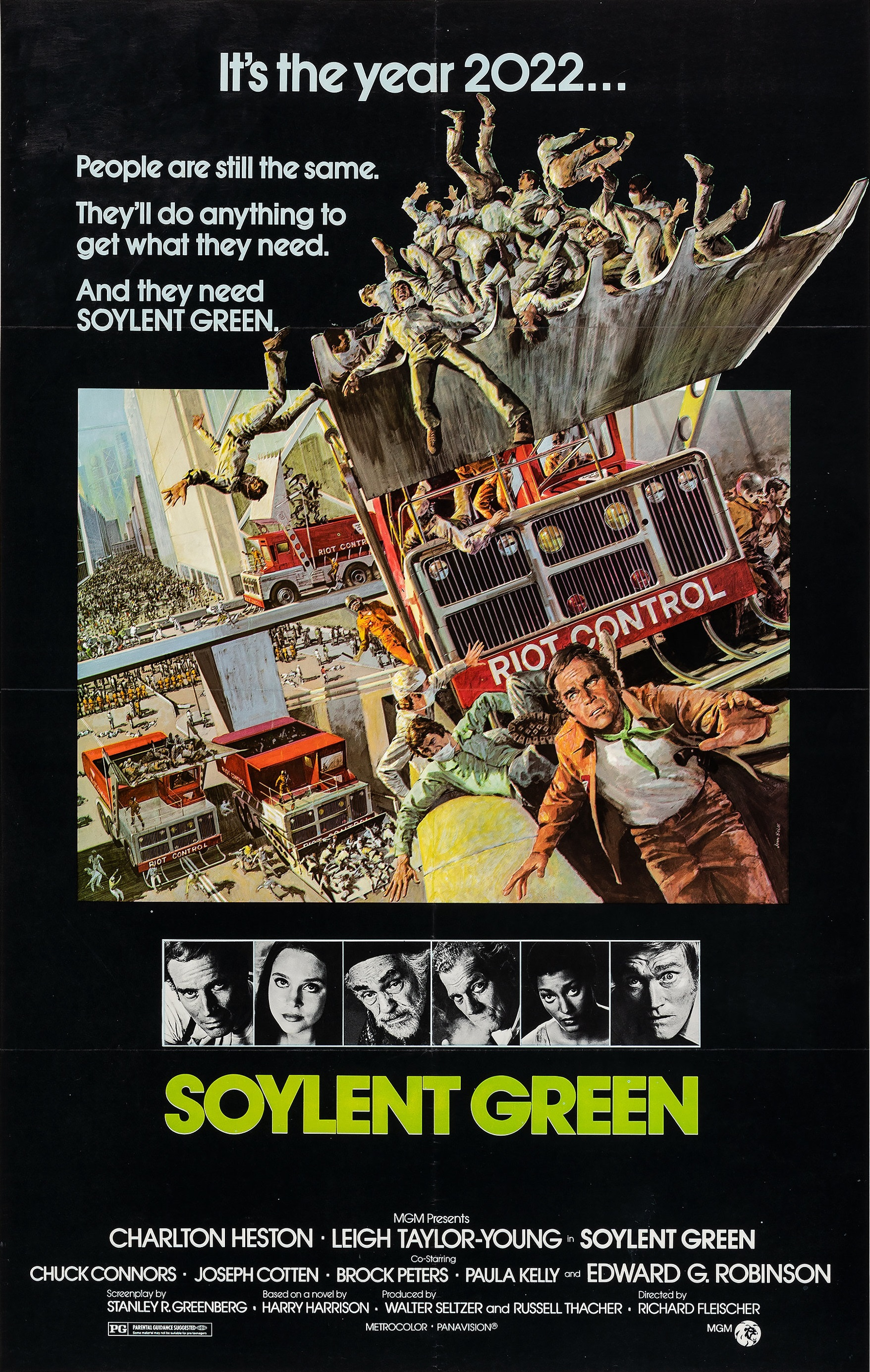
Science fiction is a genre that can either age spectacularly well, or be the subject of excruciating mockery, particularly those that take place in a realistic distance into the future. It all depends on whether the story they’re telling actually manages to be plausible enough for viewers to believe such events are possible, and the extent to which the film is able to go in speculating on what the near-future holds. Soylent Green is one of the most notable science fiction films produced under the New Hollywood movement, which sought to challenge prior cinematic conventions by looking at a range of fascinating issues through a more revolutionary set of narrative and technical styles. Based on the novel Make Room! Make Room! by Harry Harrison, the film tells the story of a world that has been ravaged by overpopulation and climate change, causing the decline of regular production of food and resources, leading to every major city becoming something of a slum, inhabited by millions of tortured souls that are grateful for a morsel to eat and an overcrowded stairwell to spend the night in. Now, more than ever, is the most relevant time to revisit Soylent Green, since it is set in the present year of 2022, nearly half a century since Richard Fleischer and his cohorts attempted to voyage into the near future. A film that touches on a number of issues in a way that is both entertaining and outright terrifying, Soylent Green is quite a remarkable work of science fiction – perhaps not the strongest in terms of actually giving detail to its speculations (and leaving slightly too much content up to the viewer’s own interpretation), the film is still a striking and disquieting existential odyssey that combines numerous genres in its efforts to comment on an imagined future that manages to hit quite close to home in many instances.
Most viewers know Soylent Green as one of the evergreen entries into lists of the greatest film twists in cinematic history, with the revelation that this ambrosia-like substance that has sustained the human population for years is not made from seaweed and plankton (as the corporation would lead you to believe), but from the flesh of human beings, as part of a means to control overpopulation. This is a classic case of a film being famous solely for its ending more than anything else – and while the ghastly surprise that would’ve likely have come for viewers watching this film without any prior knowledge would be fascinating, there is so much more to Soylent Green than this shocking twist, which comes relatively late in the film, by which point we have already been thoroughly captivated by Richard Fleischer’s peculiar version of the world. The combination of three primary genres – science fiction, ecological disaster and police procedural (all of which were mainstays of the New Hollywood movement) leads to a rivetting 90 minutes of tightly-wound, economical storytelling that is fuelled by an inherent philosophical fascination with the world that surrounds these events, and the desire to terrify audiences with the stark and unforgiving glimpse into the future, one that many viewers would live through, considering how Soylent Green leaps forward only a few decades, meaning that the issues contained in the film, and the message that is being conveyed, is truly pressing – and one only needs to look at the state of the contemporary era, and its obsession with capitalistic desire and scientific skeptisism, to see that Harrison was truly ahead of his time, almost to the point where Soylent Green is a more appropriate film to watch from a contemporary perspective than it would have been at the time of its release, being the rare kind of science fiction film that becomes more effective when the issues being questioned are no longer speculative, but rather a matter of separating fact from fiction.
Oddly enough, despite some notable flights of fancy in how it represents life in the now-modern age, Soylent Green never feels too implausible or gaudy, mainly since most of the subject matter is certainly quite pertinent, with the message remaining consistent, and only the specific details being different. Subjects such as overpopulation, the grotesque amount of power held by corporations and societal control are both the foundation for this film, and realistic issues that are present in today’s world. There was very little chance those involved in the creation of this film knew exactly how prescient this story is, which only goes to show how deep these issues were, where a film produced fifty years ago could be one of the most deeply disturbing and relevant to contemporary issues. Much of this comes through in Fleischer’s directing style – a very versatile director who could engage in excess when it was necessary, or keep everything simple in other instances, he had a knack for capturing tone and genre like very few others of his generation. His work in Soylent Green is particularly impressive, since not only is he making a legitimate masterpiece of science fiction cinema, but blending it together with both arguably the most expansive genre at the time (the disaster film) and one of the more gritty and intimate (the police procedural drama), in the process constructing a daring and provocative psychological thriller that is consistently aiming to deconstruct our understanding of some of life’s most fundamental issues. Yet, despite numerous layers, Soylent Green is a very entertaining film – it is beautifully made (some of the sequences are beyond stunning), and it has a very sardonic sense of humour, refusing to be nearly as overwrought as it could’ve been based on the subject matter, which is one of the many reasons behind the resounding success of this film.
Another reason Soylent Green works so well is because it doesn’t only pay attention to the actual filmmaking, but also puts in the effort to include strong characterization. Charlton Heston leads the film with the kind of rugged charm that consistently defined him as an actor – charming but aloof, likeable but flawed, his performance as Thorn, a police officer who will do anything to uncover the truth, is one of his most memorable. Born into a generation of movie stars that could play numerous different layers, not relying on only his charisma to sustain the film, but on a range of other qualities that make his work so profoundly moving. Contrast this with the performance given by Edward G. Robinson, in what would unfortunately be his final film – playing the personable and wise old Sol Roth, Robinson is absolutely spellbinding. His decades of experience in the industry served him well, converging in this beautifully poetic performance as a man who has decided to “go home” after discovering the reality faced by the human population. The most stunning moments in Soylent Green come in the interactions between Robinson and Heston, particularly their final scene, where the former decides to end his life in one of the most achingly beautiful depictions of a suicide ever captured on film. There’s a depth to these performances that feel authentic and earnest, and both actors manage to effectively play the roles as if they were inhabiting the minds of these characters themselves. It sounds like a simple process, but for a film as driven by its premise as Soylent Green, it’s surprising to find performances that are actually genuinely interesting, rather than peripheral components to the spectacle that is the film.
Despite being made half a century ago, Soylent Green is the kind of film that frightens the viewer enough to make us question our own existence, putting a bit of hesitance in every forthcoming step, especially since (unlike other disaster films), this story hinges on humanity’s inherent ability to destroy the planet and put it in a state of absolute crisis. It is a resonant and terrifying call to arms for anyone with any semblance of a conscience, since there is something quite profoundly motivating about a film that derives most of its commentary from the realization that if we don’t curb overpopulation, as well as hold those in power accountable, we too could end up in a position where we start to consume material that is far from ideal, both literally and metaphorically. It’s a riveting and fascinating film that isn’t weighed down by its message, but rather driven by a forthright commitment to exploring a range of issues from the perspective of future generations. Unfortunately, the downside of watching this film today is that it is a science fiction film that makes some bold predictions about the era we are living in – what we see depicted is what Harrison envisioned life would be like in 2022. Obviously, the situation is far from as extreme as shown here – however, there is still value in this approach, especially since there are small details that speak to contemporary issues, almost to the point of it being startling. Therefore, finding these small implications and applying them to our own understanding of the modern world is a thrilling experience, and one that Fleischer does not take for granted when crafting this resoundingly fascinating and incredibly potent science fiction masterwork.
 The Postmodern Pelican