
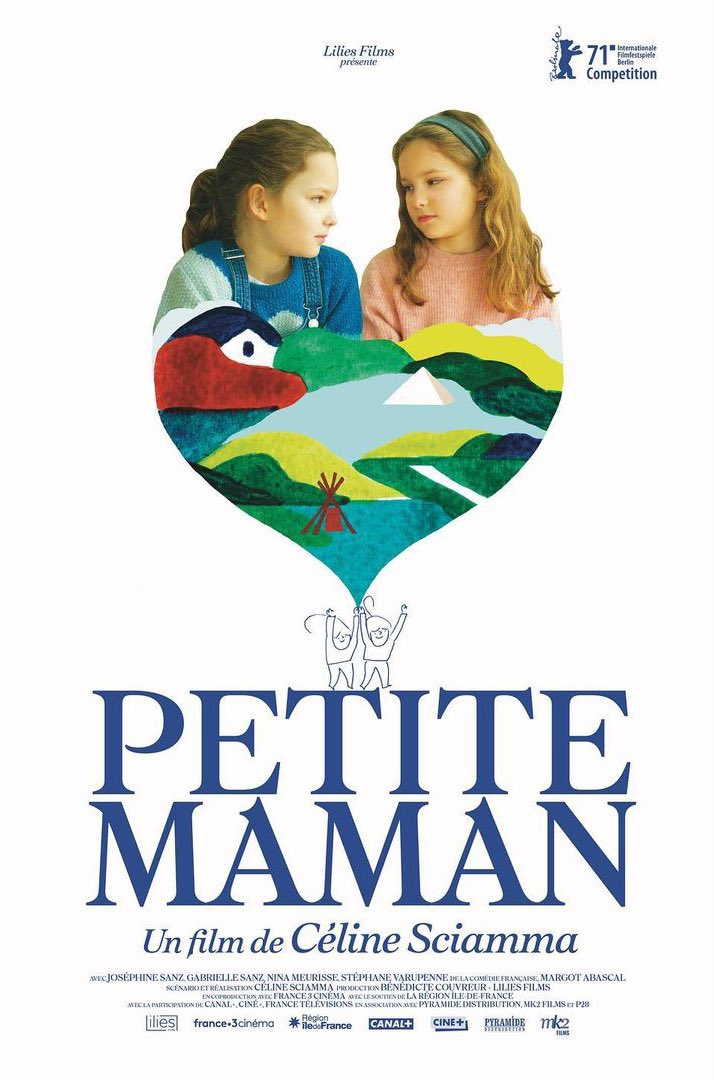
There are few filmmakers who embody the sentiment of being the future of cinema more significantly than Céline Sciamma, who has continuously proven her incredible gifts as a storyteller and visual artist through a small but masterful body of work. Each one of her films feels like it is delicately handcrafted from her extraordinary vision, a momentary glimpse into her unique worldview that covers many subjects, nearly all of them finding their way back to the overarching theme of femininity and queerness in the modern world. Sciamma has rapidly risen to the status of a filmmaker whose extraordinary gifts have made her a celebrated figure in contemporary cinema, to the point where even a relatively small-scale project feels like a major achievement. In this instance, we’re referring to Petite Maman, her follow-up to the ambitious Portrait of a Lady on Fire (unequivocally one of the best films of the previous decade). With this film, the director continues a streak of near-perfect work, writing and directing an audacious story of childhood that may contain a few abstract elements that could appear alienating had they not been handled by someone with as masterful a vision as Sciamma. She has proven on countless occasions that she can ground even the most impressionistic works within a recognizable reality, which allows her to structure her narrative techniques to reflect a deeper understanding of the human condition, which has constantly defined Sciamma’s artistry, which is found in absolutely every frame of this film, which is simply bursting with that elusive energy that can only come from someone who is as in command of her craft and the underlying themes as the director has shown herself to be over the years, making Petite Maman one of the year’s most exhilarating and stunning efforts.
There are many notable themes that can be found in Sciamma’s work, but the one that I’d argue represents her the best is that of childhood. In her capacity as both a director and screenwriter, she has been involved in some of the most extraordinary coming-of-age tales, lending her unique perspective to some incredible films. Petite Maman joins Water Lilies and Tomboy (as well as My Life as Courgette, which she wrote) as a beautiful and insightful glimpse into the formative years of young children who are on the precipice of their adolescent years – and the fact that most of these stories feature girls as their protagonists proves that Sciamma is interested in looking at the intersections between the journey towards adolescence and the experience of being a girl in the modern world. There’s something so touching about how Sciamma writes younger characters – they’re often extremely innocent, venturing through the world with doe-eyed wholesomeness, but they’re never constructed as infantile or precocious in the way that many stories centred on children tend to be, with the idea that adult audiences are only capable of connecting with characters that have some similarity to us in terms of behaviour, at least in the most fundamental sense of the word. The director is not afraid to let her characters embody the idea of childhood – they’re carefree, their actions are reckless and have consequences, and their perspective is not informed by logic, but rather by instinct – and it makes the central conceit of the film, which is questioning the very nature of reality and time, all the richer, since we’re not focused on the actual narrative, but rather the smaller and more abstract details that occur as a result, which makes for a much more interesting and evocative film.
These characters may be young, but they have a unique perspective, and Sciamma takes her cue from many notable coming-of-age novels, insofar as the emphasis is not on the particular events that they experience, but rather their perspective of ordinary life. On a purely cursory glance, Petite Maman is apparently about a young girl who meets another young person while hiking in the forest, with the two striking up a connection that leads to a strong friendship. Obviously, this is only the starting point, since the film ventures deeper into their relationship and explores a rare kind of friendship. Without expanding on the details too much (since so much of this film comes from the genuine surprise contained within the story, which does require some suspension of disbelief, but it is entirely earned and incredibly well-composed, more than one review remarking on how it resembles a more optimistic version of a David Lynch production), the film is informed from the feeling of aimlessly wandering through the untrodden territory, which can sometimes lead to an entirely different world, whether tangibly or metaphysically. Sciamma blurs the two throughout Petite Maman, looking at the idea of familial connection and friendship through the lens of a surreal story of a chance encounter, and the folly of youth, which are interesting but challenging concepts that do not always come across as clearly in most films, but which the director here has effortlessly woven together in the construction of this absolutely stunning piece of narrative storytelling that carries with it such a sincere fondness for its characters and their experiences, its difficult to not fall absolutely in love with the multitude of stunning ideas underpinning the film.
Anything following Sciamma’s previous film is going to feel like it pales in comparison, and the fact that Petite Maman runs only 72 minutes may lead prospective viewers to think this is a minor work. This could not be further from the truth, since what this film lacks in length it more than makes up for in ambition. There’s an enchantment that pulsates throughout the film, and it is a film driven by its atmosphere more than anything else. It’s difficult to describe exactly what propels Petite Maman to be such an effective film, but it likely comes from the feeling of profound poeticism that emerges from the first moment – Sciamma gives the viewer the benefit of the doubt, knowing that we’ll be able to take the scattered fragments of plot and form it together into a coherent understanding of the story, rather than having it explicitly told to us – and this creates a situation where we start to piece together the narrative, forming suspicions as to what it means, only to have it confirmed (or disproven, depending on whether one reaches the same conclusion), which is a moment of incredible catharsis, rather than a shocking revelation. This is of significant importance because, regardless of how much we may feel the need to engage with the film and uncover its many peculiarities, Sciamma is adhering to the fundamental notion that the more a film like this tells the viewer, the less they actually know, and part of the joy that comes in actively engaging with Petite Maman is to see how far our own interpretations can go before the inevitable resolution – and even in this case, just because the mystery doesn’t end with the revelation, but rather in the residual yearning that comes in those crucial final moments, which are ultimately the parts of the film that linger with the viewer with the most notable intensity.
Beautiful in the way that only someone with the magical touch and undying compassion for those vulnerable moments we all encounter could possibly demonstrate, Petite Maman is yet another absolute triumph for one of our greatest living filmmakers, who once again pushes boundaries of both form and content in her pursuit of some deeper truths, returning to her more intimate and profoundly moving roots of the coming-of-age narrative, which she has seemingly mastered over the course of her career. Sciamma is extraordinarily gifted, and knows the value of simplicity – the singular musical cue in the film comes only towards the end, and it is in this moment that all the emotions swell to form the most incredibly poignant and heartwarming sequence, which ties the film together and reinforces the message that had been slowly building up for the previous hour. The director manages to carefully challenge the notion of time and space without situating this film in the region of the implausible, so much that even referring to it as a fantasy film seems inappropriate, since it is so grounded within reality and dedicated to remaining as authentic as possible, which is the most important aspect of the film, since the story relies on the audience genuinely believing in the magic that underpins the narrative. The entire film is executed with a wistful and eerie tone, which is undercut with a sense of lingering melancholy that draws us further into this world, which expands with every step forward, revealing more about this disorienting environment through the eyes of a young protagonist who gradually grows more confident in her ability to explore it and unearth the many mystifying secrets that reinforce the film and make it such a beautifully haunting psychological drama that finds fantasy in a world that is normally seen as severely lacking any sense of enchantment.
 The Postmodern Pelican