
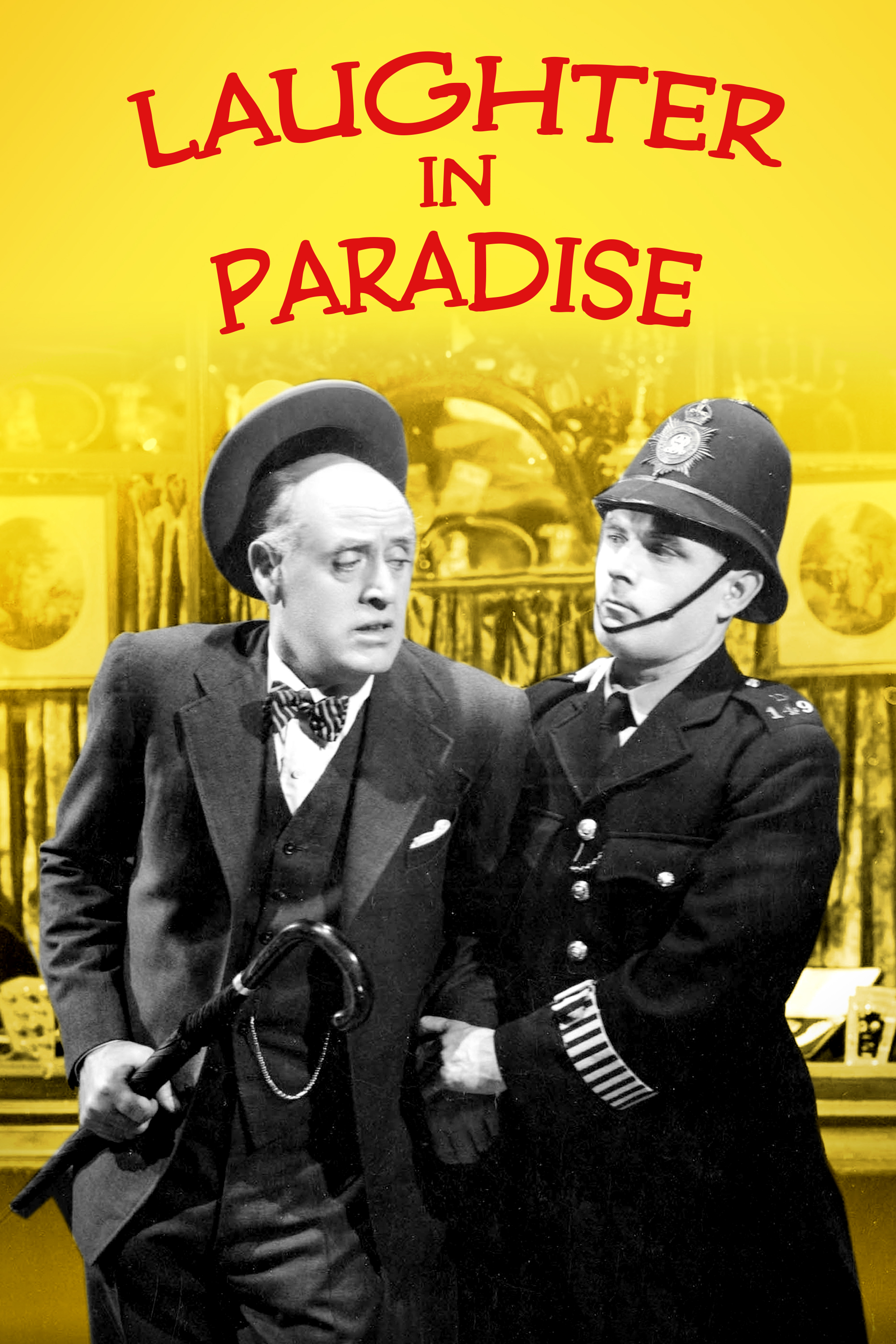
An old man (Hugh Griffith) lays dying – his death being notable, since he is Henry Russell, one of Great Britain’s most notorious jokers, having dedicated his entire life to elaborate practical jokes that defined his entire existence and made him something of a figure of notoriety. However, far from a selfish man, he decides to leave his entire fortune to his remaining four relatives, who are thrilled to hear that they are about to come into possession of quite a bit of money, as the old man was very wealthy. However, they’re aghast to learn that their inheritance comes with a caveat – Henry has left them each instructions on what they need to do in order to acquire their money, each one being tasked with doing something contradictory to their nature. Deniston (Alastair Sim), a well-regarded crime novelist, is told to commit a felony and be thrown in jail for no less than 28 days. Agnes (Fay Compton), a self-obsessed upper-class socialite, is instructed to seek out employment as a maid for a month. Simon (Guy Middleton), who has always depended on his resourceful nature and refusal to abide by the rules when it comes to women, has to start a long-term relationship with the first unmarried lady he encounters. Finally, the meek Herbert (George Cole) is told to go against his very introverted nature by robbing the bank at which he works. At first, these requests seem ridiculous – but considering they will forfeit their inheritance if they don’t agree to these tasks, each one of them goes against everything they hold sacred, all for the sake of a small fortune that they look forward to acquiring.
Laughter in Paradise is a film that offers the audience a good time, and very little else. The film, which is written by Jack Davies and Michael Pertwee and directed by Mario Zampi, is a charming comedy of errors focused on four distinct characters, united under exceptional circumstances, following them on their individual journeys to accomplish missions that are against their very nature. This is one of the many small-scale British comedies that were produced quickly and cheaply in the years following the end of the Second World War, occurring concurrently to the nation rebuilding, requiring works that are not particularly serious, and afforded viewers a brief moment of distraction – and as a delightful piece of gentle humour, Laughter in Paradise is just as charming and lovable as its title would suggest. If we look beyond the simple premise, we can see how effective this film is in conveying a particular message, especially in the more intricate details that co-occur alongside the more endearing subject matter that drives this film and makes it such a special production, even if it remains relatively obscure, joining the many comedies produced at this time that are wonderfully funny, but haven’t registered as classics of the genre, whether it be for the very simple premise that doesn’t stand out in an ocean of similar stories, or the structure that doesn’t come across as particularly ambitious – but for anyone who stumbles upon this film (or hears about it from the few but vocal supporters), there’s a true treat waiting for them on the other side of the film.
Zampi, who had his fair share of comedic work prior to taking on this film, deserves an enormous amount of credit, not only for working outside of his native Italy (a massive achievement considering how this is a comedy very much based on social and cultural quirks of the postwar era in Britain), but also in how he manages to tie together a rather complex script. The director shepherds four distinct stories into a single coherent narrative – Laughter in Paradise is very much composed of fragments working together in tandem, and the effortless style of telling this story without becoming too convoluted is paramount to its success. These are four individual narratives working together to create a particular tapestry of the social structure of Britain, while still being buoyant and hilarious – it’s a work of incredible skill, the kind that is so refined, we don’t even notice it on first glance, seeing this as a rather pedestrian work. However, Zampi’s directorial vision, while very simple, managed to add the many nuanced details to the proceedings in what is an undeniably thrilling comedy that makes us laugh just as much as it provokes thought, which is not something that could’ve been predicted based on a cursory glance of this film. Solely on the virtue of its intricate details that don’t manifest particularly clearly at first, Laughter in Paradise is a fascinating work of comedy – and through engaging with the more intimate aspects of this wide-ranging story, he produces something quite memorable.
Part of the appeal of Laughter in Paradise is the social aspect – it’s a film composed of many interesting characters that both have their own individual storylines, while still being woven into the narratives of others. Zampi employs an ensemble cast, anchored by four leads who are all equally excellent. The iconic Alastair Sim (one of the greatest character actors in the history of British cinema) is as jittery and lovable as ever, playing the dignified author who has to get himself arrested or forfeit his fortune. Fay Compton, one of the stage’s most accomplished actresses, is hilariously droll as the upper-crust spinster who is dedicated to honouring her inflated sense of ego, while Guy Middleton is a riot as the sardonic con-man and womanizer whose worst nightmare is having to commit to someone for life. Finally, the young George Cole is terrific as the shy bank clerk who has to overcome his milquetoast nature by robbing his own place of employment. This quartet of gifted actors are complimented wonderfully by the other supporting roles (amongst them Audrey Hepburn in her first credited screen appearance – even when playing a relatively tiny role, she manages to light up the screen), creating a tapestry of eccentric individuals that carry this story, embracing its small peculiarities and managing to be quite creative in how it presents these characters as more than just archetypes, a bold and daring choice that works beautifully well in the context of the film and its perpetual efforts to look beyond the social conventions that supposedly define a community, which is what this film is actively calling into question, albeit in a very roundabout, strangely absurd manner.
Despite being relatively unknown, Laughter in Paradise is such a delight, it’s difficult to imagine the reasons for its obscurity – it certainly has enough merit on its own terms to be more than just a run-of-the-mill comedy without artistic merit. Both on a narrative and technical level (in terms of how the film is put together), the film is a fascinating experiment that succeeds in nearly every area in which is pursuing some deeper truth. This isn’t a particularly serious work, but it does have some complex commentary on social strata and how the culture is never-changing in how it is constantly pursuing material wealth over human decency in many instances. Too lighthearted to be a preaching-filled parable, but also committed to adding nuance to a resonant story, Laughter in Paradise is quite a special film that works when it is embracing the strange, carnivalesque details of society, from which so many of the funniest moments at the heart of this film are built. Elegant, outrageously funny and always enthralling, Zampi made a delightful comedy with as much heart as it has darkly satirical humour, leading to a truly unheralded piece of storytelling that deserves a much wider audience, and an elevated reputation as an engrossing, delightfully camp black comedy with an abundance of wit and soul.
 The Postmodern Pelican