
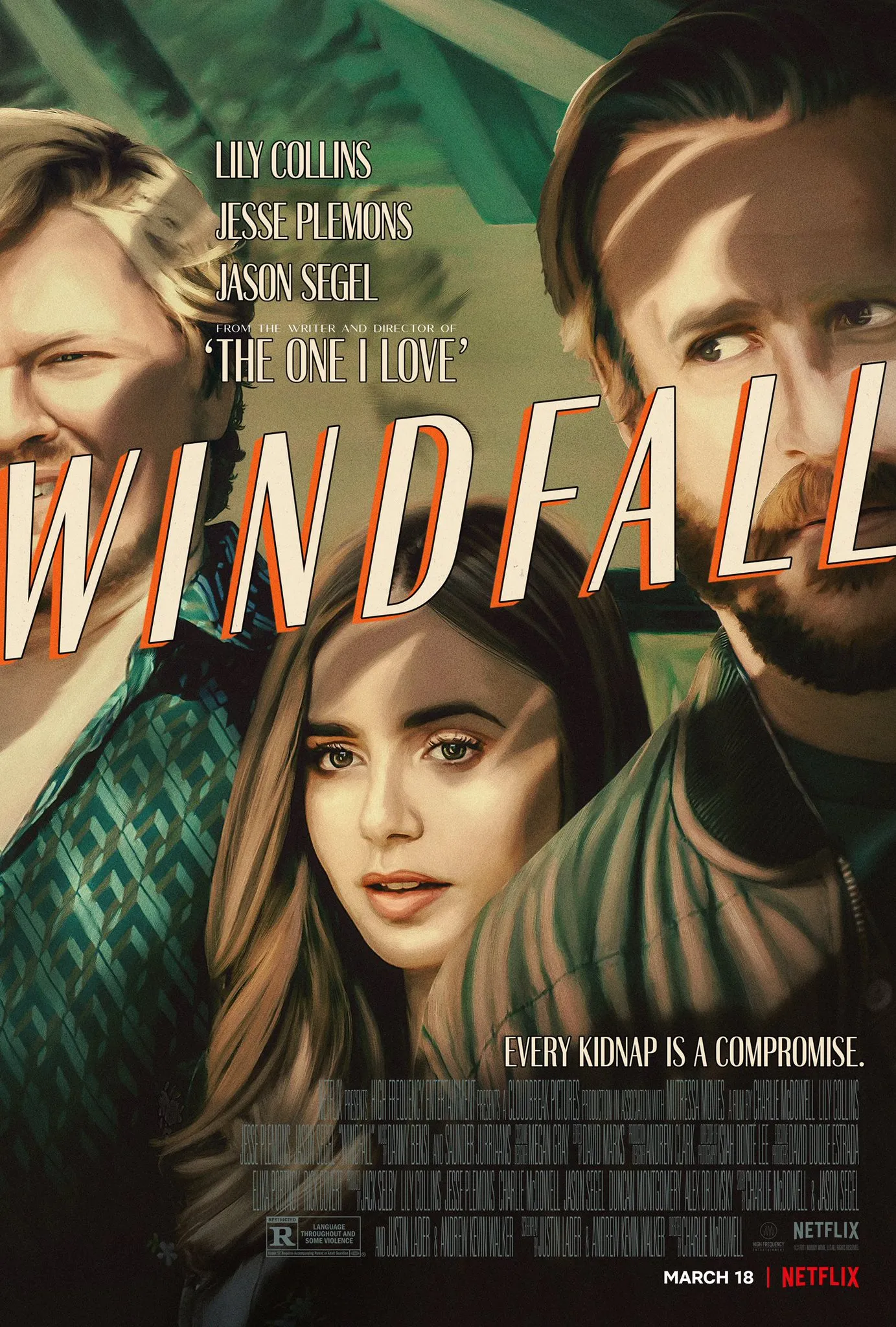
The term “Hitchcockian” is thrown around a lot nowadays (or at least since the great master departed this mortal coil and left behind an unimpeachable legacy). Essentially, any work that has a sense of foreboding dread and extreme suspense, as well as potentially a wicked sense of humour and an abundance of peculiar twists and turns is inevitably going to be compared to his work. Some of these associations are useful, others are far too tenuous. Windfall, the most recent film by Charlie McDowell, is somehow caught between the two, since many have drawn comparisons to this psychological thriller and the many great ones that came before it, all of which were either made by Hitchcock, or at least inspired by him. Perhaps starting this review with yet another instance of referring to the director when discussing this particular film indicates where I lie on this particular issue – and it goes without saying that, while it may not reach those impossible heights, Windfall is still a truly tremendous film, a sardonic and bleak crime drama that is filled to the brim with tension, which is undercut by an almost perverse sense of humour that reminds us of the inherent absurdity that was required to make this film, which serves as both a homage to the great psychological thrillers of the past, while forging its own niche place in the genre. It’s a challenging film, but the kind that rewards viewers who have enough patience to bear with this film to the end, watching as it goes to increasingly dark places within the human soul, all for the sake of this shockingly profound analysis of greed and desire.
On the surface level, it’s easy to overlook Windfall – it has received very little attention in terms of marketing, and nothing about it immediately strikes the viewer in a way that makes us rush off to watch it. Whether this was intentional or just the result of the film being buried (as is often the case with independent gems), it makes the film one that depends almost entirely on word-of-mouth, which is precisely how it came into my orbit. There’s something very sinister about the premise of the film – a mysterious stranger breaks into the summer home of a billionaire (who he assumes is far away at this particular moment) in the hopes of stealing a few prized possessions, only to be confronted with the owner and his wife, deciding to take a serendipitous vacation at a very inopportune time, leading to a couple of days of extreme tension and lingering danger. This becomes the basis for this incredibly dark exploration of human greed, told from the perspective of three distinct characters as they negotiate not only their terms and conditions for getting out of this situation as seamlessly as possible, but also doing their best to remain alive in the face of uncertain consequences. It is very much designed along the lines of small-scale psychological thrillers, being set within a single location, and featuring only four actors (none of which are ever given names, referred to merely as “Nobody”, “CEO”, “Wife” and “Gardener”) and focusing on the growing tensions that gradually start to emerge when any group of individuals are enclosed in a small space for a lengthy amount of time – and it converges into this bizarre but captivating drama that knows how to hold an audience’s attention and make us invest in this story.
The film was developed primarily by Jason Segel, who conceived of the story, and worked with McDowell and screenwriters Andrew Kevin Walker and Justin Lader to turn it into something coherent. Segel is naturally the best part of the film – mostly known for well-intentioned but otherwise inconsequential comedic roles, normally playing congenial and endearing characters, Windfall represents one of the few instances where he is able to show his dramatic talents, something that he has succeeded in doing in nearly every other occasion that called for more serious work. This is one of the first times he has been given the opportunity to use his hulking frame to play a legitimately intimidating character, with his “Nobody” being one of the strongest villains in recent memory, precisely because of how Segel embodies both the deep insecurities of this main, which lead to his violent and erratic behaviour. We often feel like we should be looking at the character through a different lens, not as a maniacal villain, but rather as someone who should be pitied, since his circumstances (while vague), do appear quite tragic. Contrast this with Jesse Plemons and Lily Collins, who play the rich couple who he holds captive for two days while awaiting the delivery of a large amount of money. Plemons hasn’t played a legitimately unlikable character in quite some time (having been typecast as principled but good-natured everymen), so to see him play someone who is truly despicable, almost to the point of becoming the villain of the film, was a terrific reminder to the fact that he too is capable of tapping into the darker side of his characters. Collins is mostly very subdued, playing the quiet wife who gradually starts to fall apart at the seams, a result of being forced to confront not only the reality of this situation, but also her entire life, which has lost meaning. It’s a strong cast, and the decision to keep it restricted to this central trio (as well as Omar Leyva, who enters very late and plays a small but pivotal part) adds to the terrifying nature of the film.
While it may be a really effective and enthralling film, Windfall is not without its flaws, especially when it comes to the early scenes, where the foundation of the film is established – the audience is asked to suspend disbelief (such as in the case of wondering why the main character didn’t just retreat when he had the opportunity, which the film doesn’t do a good enough job of explaining), which can sometimes be tricky when a story is intent on hinting towards some more poignant subject matter. There’s a severe disconnect between reality and fiction in the film, one that isn’t necessarily fatal to the film, but does show that it required more work, at least in terms of its theoretical basis. These stories are not uncommon – we’ve seen tense thrillers about greedy individuals going for broke and making sure they emerge successfully as a result of the risk, and this film doesn’t necessarily do anything all that differently. However, where it succeeds is in the small, intricate details – the performances are very good, but they’re only the start, with a lot of what makes Windfall so effective coming through in the tone, with the director grappling that razor-thin boundary between absurdity and terror, which ultimately informs the vast majority of the film and makes it such a unique reconfiguration of a genre that has been explored to seemingly its full capacity. McDowell is a very gifted director, and while his body of work may be relatively small in comparison to his peers, he has produced extremely strong work that showcases his deep and unflinching talents, with his prowess being one of the key elements to the very strong aspects of this fascinating but uneven film.
Windfall is a very measured film – it moves at a slow pace, but never to the point that it feels overlong (and at only 92 minutes, it feels even briefer than it should), with the first two acts being intentionally laboured, so that the third act (when we see the first glimpses of action) register as jarring and effective, much more than had they been featured towards the beginning. As a whole, the film is a strong effort, the perfect diversion from reality, tied together in a way that forms a very compelling psychological thriller, which emphasizes both sides of the term – it uses a very complex crime plot with several twists and turns to not only entertain the audience, but also take a deep voyage into the minds of these individuals that populate the film. As a result, Windfall is as much a crime thriller as it is a character-driven drama, a glimpse into the modi operandi of people compelled towards madness as a result of their excruciating inability to adhere to the status quo – it can be quite unsettling at times, but there’s a reality underlying the film, one that could’ve actually been further explored (since the final act is far too brief, with everything happening much too quickly). It brings up ideas of ethical consumption under capitalism, the role of individuality in the world of business, and, perhaps most importantly, the tendency for many people to take their privilege for granted, which can drive others to act out in increasingly hostile ways. Dark, brooding and always fascinating, Windfall is one of the year’s most intriguing films, and one of the few that seem to genuinely earn its mettle as an entry into the canon of Hitchcock-inspired works.
 The Postmodern Pelican