
Growing up is difficult already, so having the constant threat of inter-faith violence lingering over your quaint Irish neighbourhood is not the most pleasant experience for a young boy trying to make his way through a world he has barely begun to understand. This is the starting-point for Kenneth Branagh’s Belfast (quite literally, with the film beginning with one of the many violent riots that terrorized neighbourhoods during the Troubles), his profoundly touching semi-autobiographical film that traces the life of a child growing up in Belfast during an era of profound social and political unease, where his faith was something that he and his family felt they needed to hide to avoid becoming yet another casualty in the frequent bursts of violence that occurred between the Catholics and the Protestants, who somehow constantly failed to find a way to live together peacefully, resorting to barbaric riots, to which Branagh was unfortunately a first-hand spectator. Belfast is not a perfect film – there are flaws that constantly persist throughout the film, suggesting that the director (who is notoriously prolific, but not necessarily particularly versatile when venturing out of his comfort zone) perhaps needed to refine a few of his skills before telling this fascinating story – but it’s one that touches on some very deep issues that are filtered through Branagh’s own perspective, being his most personal work to date. I’m hesitant to lend this too much credence – he succeeds more frequently with either his Shakespearean adaptations (leading to the often misguided belief earlier in his career that he was “the new Olivier” rather than a unique artist on his own terms, an epithet that has haunted Branagh for decades, culminating in the actor playing the esteemed thespian a decade ago) or his more ambitious projects – but it’s difficult to look at Belfast and not be thoroughly charmed. It’s slight and probably more minor than a film of this scope should be, but it’s foolish to think that there isn’t value in this story, especially when it comes to the small details, which help compensate for the more glaring shortcomings.
Over the decades, many of cinema’s greatest voices have put pen to paper and attempted to tell the stories of their childhood – it almost seems as if it has become a rite of passage for great filmmakers to curate films that are thinly-veiled recreations of their upbringing, where both the specific events of their early years, as well as the socio-cultural milieu, were the impetus. Belfast is yet another entry, being Branagh’s attempt to leap into the past and construct a version of his life, where his younger self is replaced by the character of “Buddy”, an impressionable young boy who may be timid, but has a fierce confidence that is waiting to burst out once he has the opportunity. The coming-of-age narrative is one that is essentially as old as literature itself – there’s something so profoundly moving about a story that centres on younger characters, with the perspective lent by more youthful protagonists lending the viewer new insights into the world, especially for a film as intrinsically tied to a time and place as Belfast, which is as much about Branagh’s own childhood as it is about the environment in which he was raised, a single street in working-class Ireland that was home to individuals of numerous backgrounds, where the division was widespread, but the underlying unity that existed between them being of much more value. There’s nothing quite like seeing the world through the eyes of a child, as everything is bigger and more intimidating, but also covered with a sheen of sincere optimism, which may become battered and beaten through a variety of events, such as violent riots and the possibility to leaving this pleasant life behind in favour of starting afresh in another part of the world – but it’s never once broken, which seems to be a common quality in these autobiographical tales of childhood, which tend to be a lot more touching when the director is telling a genuine and interesting story, which is certainly the case with Belfast, which always has its heart in the right place, for better or worse.
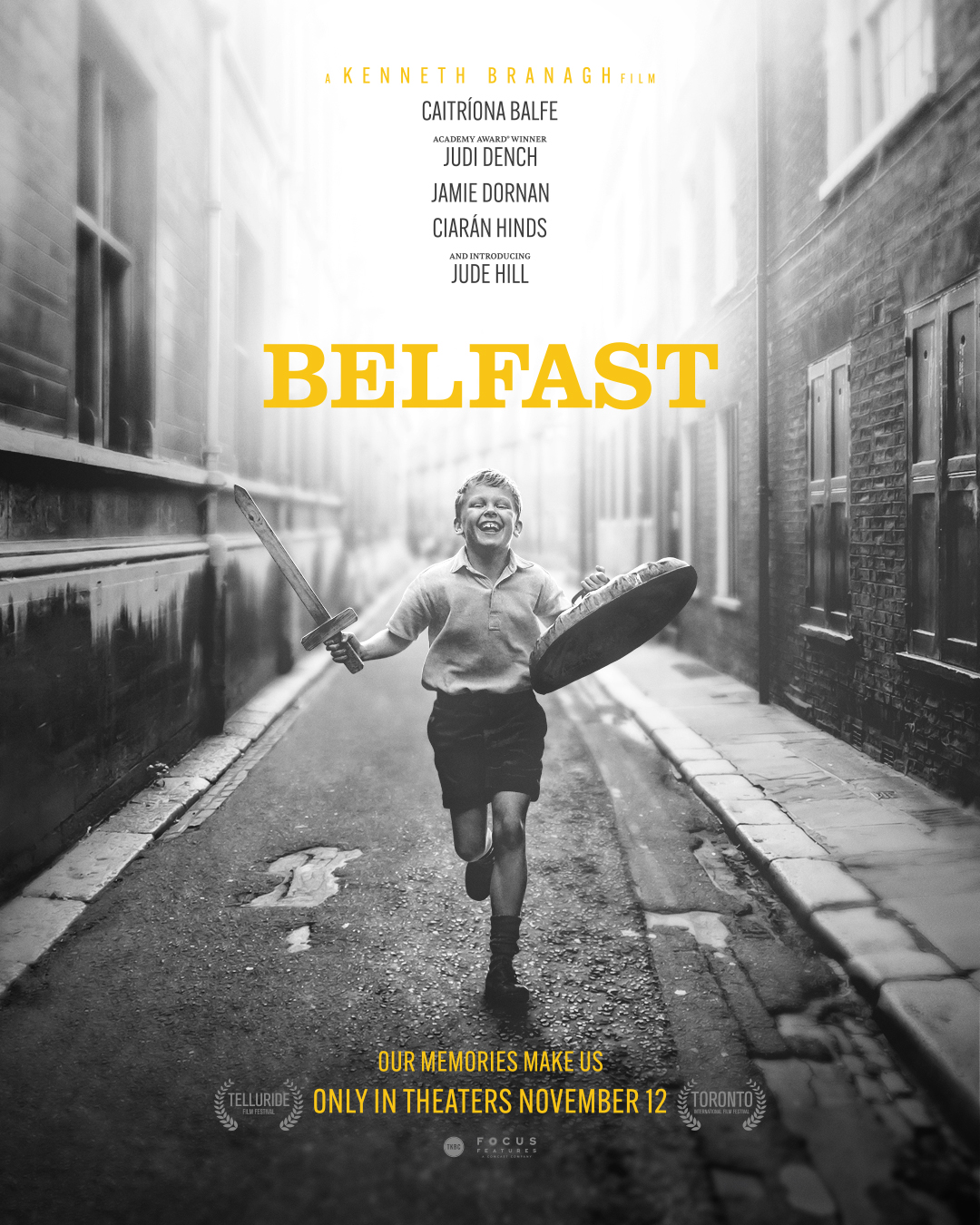
Characterization is pivotal to Belfast, a film that frequently feels as if it is plucking scenes directly from the memory of its director, who constructs a fascinating working-class tapestry purely through the versions of his family and friends that make up the film. Buddy, the surrogate for the director as a child, is as charming and endearing as a young protagonist can get, with Jude Hill playing him as the rambunctious, spirited 8-year-old we’d expect, never needing to be too overly precocious, and instead being allowed to simply play a child. Hill is the heart of the film, but the most interesting performances come in the supporting cast, with some of the United Kingdom’s best actors taking on pivotal roles that feel tailor-made to their sensibilities as performers. Judi Dench (who certainly does not need any introduction) and Ciarán Hinds are the veteran performers that lend their years of experience to playing Buddy’s grandparents, while Jamie Dornan and Caitríona Balfe, who have been working steadily for several years now, are his parents, the latter in particular being the embodiment of elegance and ethereal grace – you can truly tell that Branagh adored his mother, and Balfe captures the spirit of a woman caught between tradition and modernity with such gracefulness, easily stealing every scene of the film she is in. The ensemble of Belfast is truly splendid – everyone is doing wonderful work, and while they may not be extending themselves too far beyond what we’d expect from them as actors, its the small details in these performances that ground the film, every movement and line of dialogue hinting at something deeper, some of which become vital to later developments in the film. They’re simple but affecting performances that constantly work to the benefit of the story, which depends almost entirely on the audience’s ability to believe that we’re witnessing a realistic family saga, rather than merely an artistic construction.
Interestingly, outside of a few minor characters (such as fellow children, and a few arbitrary troublemakers), none of the characters in the film are given names outside of the protagonist – Buddy’s parents are simple “Ma” and “Pa”, and his grandparents as “Granny” and “Pop”. This is a small but pivotal detail, and helps us realize that Belfast is presenting a singular view of childhood, where the world is so enormous, and where no one other than one’s friends even have proper names – navigating the world is difficult for any young child, and whatever flaws exist in Belfast, they’re certainly not glaring enough to detract from the very genuine and tender emotions that run through the film. Inarguably, some of the commentary is quite heavy-handed – Branagh has never been a director with a particularly effective approach to the emotional content of his films, which can often be quite overwrought, especially when they’re touching on very important subjects. Belfast is sometimes quite inconsistent, and often feels severely rushed, with the director’s attempts to compress far too many themes into the film’s paltry 98-minute running time leading to a lot of inconsistencies, particularly in how some of these situations develop – it almost feels as if Branagh was inspired by kitchen-sink realism (both visually and narratively), but forgot to add the depth that made that such a revolutionary movement, instead working on a set of surface-level conversations that may not be particularly deep, but do still contribute to the general message of the film. It isn’t helped by the fact that this is one of the instances where a film is shot in black-and-white without an apparent reason, only made more puzzling by the fact that cinematographer Haris Zambarloukos (who has shot some stunning films in the past) doesn’t do anything particularly strong with the format, several of the most important moments in the film losing its impact due to both the heavy-handed commentary, and the flat visual scope that slightly betrays the overall message of the film.
As a social realist text, Belfast is not always particularly effective, but it has a kind of genuine charm that sustains it and makes it quite special, even if there are a few too many flaws embedded in the film. These shortcomings are clear and unavoidable, but mercifully they aren’t impossible to overcome, and the heart of the film is so much more riveting than any of the problems that afflict it. Perhaps not a definitive film, but rather one that is comforting, endearing and beautifully poetic in how it addresses certain issues, Belfast is a triumph, one that may be a lot minor in comparison to several recent directorial efforts that find filmmakers using cinema as a medium to explore their own pasts, but still carries value in how the heartfulness ultimately trumps any superficial problems that may persist throughout the film. Branagh is certainly a director who has had a career that is best defined as hit-or-miss (emphasis on the latter), but this is one of the instances where it seems like he is genuinely in control, and doing something with authentic artistic resonance, rather than relying on old conventions in his genre-based efforts. Not a perfect film, but one that has enough soul (and an abundance of Van Morrison needle-drops, so any aficionado of the Irish crooner is certainly going to find themselves enjoying this film) to maintain our interest, granted we have the time and patience to just allow this film to get to the point that it is making, which really only happens in the final few scenes, but are undeniably worth the time it takes to get there, since the emotional pay-off, whether manipulative or not, warrants the effort. Belfast is a decent effort from a director who sometimes veers too close to ineptitude, so it is truly refreshing to see him make something much stronger (granted, it is difficult to do an injustice to one’s own past), and the wonderful and heartwarming moments that accompany it only sweeten the deal and make Belfast a charming and lovable little comedy about enormous issues.
 The Postmodern Pelican