
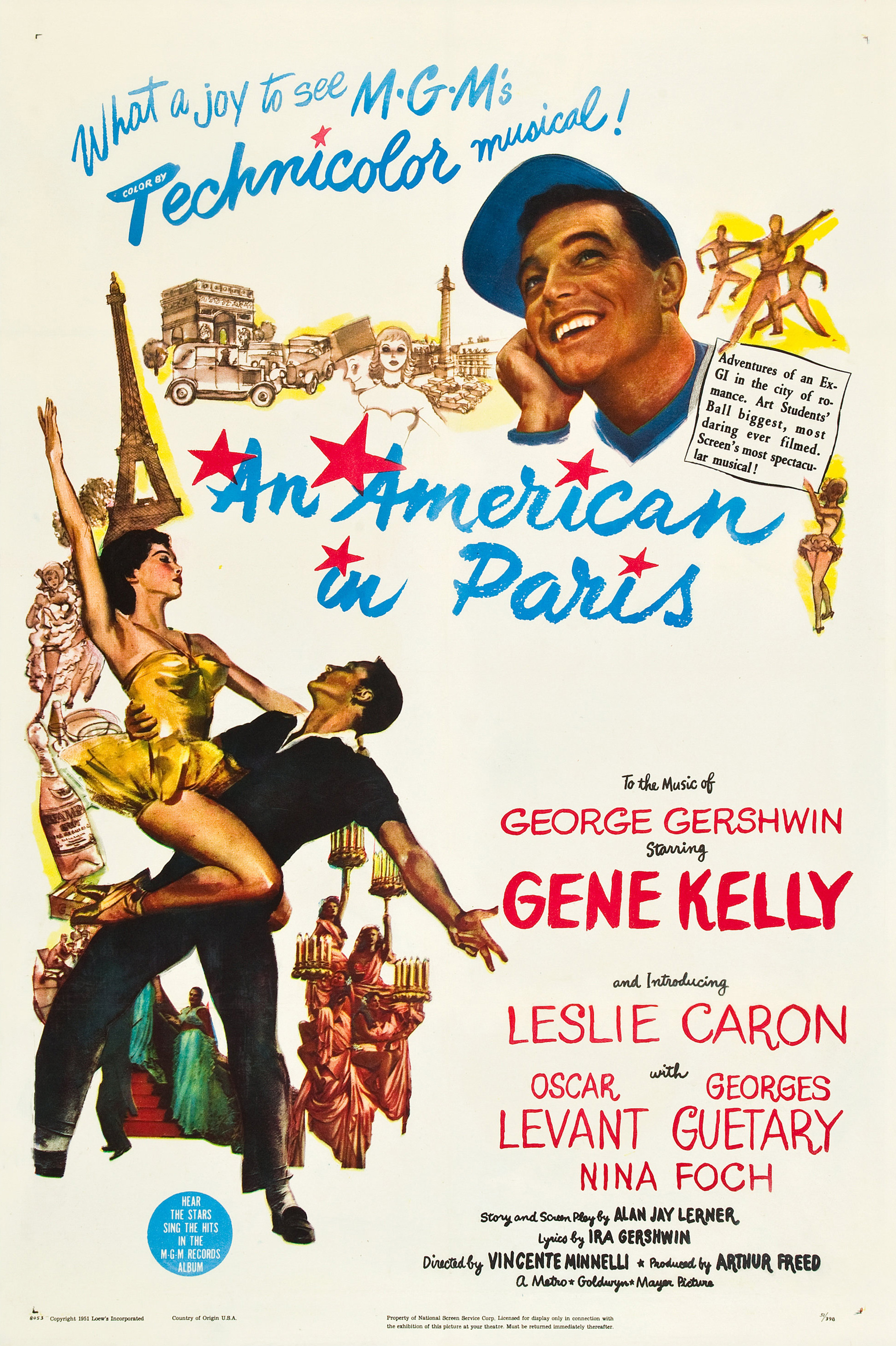
Whether or not you find his particular brand of filmmaking effective, there are few names that evoke the idea of quality quite as much as Vincente Minnelli, whose career is filled to the brim with every kind of film, ranging from big-budget musicals to lush melodramas, intimate character-studies and barn-burning extravaganzas that have solidified their place in the canon of unforgettable cinematic experiences. A rather prolific director in his own right, Minnelli produced a steady stream of fascinating films while he was at his peak, amongst them a few definitive masterpieces that embody his full range of talents. An American in Paris is often considered one of his greatest works, an elegant and exuberant musical comedy that blends romance and humour in one memorable package. There is very little room to find fault in this film – each frame is filled with passion, the result of impeccable craftsmanship, the story is thrilling and the romance is enough to make even the most cynical viewer’s heart skip a few beats. An American in Paris isn’t just a masterpiece – it’s the gold-standard for the broadly-embraced concept of the MGM musical, which carries a reputation for entertaining audiences across every generation as they wove their way through these dazzling, colourful worlds – and at the forefront of all of this were a few key artists that put every iota of their creativity and imagination into telling a truly unforgettable story that might be slight when taken on its own, but rises to the point of being absolutely delightful when coupled with the masterful filmmaking that encompassed this tremendous film.
Imagining an MGM musical without Gene Kelly is challenging, even if there were countless made without his involvement. The more I venture into every corner of his career, the more convincing the argument that he is possibly the greatest physical performer in the history of Hollywood becomes – his ability to not only move his body in ways that can only be described as hypnotizing, while still being the epitome of charm and candour just solidifies every bit of acclaim he received throughout his prolific career. Kelly and Minnelli, who both defined a particular era in musical filmmaking, were a match made in cinematic heaven – they were both capable of making great musicals independently, but their work together produced pure magic, each bringing their own unique skills to the process and collaborating in such a way that they liberally sample from each other, which was especially strong considering how both artists were at their creative peak during this period. In his capacity as both the film’s central star, and the choreographer for the several elaborate musical numbers, Kelly was just as involved in adding his authorial vision to An American in Paris as the director, who functions mainly to give the film its distinct appearance, and simply capture the pure madness that emerges when Kelly starts to move his feet – not many filmmakers were able to harness the actor’s energy in such a way, so even if we view this film as mainly a vehicle for Kelly, Minnelli’s work behind the camera is just as impressive, both stylistically and functionally in how it grabs our attention.
Yet, there is so much more to An American in Paris than just waxing poetic about how talented Kelly was, and how he could do anything on screen and still be profoundly captivating. This film functions as a whistle-stop tour of some of George Gershwin’s most memorable music, using many of his most iconic songs in a way that is effective in progressing the plot, even when the story is designed to complement the music (rather than the other way around). There’s a perfect symbiosis between visual splendour and the aural bliss that comes from hearing these impeccably-composed songs performed – whether containing lyrics or simply instrumental accompaniment to the awe-inspiring feats of human movement conducted through well-choreographed dance numbers, Gershwin is paid adequate tribute by this film, which uses his music to tell a compelling story. It’s not often we find cinematic works being so enveloped in the musical side of their story that the entire film can be defined by these melodies (since even the most popular musicals tend to be propelled by the story), with An American in Paris being the rare spectacle that is all focused around the music – everything else is simply in service of the legendary composer, whose work is committed to film in a way that it’ll remain indelible, leaving a portion of his legacy intact for future generations to experience the pure exuberance that emerges as a result of his musical genius – and yet, the film never feels as if it is solely intent on honouring him, using his music to tell a universal story, more than just paying homage to his artistic output.
Artistic freedom was always one of the most primary components of a Minnelli film – his work had a certain vibrancy that came through the director’s very unique gift for storytelling through both the narrative and visual medium. As enticing and compelling as the story at the heart of An American in Paris may be, no one leaves this film only remembering the plot mechanics. They serve to buttress the creative flights of fancy taken by the filmmakers in creating this beautiful world, rather than standing on their own – and while this does sound like a criticism (or an excuse for paltry storytelling), this could not be further from the truth. Instead, An American in Paris is a film driven so deeply by the visual spectacle, both the aforementioned dance sequences that keep us engaged, and the more stagnant production design that immerses us in a faraway version of Paris, the kind often confined to films such as these. Undeniably, Paris is a beautiful city, and Minnelli and his cohorts do well in replicating it (using nearly four dozen sets built in Los Angeles, rather than filming on location in Paris – but it would take the most eagle-eyed viewer to actually be able to tell the difference), offering a fantastical depiction of the City of Love that serves as the setting for some of the most gorgeous and striking scenes of this era. An American in Paris is a cinematic experience in every sense of the word – the production is so lush, the film positively bursting with the brightest, riches colours that work alongside the other artistic elements to create such a beautiful landscape. If there is something we can credit to Minnelli it would be that he never spared any expense, and always committed to portraying his stories in as vivacious and intricately detailed a way as possible, which is undeniably true for this particular film, and almost everything else he did in his fascinating career.
From beginning to end, front to back, upside and inside out, An American in Paris is an absolute marvel. This film is the perfect example of a director simply surrendering to the madness and delivering a work that is inspired by nothing but the most effervescent and far-fetched ideals imaginable. It borders on absurd at times, and certainly doesn’t ever propose to be entirely realistic at all – but this is all part of the charm, since the film is driven by an otherworldly mystique that keeps us enthralled throughout. They simply don’t make films like An American in Paris anymore (although not for a lack of trying) – the sheer joy that exudes from every frame, the relentlessly captivating spectacle that comes through in each artistically-resonant choice, and the endlessly creative methods of telling this story all lead to a truly enthralling, captivating story of love and desire, set in arguably the most profoundly cinematic city in existence. Minnelli receives a lot of acclaim for his wide body of work, but it has always been his musicals that have stood head and shoulders above all the rest – and in collaborating with someone as creative and brilliant as Gene Kelly, who brings with him his own unique set of tricks that make for captivating viewing. There are few words that can accurately summarize the impossibly brilliant world of An American in Paris, which remains a film that has to be experienced firsthand to understand the true extent of what can be done with the most simple, elegant of artistic tools, and how pure magic can be spun out of movement, music and a story well told.
 The Postmodern Pelican