
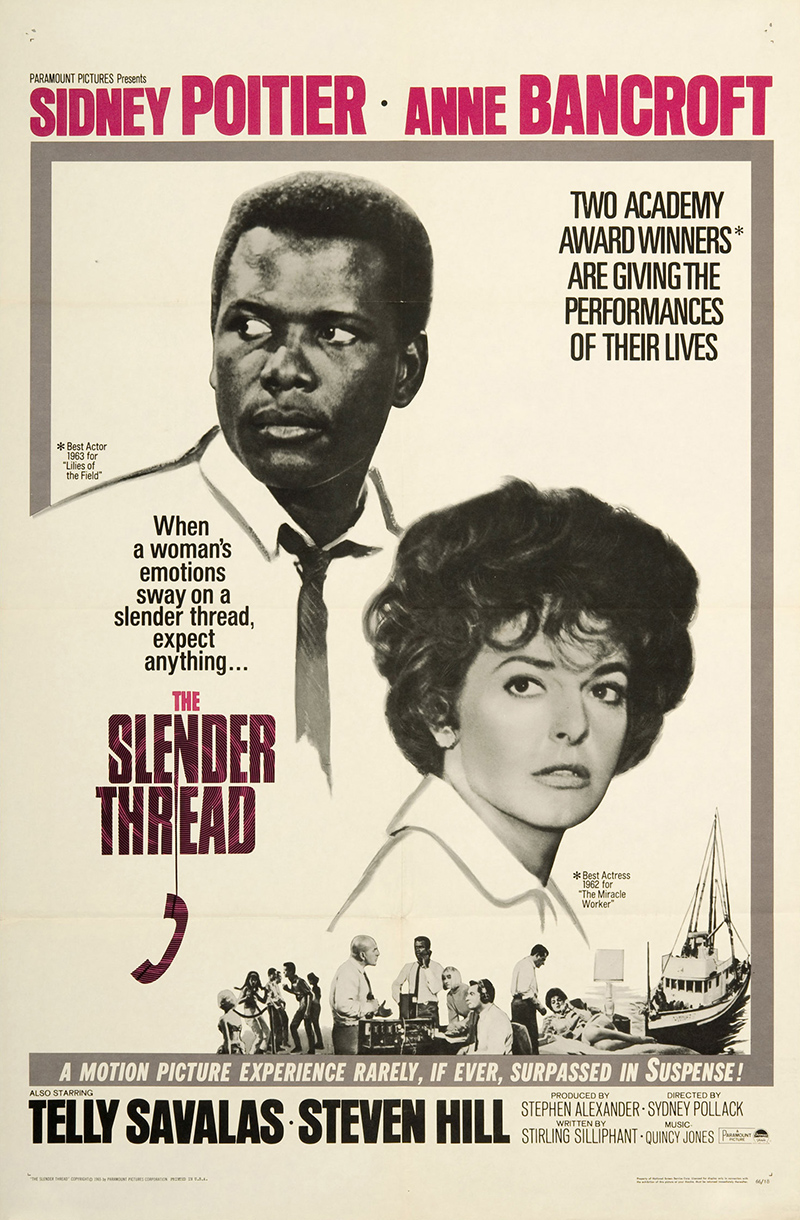
Art loves a crisis. There’s something about a person (or several) being in peril that inherently fascinates us and keeps us coming back, especially when it is in relation to the movies – from horror to action, comedy to melodrama, people facing adversity is the foundation of the film industry in one way or the other. We’ve seen every kind of valiant hero stake their claim to become the epitome of courage and valour across many different films over the years. However, what we don’t see all that often are the people in behind the scenes, many of whom are just as heroic, if not more so. In recent years, we have become more aware of the importance of first responders as a multimodal group of people responsible for keeping our society safe, and an important component in this carefully-structured social system are the people simply tasked with answering the phone, which is often the first point-of-call for any emergency. This is where we can start discussing The Slender Thread, an enthralling film that combines psychological thriller and social issues drama by telling the story of a young woman driven to an attempt to end her life, and the operator at the suicide hotline who she calls to talk to in her dying moments. The directorial debut of Sydney Pollack, who would go on to make some of the greatest films of the New Hollywood movement and beyond, and inspired by an article in Life magazine that covered the trials and tribulations of those that work for crisis centres, The Slender Thread is a remarkable film, a carefully-constructed drama that looks at a few pivotal themes that both situate it at a particular moment in time, as well as being a universal story, since it touches on issues that are as resonant today as they were at the time of production. A deeply inspiring but complex existential odyssey, the film is a remarkable piece of filmmaking that may be simple on the surface, but contains enough emotion and nuance to fully capture our attention when it matters.
Even by modern standards, the premise of The Slender Thread is quite ahead of its time, since contemporary media is still somewhat hesitant to address the subject of mental health and suicide in a way that draws attention to the issues, instead choosing to skirt the issue rather than exploring the circumstances a huge portion of the population find themselves having to endure. For a film produced in 1965, the film is remarkably light on its feet when it comes to handling the more serious social commentary. The subject matter of this film is far more complex than many mainstream studios may have been comfortable with at the time – after all, it is a deeply melancholy story of mental illness where the victim nearly succeeds in her quest to end her life, which comes at the end of a labyrinthine series of moments in which he makes her conviction to die more than clear, while quietly terrorizing the young man on which she’s placed this unreasonable burden, who in turn has to scramble to help save her life. Its heavy material that is not helped by the real-life situations that surrounded it, with the tensions that simmered both domestically and globally leading many Americans to fall into a state of deep despair, a byproduct of the post-Second World War era, which brought as much prosperity to the country as it did uncertainty, especially with the constant threat of further violence caused by international diplomacy, or rather the lack thereof. It might not seem obvious, since it is essentially the story of two individuals speaking over the phone for the most part, but these tensions and quandaries are carefully woven into the fabric of The Slender Thread, which explores the rising concerns faced by many ordinary citizens, who find themselves frequently questioning their own sanity. This is the underlying conversation evoked by this film, which is done through a masterful control of both tone and content, leading to an exhilarating exploration of the human condition.
It was not uncommon to find morality tales and dramas fueled by social and civil issues produced during this era – the rise of the after-school special, combined with a more socially-conscious approach to artistry, led to many films like this being produced, especially considering how cheaply they could be made, and how many notable actors were willing to lend their talents for a quick paycheque and some self-serving clout for helping bring awareness to particular issues. It would be foolish to think that The Slender Thread is much of a deviation, since it was fashioned as a film done to draw attention to a major theme, which it did through a very simple and relatively inexpensive approach. However, the film does carry a lot more weight than merely being a chance for two major actors to turn in reasonable but unremarkable work. In many ways, The Slender Thread plays like a psychological thriller, carrying overtones of film noir (whether intentionally or not), as we watch these two individuals with wildly different intentions for this particular evening interact and force the other to change their mind. One of them is convinced she wants to die, the other fervent in his belief that she should live, and both will do whatever it takes to accomplish this goal. The film thus has two very different narrative channels – the first being a complex character study of this young woman who intends to end her life, told mostly through flashbacks that fill in the details as to why she has been driven to this point. The other is a procedural drama, where we watch the crisis centre hotline operator and his team use every resource they can to track down this woman and save her, each new detail they encounter through their conversation being an additional piece of this psychological puzzle. The two work together in perfect symbiosis in the creation of this intricate and compelling drama that has numerous layers, all of which are perfectly captured by Pollack as the story unfolds.
As a character-driven drama, it was vitally important that The Slender Thread had strong performances occupying the two main roles, especially since everything that makes the film so enduring comes through in the interactions between the leads, who depend on one another to make this complex story work. The film is the result of the magnificent collision of talents between Anne Bancroft and Sidney Poitier, two of the most remarkable actors of their generation, who unite under Pollack’s director to tell the story of these two lonely individuals who find themselves becoming part of each other’s lives, solely through the telephonic channel, as they discuss, debate and plead for their specific position on a deeply unsettling issue. They manage to turn in quite impressive work, even if it isn’t necessarily complex work, at least not in comparison to the kinds of characters they were playing during this era. On a purely technical level, neither of them had particularly challenging characters – but yet, through their undying devotion to telling this story, they somehow manage to rise above the more paltry material, getting beneath the skin of these characters and making them fully-formed individuals. The story is simple, but through their spirited work, we hold onto every word they say, each new detail adding layers to these fascinating characters. The Slender Thread fits in well with both actors’ own liberal leanings, as evident by their many years of doing socially-charged work (some of which was even produced concurrently in this same year, with 1965 being a notably busy time for both actors), and their ability to provoke thought with even the most opaque characters, who are rendered as exceptionally complex when filtered through their own unique perspective, and in turn they’re provided with the chance to show why they truly were amongst the greatest artists of their generation.
The Slender Thread is not a perfect film – inarguably, it can be quite clumsy with its methods of addressing certain issues, and it sometimes feels as if it isn’t giving too much perspective to the roots of the main character’s mental illness, and why she has been driven to that point, presenting her as erratic from the outset. However, it is a product of its time, and the fact that it showed a willingness to even have these conversations in the first place is beyond impressive and should be noted long before we pay too much attention to the small flaws that populate the film. The Slender Thread is an intriguing film, a daring and tightly-woven drama that plays like a thriller, keeping the viewer on the edge of our seats – much like Poitier’s empathetic crisis hotline operator, we’re invested in the story, accompanying him on his journey to feverishly save the life of a woman he does not think genuinely wants to die. There’s a razor-thin boundary between a suicide attempt and a cry for help, and this film looks at “slender thread” with a fervent dedication that makes it such a profoundly moving text. We’re constantly questioning the motives of the characters, with Pollack refusing to resort to archetype, and instead frequently developing both protagonists as complex individuals – and it makes for an engaging, bold psychological drama that provokes discussion on matters that still remain relatively taboo, even by contemporary standards. The Slender Thread is a masterful film, an audacious debut for a gifted young director and a brilliant showcase for the two lead actors, who prove their mettle in being able to keep us invested in a story that is essentially just a pair of individuals talking on the phone, but somehow comes across as incredibly potent and unquestionably interesting, all of which results in this stunningly profound glimpse into the darker side of humanity, and the challenges many face when they start to feel that life is getting slightly too overwhelming for them to handle, and the people who are often there to help them work their way through these difficult situations.
 The Postmodern Pelican