
There are many ways to look at life, but perhaps the most effective way to describe it is that we exist to tell our stories in various forms, since we all have individual journeys that make for profoundly moving narratives when we look at it from an outside perspective. In this regard, one of the most fascinating stories is that of Amin Nawabi, whose life has been a neverending series of movements, taking him across entire continents as he escapes hostile social and political issues that have torn apart many families similar to his own – and it serves the foundation for Flee, one of the year’s most daring and accomplished achievements. Venturing from his native Afghanistan in the 1990s, and finding his way to Europe, with the help of a variety of unsavoury characters that help him and his loved ones evade the draconian authorities, his life is incredibly powerful, showcasing the importance of tenacity and persistence, and proving that the human drive to escape danger has not disappeared in our evolutionary genre, as demonstrated quite clearly by his efforts to survive by any means necessary. Heartbreaking but uplifting (often at the exact same time), Flee is an absolute masterwork, the kind of documentary that may seem simple at the outset, but proves to have a complexity embedded deep within it that is almost impossible to overlook, especially when the subject’s story is told by someone who is intent on committing this incredible story to film in a way that will not only inspire the viewers of today, but also preserve it for future generations to get a glimpse into the past, as dictated by someone who endured some of the most unsettling experiences as a result of his natural instinct to simply flee from danger, refusing to become the hunted, and in the process finding a deeper resolve that ultimately coalesced in this stunning film.
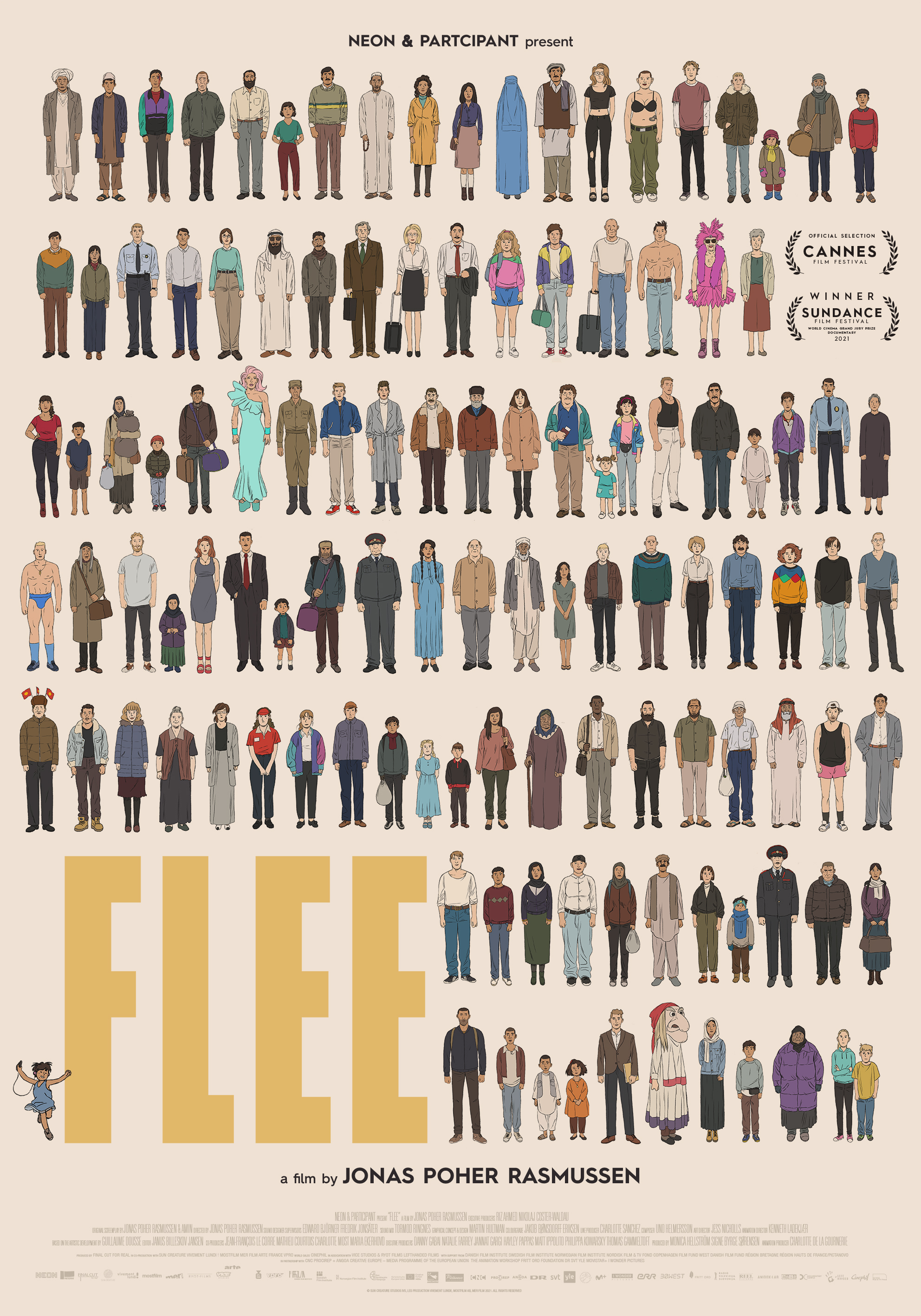
Amin’s story is undeniably remarkable, and therefore required a film that would reflect the same unique qualities that inspired Jonas Poher Rasmussen to have his story recorded on film. The director did this in a few ways, particularly in the use of a medium that is rarely utilized when it comes to documentary filmmaking – Flee is almost entirely animated, with the film being guided by a series of conversations between the director and Amin as he tells his story, which Rasmussen then uses as the foundation for a thrilling odyssey that sees him recreating the scenarios described by the protagonist, taking him back to his childhood and depicting his experiences in the form of a visual diary that accompanies his testimony. In lieu of the actual footage, the approach of taking this story and using it as the foundation for one of the rare instances of an animated documentary worked out tremendously well, especially in how Rasmussen never oversells the concept, rarely making it about the spectacle or his own directorial prowess (which pales in comparison to the story being told), but rather that he, much like many who have had the fortune of hearing Amin describe his decades-long journey, found so much value in the small details, so much that he took the subject’s experiences and repurposed them into a masterful, thrilling work of art, one that actively works alongside Amin’s spoken narrative (which is the most distinct and vital element of the film, the director ensuring that attention is always drawn back to the source), with the innovative structure being supplementary to an already riveting story, which is in turn elevated beyond a mere discussion between two individuals, and turned into something even more special, handcrafted with nothing but love by a director who clearly cares deeply about the man whose life inspired this stunning socio-cultural odyssey.
The refugee crisis is a subject that has been the source of many fascinating and heartbreaking films for the better part of two decades now (if not even longer), with the idea of individuals from nations torn apart by war or other socio-political issues fleeing their oppressive home countries and finding safety in distant lands that harbour them the hope and freedom they could not find at home being one that has dominated our consciousness. Flee adds to this remarkable canon of films, which are often some of the most moving, since they touch on very real issues in a way that feels genuine and insightful. The obvious difference between this film and others that tell similar stories is that this is an animated documentary – but it extends far further than that, with the decision to recreate the main character’s past through animated scenarios giving the film a very distinct appearance, one that is more akin to a work detached from reality, which only makes its heartwrenching message so much stronger, since there’s a dissonance between the bleak story being told, and the very simple but evocative drawings that one might imagine would soften the impact of the narrative, but actually surprisingly makes it even stronger and more challenging, since presenting as haunting a story as that of Amin in the form of an animated film prevents the harrowing facts from being concealed – instead, the director engages with them directly, using the subject’s testimony as the guiding force for his deep exploration of his life, bringing it to life in a way that leans into the more abstract ideas that govern the film alongside the deeper social and cultural elements, showing how Flee was about more than just the refugee crisis, but a potent and resonant voyage into the heart of the human condition.
Flee is a film that demonstrates the incredible power of a tale well-told, and the director doesn’t neglect to show how, despite the very expansive subject matter, that Amin’s life was not representative of the entire refugee crisis, but rather one example of far too many people who had to leave their homes to seek a better life elsewhere. This is a film about storytelling, with the focus on Amin’s narrative being the foundation of the entire project. There’s a mythological quality to Flee that comes through in the decision to centre it almost entirely around Amin’s story and reconfigure it into an animated format (with the visual landscape evoking the idea of a storybook coming to life). This is a result of Rasmussen allowing the subject to tell his story in his own words, not acting as a director making a film about this life, but rather a companion with which he can talk and pore his entire heart out, knowing that this honesty will only converge into a very resonant story of desire in its various forms, namely that of the need to escape, and the allure of foreign lands that not only yield better opportunities, but simply a pathway out of a hostile, dangerous situation. Rasmussen seems to have authentic compassion in the story, genuinely taking an active interest in Amin’s story, and using it as the foundation for an extraordinarily delicate glimpse into a much wider social milieu. These stories can sometimes be quite overwrought, which is one of the more significant problems with any film focused on some worldwide crisis or event, so this film was doing its best to tread carefully through the lives of these individuals, as shown through the perspective of a man who experienced some of the most harrowing conditions in his efforts to simply survive to see another day, which is a legitimate concern for many people who find themselves in difficult circumstances, especially those that consistently feature the threat of violence against whatever innocent people don’t manage to escape in time.
This is a remarkable film – as a documentary, Flee is absolutely heartbreaking. The story of Amin Nawabi is one that strikes a very resonant chord with anyone who has even the vaguest knowledge of current affairs, since it puts a name and face to the multitudes of victims that we see escaping from the hostile conditions of their home countries, being one of the fraction of those who actually successfully managed to flee after the threat of violence came very close to destroying his entire family. It’s a film that burrows its way into the viewer’s heart and mind, which it does primarily through engaging with a shocking story of the immense inhumanity that many people have to endure as a result of inequality and political squalor, as filtered through the perspective of a man whose physical journey was one filled with obstacles, which are rendered in extraordinary detail by Rasmussen, making his feature directorial debut by forging this unforgettable testament to the human condition, taking this story and constructing a stunning animated odyssey that is built entirely on the words of its subject, who lends first-hand experience into the experiences many people like him endure in order to make their way to a brighter future, away from the homes they may love, but have grown to fear, solely for the constant threat that they may be the next casualty in a war against humanity. It’s easy to view the horrifying events as historical moments, and the countless deaths as tragic statistics – but Flee puts together a truly captivating portrait of one man’s experiences, which are both his own, and representative of the challenges faced by many people like him. It’s difficult to not be moved by Flee, a film that represents many dark moments, but presents us with a glimmer of hope, since Amin’s story demonstrates the power of tenacity and fighting oppression in a variety of ways. It’s a motivating and beautiful film that aims to make a difference, whether big or small, and succeeds wholeheartedly, being one of the most extraordinary testaments to the importance of life produced in recent decades.
 The Postmodern Pelican