
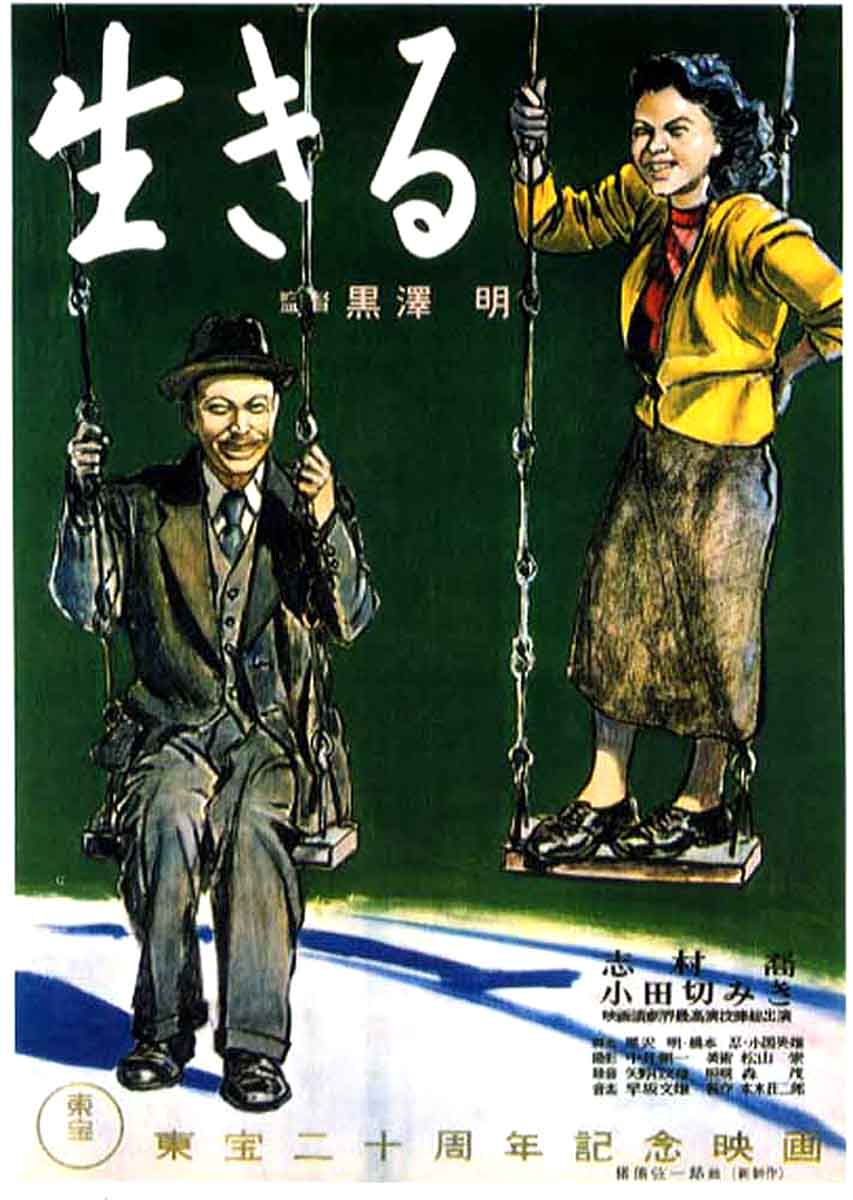
Ikiru (Japanese: 生きる) isn’t a film so much as it is a deeply moving voyage to the heart of the human condition, told through a fervent form of compassion rarely found in even the most empathetic works of cinema. Praising Akira Kurosawa for being a gifted filmmaker is the same as calling Mozart a talented composer – the very mention of their name brings a level of prestige. Kurosawa mastered his craft in a way very few of his contemporaries were ever able to do, and whether in the form of a towering historical epic, or a deeply moving social drama, he was always in firm command of his vision. Ikiru is one of his most cherished works, with the story of a middle-aged bureaucrat discovering that he has terminal cancer, and has only a few months left to live being one that has struck a chord with viewers old and new ever since it first emerged nearly seven decades ago. As one of his more subdued projects, Ikiru saw the famed director working from a place of profound intimacy and perpetual reverence for the human condition, crafting a touching and hauntingly beautiful odyssey that celebrates life as much as it anticipates the inevitability of death – and with a tremendous leading performance at its heart, and a mighty control of its emotional content, it’s truly impossible to view Ikiru as anything less than an absolute triumph, a heartfelt and unforgettable journey into the final days of a man who does whatever he can to leave a legacy, proving that it is never too late to change the world and provide a sense of hope to those who need it, even if you do it one step at a time, with even the smallest efforts changing the world in a significant way.
Kurosawa certainly had his work cut out for him with this project, which is essentially a film that requires him to balance two wildly disparate themes – the first being the surface-level narrative about an old man who discovers that he is soon to meet his demise, with his efforts to leave behind some legacy taking up a considerable amount of space, which leads to the second theme, that of celebrating life. Ikiru has a lot of heartful commentary, all centred around the importance of cherishing life, whether it be the major events or the smallest, most seemingly inconsequential moments. As downbeat as the premise may be, Ikiru is not a sad film – it has heartbreaking moments, but as we can see in the translation of the title (which means “to live”), this film sets itself up to be a strong exploration of life in all its unconventional glory. Kurosawa may have been known mainly for his bolder films, but the ones that often left the most profound impression are those that are slightly more intimate. Despite the running time (reaching nearly 150 minutes), Ikiru never feels overloaded or unnecessarily long, every scene absolutely essential to the director’s dedicated and passionate pursuit of the elusive metaphysical elixir that helps us look beyond our own individual tragedies, and instead celebrate life, not as something that is owed to us, but rather a blessing. Our existence here is so unlikely in terms of odds, to take it for granted seems misguided – and Kurosawa does so much better in explaining this concept through this film than anyone else could, avoiding cliche and cutting right to the root of what it means to be alive.
It helps considerably that Ikiru features a truly staggering performance in the form of the legendary Takashi Shimura, one of the finest actors working in Japanese cinema during this era (and a regular collaborator of the director, appearing in a number of his films in memorable roles). Playing the part of Mr Watanabe, Shimura is absolutely spellbinding – it’s the kind of performance that doesn’t necessarily rely on the verbal channel as it does the more subtle nuances found in the character, such as the actor’s incredible expressivity and ability to command any scene without even saying a word. Ikiru is a character-driven piece, and therefore depended almost entirely on the strength of the central character and his development – and it goes without saying that Kurosawa, who could extract the finest performances from absolutely any actor, knew how to harness the raw, unfiltered emotion exuded by his leading actor, who offered exactly what the film needed, which still showing the restraint to step back and allow some of the other actors to have their moment too, since this film isn’t solely focused on the protagonist’s journey, but also the community around him. The director weaves in some wonderful performances from the supporting cast, particularly in the second half of the film, where the story takes place after the main character’s death, the perspective now shifting to a few characters looking back on his life and the intentions he had in the weeks leading up to his death – and as much as we gravitate towards the incredible work being down by Shimura, Ikiru is just as interested in looking at the lives of these other characters in the process, and how they too are an invaluable part of the narrative and its perpetual search for the truth.
Had someone without the reputation and self-assured vision present in Kurosawa been tasked with bringing this film to life, it’s likely that it would not have been nearly as successful, since so much of what makes Ikiru so successful comes in the form of the intricate details that the director infuses into the film alongside the bold strokes of emotion. A story like this easily lends itself to overwrought emotional content, and could lead the more cynical viewer to believe they are being manipulated to feel something by force. As much as Kurosawa ensures that the emotional content of this film is always very clear, it never feels like the audience is made to endure emotions that aren’t really there – every sensation is drawn from something genuine, a result of the very authentic and simple approach to the story, which is in itself very emotional. There is a reason why Ikiru is regularly listed as one of the most heartbreaking films ever made, but because there are an abundance of scenes that extract tears, but rather it features a kind of functional compassion that isn’t afraid to touch on some raw nerves. This is a beautiful film, but not an easy one – Kurosawa challenges the audience in the same way as he does the characters, provoking our inner conscience and causing us to question deeper themes that we often take for granted. The impact of the film doesn’t come merely in watching Mr Watanabe gradually meander towards his demise while trying to make a difference in a world from which he is soon departing, but in how we are placed in his position too, forced to look at the impact we are making on others, in the hopes of reminding us that there is always an opportunity to kindle some form of change and make the world a slightly better place. Kurosawa does all of this without ever veering towards heavy-handed preaching, allowing Ikiru to speak on its own as a work of pure compassion and humanity.
In the canon of great Japanese dramas, Ikiru is sometimes forgotten, with more notable productions eclipsing this very simple but effective portrayal of the human condition. However, this is a film that is far from obscure, especially considering how cherished it remains amongst those who are either devotees of this era of Japanese filmmaking, or are generally adherents to the career of the esteemed director. For whatever reason one may be enticed by this film, there is a very clear sense of compassion that fuels our relationship with this story – it’s almost as if the director who not trying to tell a story so much as he was attempting to splash a vivid, unforgettable image of life on the screen, taking us on a journey into the mind of a man who realizes his days are numbered, and who chooses to spend whatever time he has left helping make the world slightly more pleasant, so that he can exit this life knowing that he’s made a difference. This is a truly inspiring film, and in between moments of heartbreaking melancholy, it makes some profound statements, using deep discussions on social inequality and bureaucratic frustrations to flourish into a gorgeous, evocative drama that gets to the root of the human condition and leaves us thoroughly engaged with its unique perspective on everyday matters. Ikiru is a film that will provoke thought as often as it draws tears, which is frequently and without any restraint – but it all appears quite genuine, everything being exceptionally well-placed in this film’s frequent pursuit of a series of deeper truths that ultimately inform our overall perception of a world that is filled with challenges, and a life that is finite, with our responsibility to be to make the best of both while we still have the opportunity.
 The Postmodern Pelican