
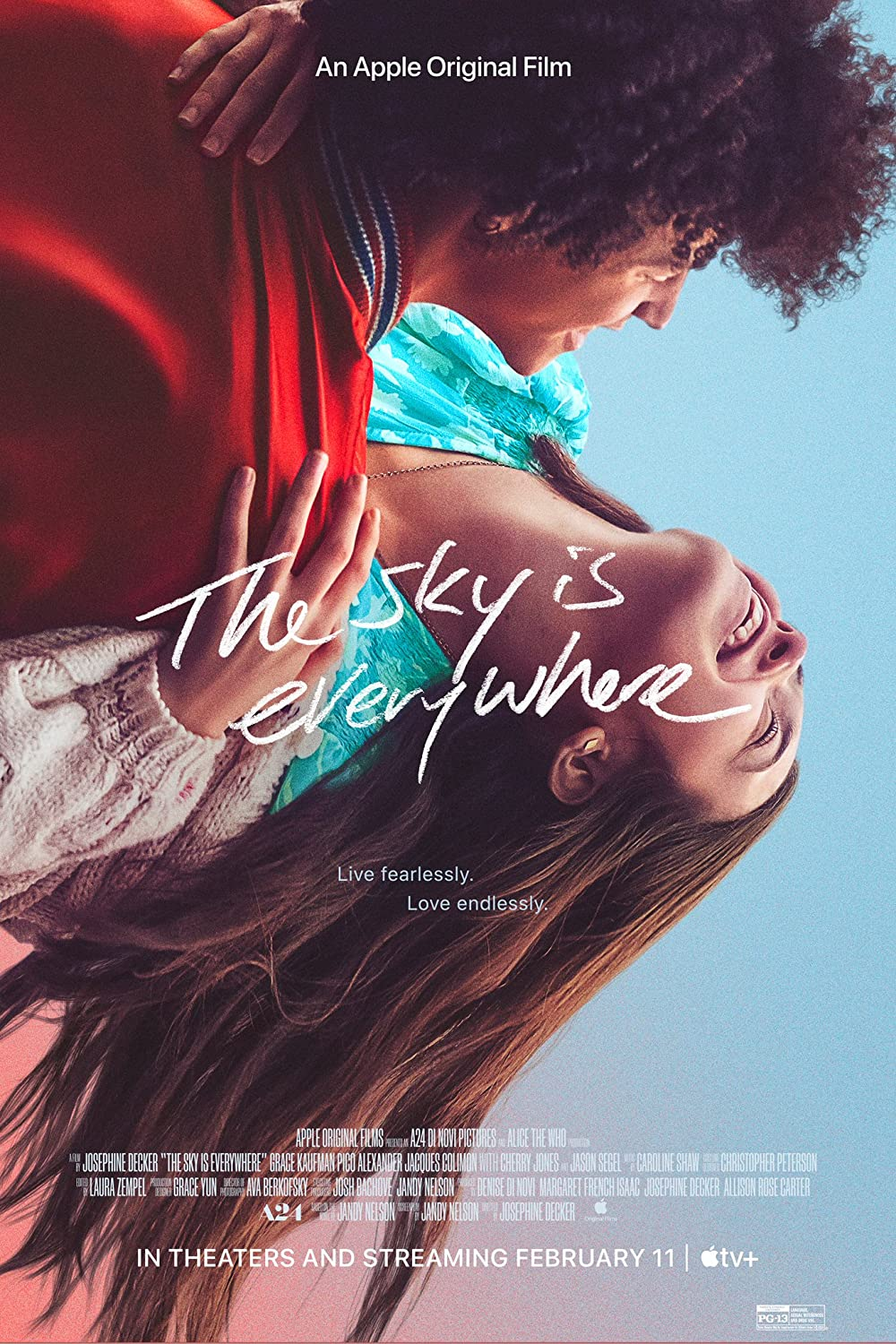
After nearly a decade of making small, intimate independent dramas that bordered on outright horror, it seemed inevitable that Josephine Decker would make something that veered towards populist filmmaking. Mercifully, her first foray into the realm of the mainstream was one that actually seemed very fitting for the director, in the form of The Sky Is Everywhere, an adaptation of the novel by Jandy Nelson, who also wrote the screenplay, which tells the story of a young musical prodigy coming to terms with the nature of her mortality after her older sister suddenly dies, leaving behind a legacy that no one seems capable of honouring, since their grief makes any attempt nearly impossible. A story steeped in many of the qualities that Decker has shown extreme preference for in the past – folklore, the musicality of everyday life and the process of redefining femininity through difficult situations – this film seems very much aligned with the director’s sensibilities, so much that it stands as one of the most inventive and unique young adult films of recent years. An extraordinarily strange, but undeniably captivating work of romantic drama, The Sky Is Everywhere is a triumph, effectively avoiding all the well-known pratfalls normally found in similarly-themed films, and instead glides over cliche to become a hauntingly beautiful testament to a number of themes, whether it be that of grief after the death of a family member, or the process of falling in love, which can be a difficult experience when having to deal with other factors that are somehow outside of our control. It’s a striking and beautiful work of carefully-constructed surrealism, curated by a filmmaker with a keen eye for detail, and the fervent compassion to tackle something as simple as the source material, and produce an exceptionally affecting work that reminds us of the value of not only accepting our losses, but also appreciating what we have while they’re here.
In a cinematic landscape where the vast majority of young adult adaptations are either the same dystopian story told in different ways, or overwrought, melodramatic romances, a film like The Sky Is Everywhere is bound to stand out. It does structure itself as a romance, by virtue of the storyline, but it never feels trite, instead having a very peculiar sense of direction that undoubtedly comes about as a result of Decker’s very precise and distinctive style, which has served her well over the years as she has gradually risen to become one of the most exciting young directors working today, and someone on the precipice of an enormous breakthrough. Rather than having this director, who has received considerable acclaim for her arthouse work, change her style to fit into the constraints of this genre, the decision was to rather pair the novel with Decker’s very unique approach to directing, placing them together and finding that these two wildly different entities somehow bind together perfectly. Part of this comes in Decker’s decision to not tone down her style insofar as she refuses to abandon the sense of surrealism that often underpins her work and makes it such an engaging experience for anyone who voyages into her world – the difference here is that, rather than using her ability to carefully but effectively challenge the laws of logic for the sake of instilling fear in the viewer, she reconfigures them in an effort to evoke a genuine emotional reaction in her audience, one caught somewhere between curiosity and sadness, which are not responses that are normally commonly found in close proximity, but yet make perfect sense when filtered through the director’s distinctly surreal lens, which captures the most intricate elements of the story and presents them in a way that is vaguely fantastical.
There is a seemingly endless stream of romance in this film, which is to be expected from a young adult novel, since these are often texts that look at the awkward stage between adolescence and adulthood, which is a time when love begins to blossom. However, despite being exceptionally well-executed, this side of the story is probably the least interesting, not because it is in any way poorly conducted, but rather since it is used as a facade for the real theme of the film, which is that of grief – and this is exactly what the film was aiming to be in the first place. This is precisely where The Sky Is Everywhere begins to deviate from similar texts, particularly in how it presents the mourning process as not being a linear, consistent stream of emotions, but rather a collection of moments that someone has to go through daily, some of them being harder than others. The emotional resonance of this story is extraordinary, especially for those who have lost someone close to them. The story is made with a lot of heart, and it is very likely that what endeared Decker to this material aren’t the inconsequential romances that essentially just serve as thematic markers to demonstrate the protagonist’s growth and changing mentality, but rather the unique perspective on the human condition offered by the story. It’s an unexpectedly complex view on grief, which is something that is not uncommon in this category of film, but is rarely produced with as much genuine empathy as it is under Decker’s careful guidance, which allows the most significant themes to gradually simmer to the top, while those that are somewhat less effective barely even register. There is an earnest sincerity to The Sky Is Everywhere when it is confronting these difficult themes that demonstrate maturity and genuine interest in looking at these ideas, rather than just bundling them into an overwrought series of heavy-handed conversations, which could have indelibly changed the course of this film had it been allowed to follow this default path.
Considering the subject matter, The Sky Is Everywhere is not the easiest film to watch – but with Decker at the helm, it becomes something quite extraordinary. Primarily, we are presented with an image of the world that is truly mystifying. The idea of setting this story in and around a house situated in “California’s enchanted forest” could be seen as twee in the hands of someone less well-versed in the abstract nature of reality (as well as the powerful realities that come about through engaging with the natural world). Decker doesn’t entirely require us to suspend disbelief, but rather just take her peculiar flights of fancy in stride, since she is not interested in presenting us with a landscape that resembles reality. This makes more sense when we look at The Sky Is Everywhere as less of an objective realist text, and more a bildungsroman of a young woman who sees the world in various shades that differ from anyone else. We always tend to look at our surroundings through our own unique perspective, so this colourful, unconventional world is not an effort to trivialize the story, but rather offer an entirely different view on reality through the eyes of someone who exists in a state of near-fantasy, which is her primary method of working through some very harsh emotions. It helps that the film serves as an excellent showcase for Grace Kaufman, who seems primed for a major breakout based on a small but meaningful body of work, allowing her to take on the character of Lennie Walker, a young woman whose life is shattered by the death of her sister, but rebuilt with the help of the people who remind her of the value of living – included in this group are Cherry Jones and Jason Segel as Lennie’s loving family members, and Jacques Colimon as her extremely charming love interest that serves to be the catalyst of her eventual change – and as we’ve seen on many occasions, Decker is incredibly adept at extracting wonderful performances from her actors, with The Sky Is Everywhere not being any different.
It is certainly easy to not notice The Sky Is Everywhere, since it’s not a film that immediately jumps out as anything special. While it is a sub-genre that is respectable and not deserving of the ire it receives for being supposedly less-prestigious than other films, young adult fiction does not have the strongest reputation (and it doesn’t help that film adaptations often tend to be produced rapidly without much attention being paid to the actual filmmaking process, instead being fashioned along with the guidelines of trying to capitalize on a key market). However, if there was going to be someone who would take a relatively cherished young adult text and transform it into a hypnotic, evocative romantic drama that is filled to the brim with artistic integrity, it would certainly be Decker, whose own career has been reflective of a key set of themes that usually see her questioning very similar issues, often just in the form of more unsettling psychological horrors, rather than deeply meaningful romantic dramas like this one. The Sky Is Everywhere is a special film – it is anchored by strong performances, and it reconfigures cliches with impressive consistency, knowing that they cannot be avoided in such a story (especially with the novel’s original writer being behind the screenplay), but rather that they can be assimilated into the text differently. Beautifully poetic and frequently deeply moving, this film is an endearing and simple meditation on life and death, romance and heartbreak, and everything that occurs between them, being one of the most affecting stories of grief in quite a while, not for how it depicts the mourning process, but how it shows that there is always a silver lining, and that even the most hopeless days have the capacity to bring joy, but only if one is willing to look for it.
 The Postmodern Pelican