
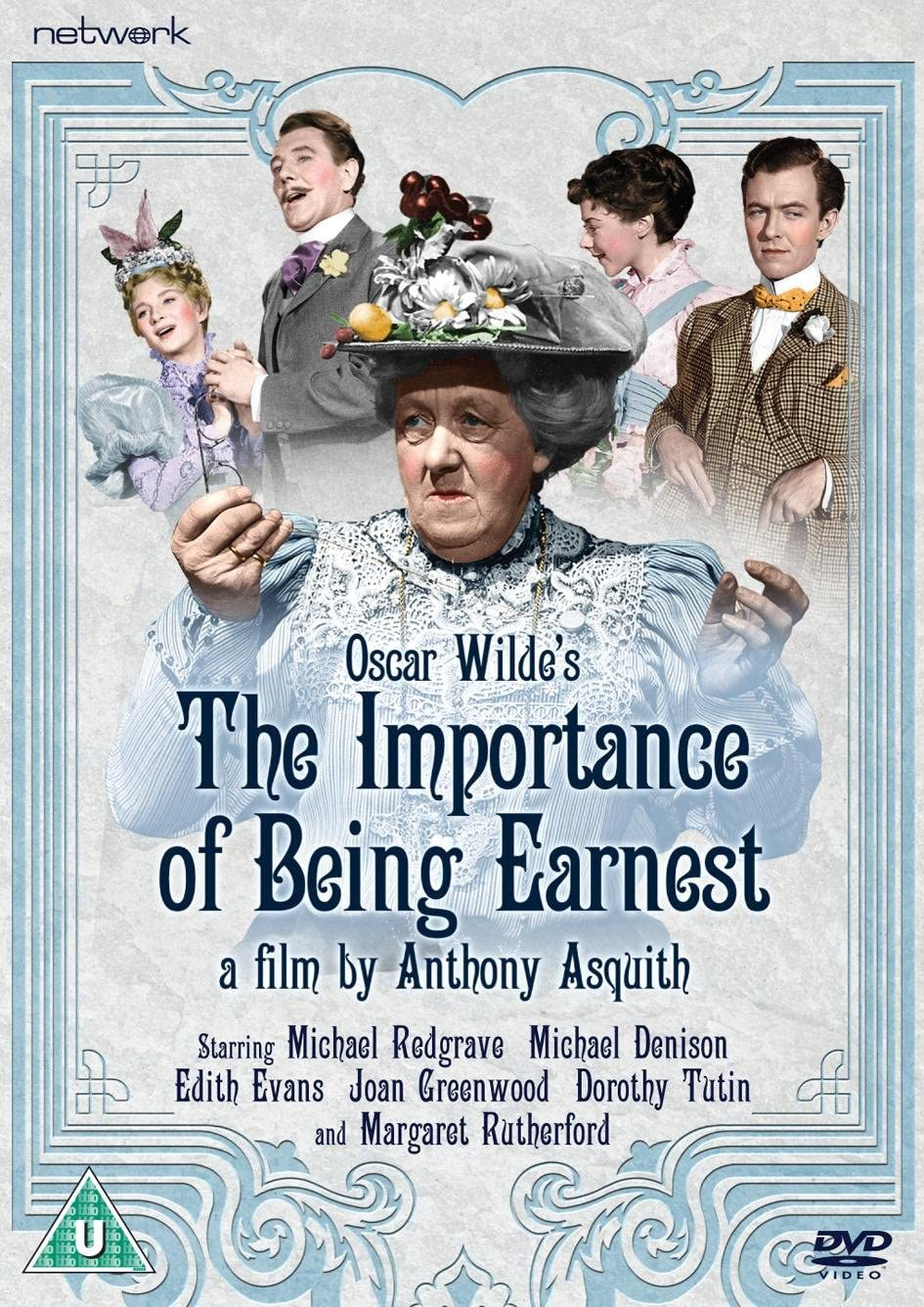
Without any doubt, there are few writers that defined the concept of wit quite as well as Oscar Wilde, who essentially set the standard for much of modern-day humour with his scintillating, scandalous comedies, whether they were written for the page or the stage. The piece with the most notable cultural footprint is undeniably The Picture of Dorian Grey, but there is certainly an argument to be made that his most important works are those when the writer was able to make use of his remarkable sense of humour, which is exemplified in The Importance of Being Earnest, which has often been cited as one of the most commonly-performed productions in the history of theatre, second only to Hamlet. Like any notable work of fiction, this particular play was subjected to the inevitable film treatment on a few occasions, whether direct adaptations, or merely films that were inspired by the story. The best film based on Wilde’s play is the version directed by esteemed British filmmaker Anthony Asquith, who takes the original text and turns it into a rivetting screen comedy that is as hilarious as it is fascinating. Whether through the lush Technicolor photography, or the remarkable cast of some of Britain’s finest thespians, or the general approach taken in working through Wilde’s iconic play, The Importance of Being Earnest is an absolute delight, a charming and eccentric comedy that honours the source material while still making a few interesting choices in the transition from stage to screen – and while it may not be the definitive example of a good theatrical adaptation, it does prove that one can still take a cherished work of fiction and bring it to the screen in a way that is meaningful and entertaining.
The aspect of The Importance of Being Earnest that helps it stand head-and-shoulders above many other stage adaptations is how Asquith is thoroughly committed to paying tribute to Wilde and his incredible work. One has to wonder why many filmmakers choose to rewrite and reconfigure notable works of fiction, when many of them are well-written enough already, at least enough to justify their existence – and avoiding this entirely, he chooses to honour the original text by staying extremely close to it. With the exception of a few moments where the director is changing a few minor elements of the dialogue (mainly to adapt it to the medium of film), Asquith keeps the original text almost entirely intact, allowing it to speak for itself. Considering how quotable his work is, and how he is often considered one of the most significant figures in the history of comedy, it would be foolish to tamper with his works of genius. The film keeps everything that made the original play so special, from the irreverent dialogue that sparkles with the wit of someone who defined comedy, to the masterful development of very interesting characters, all through the endearing lens of a delightful comedy-of-errors that keeps us engaged, regardless of whether we are aware of the specific nuances of the plot, or are just passive viewers looking for 90 minutes of solid entertainment. Asquith had a tendency to make quite strong literary adaptations in both the realm of comedy and drama, so it’s hardly surprising that The Importance of Being Earnest is such a triumph for the director, who understood how to balance his own authorial voice with that of the original writer.
It’s likely that the main reason many would watch a production of The Importance of Being Earnest, whether on stage or screen, would be to spend some time with these wildly funny characters that are interesting archetypes of the kinds of people Wilde encountered in upper-class English society. It stands to reason that stories like this depend almost entirely on the actors portraying these characters, and this adaptation is not any different in how it uses its actors, with some of the country’s finest thespians finding their way through the film. Michael Redgrave, the patriarch of one of the most important acting dynasties in the history of the profession, is as dynamic as ever in the role of Jack Worthing, whose choice to adopt the pseudonym of the more sophisticated “Ernest” is the centre of the film’s central tension, and the cause of nearly all the comedy that resides at the heart of the film. Redgrave is naturally exceptional, finding the perfect blend of stiff-upper-lip elegance and outrageous eccentricity, which makes his performance so memorable. He shares many qualities with Michael Denison, who plays his good friend and momentary rival who has the same tendency to construct false identities for the sake of getting his way, and who comes into direct conflict with the protagonist when they find their lies catching up to them. However, the true star of The Importance of Being Earnest is Dame Edith Evans, the veteran of stage and screen who steals every scene she is in as the droll Aunt Augusta, who believes in strict decorum with the same fervency as the most faithful believe in a higher power – and while she only appears in a handful of scenes, every word and expression is absolutely hilarious, and both grounds this film in reality, and allows it to flourish into a truly outrageous piece of comedy.
For those looking for a subversive comedy that tests the boundaries of good taste, The Importance of Being Earnest may not appear to be all that impressive – after all, so much of the film is focused on adhering to social mores and the strict traditions that make up supposedly “decent” society. What many who are critical of these kinds of stories tend to overlook is how this is just about as revolutionary as a Victorian-era play can get. Instead of looking at a film like this from a contemporary perspective, we should consider it as a product of its time, and for a play written and originally performed in 1895, there is a lot of subversive material that can be considered quite shocking for that particular period. Asquith doesn’t dismiss the risque and controversial aspects of Wilde’s work – much of what can be found in The Importance of Being Earnest can be seen as testing the confines of good taste, and the prim-and-proper exterior acts as a veneer that covers the darkly satirical aspects. This has allowed Wilde’s work to remain so endearing and timeless, since he didn’t only write for the sake of entertaining audiences present during his lifetime, but also to make a statement – and throughout this adaptation of the play, the director ensures that the spirit of the author’s ideas remain intact, staying extraordinarily faithful to the origins of the story while adding his own directorial flourishes, such as in the sumptuous production design and costuming (the latter on behalf of Beatrice Dawson, who literally tailors the clothing to reflect the characters who don them), creating a vivid and detailed exploration of some fascinating ideas.
When it comes down to it, The Importance of Being Earnest gives the viewer exactly what they paid to see – an upbeat comedy about high society life, filtered through some trivial but captivating activities that are seen as the definition of scandals in the aimless lives of these wealthy characters, with an undercurrent of scathing social satire that is as refreshing today as it was when Wilde put pen to paper, and a few decades later when Asquith chose to bring it to the screen. It’s a peculiar film, but one that never fails to entertain us, especially when it comes to looking at the intricate details that make this such an endearing comedy with as much heart as it has humour. Featuring some tremendous performances from actors that always understand how to command the screen, interpreting the material in their own way while still paying tribute to arguably one of the greatest writers in the English language, and turning in strong work that is so profoundly interesting to watch. It’s a striking piece of cinema that works as both a charming comedy and a snapshot of a particular era – and it sets the standard for stage-to-screen adaptations, proving that one can have artistic freedom while still paying tribute to the source material. It’s a wonderful film that gives us exactly what we seek, and for that reason alone, The Importance of Being Earnest is a terrific adventure into the bewildering world of Victorian society, as facilitated by a writer whose legacy remains as poignant as ever.
 The Postmodern Pelican