
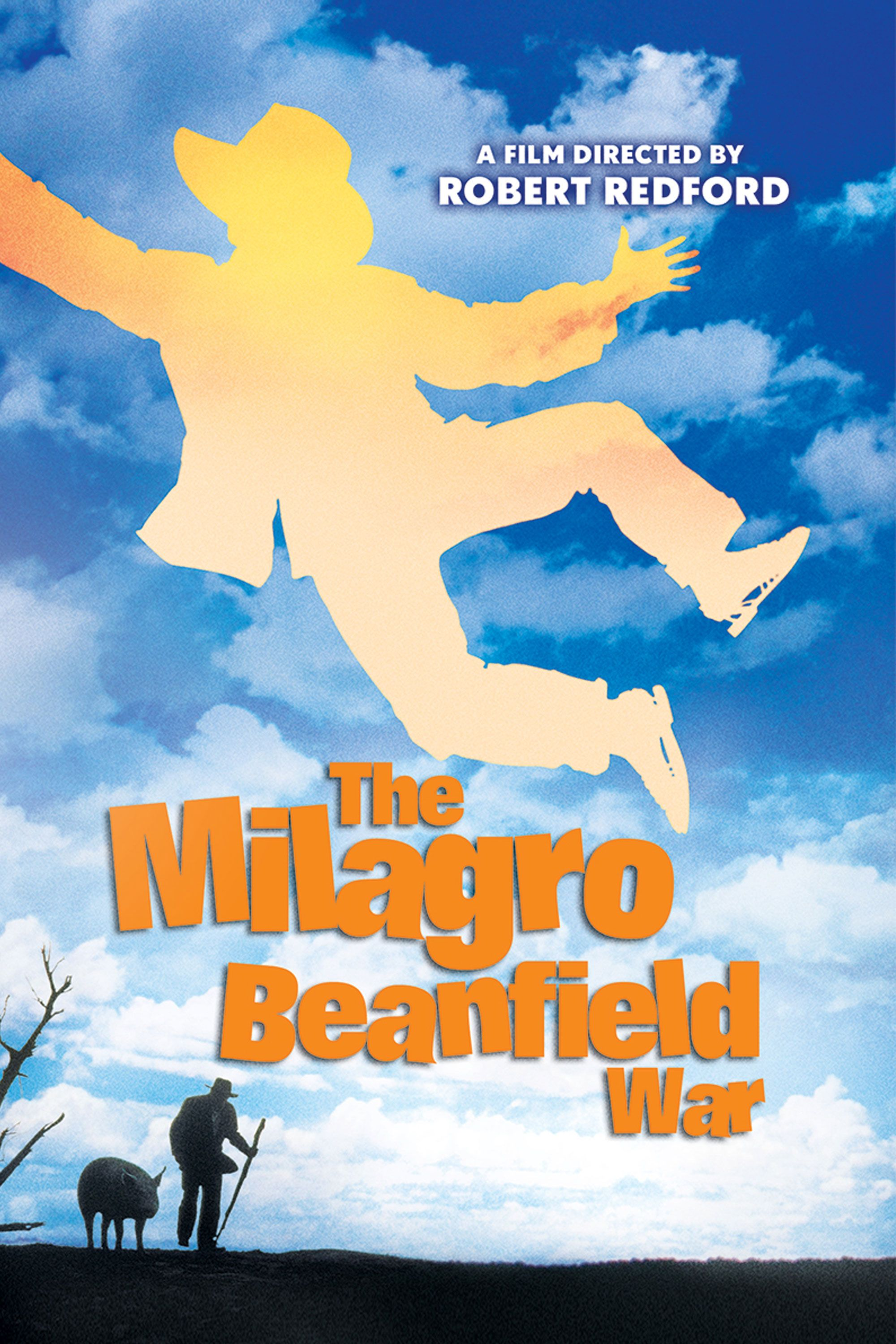
Robert Redford has directed several fantastic films, with the likes of Ordinary People and Quiz Show being relatively well-regarded, with many dedicated supporters that argue towards them being much better than most efforts produced by actors-turned-directors. For a lot of his career, Redford struggled with shedding the image of being an irresistible heartthrob, taking on increasingly interesting roles, including some of them behind the camera, which led to some terrific films. However, one of the few that is not as well-remembered is The Milagro Beanfield War, a film as eccentric as its title would suggest. The story of a close-knit Hispanic community fighting against the encroaching danger of maniacal industrialists, who hope to take over their small New Mexico town for the sake of capitalistic expansion, is not one we’d traditionally expect from Redford, but when we look at the general components, and how the director effortlessly explores some deeper issues, we can see some of his distinctive traits simmering beneath the surface. Adapting the novel by John Nichols, which is a relatively charming text on its own, the director asserts some fascinating ideas throughout the film, touching on issues relating to cultural bonds, the value of tradition and the contrast between community and financial gain, which are two ideas that are not often found to be particularly likeable bedfellows, especially in a very materialistic world. Redford provokes some very deep thought, but in the form of a lovely, endearing comedy about a group of defiant people willing to stand up and defend their home and everything it stands for, leading to a delightfully irreverent and very moving little comedy.
Redford has always been something of a red-blooded liberal, with even his earliest works finding the actor using film as a platform to discuss certain issues, even if it was only through playing these urbane, intelligent men who often find themselves in strange situations. As a director, he has consistently provoked conversation around social issues in some way, so it only makes sense that The Milagro Beanfield War would be something that would appeal to him, since the story is primarily one that focuses on underdogs going against the draconian world of corporate America, and ultimately managing to win (albeit not all that easily), their victory being one that is meaningful but bittersweet. There are real-world correlations, and despite being made over a quarter of a century ago, this film has many ideas that remain relevant, particularly in how it focuses on a world growing increasingly dependent on capitalism, which has gone from promising prosperity to demanding adherence, at the risk of stripping us of the fundamental freedoms that we don’t realize are as deeply ingrained in the global culture until they’re taken away. The general story by Nichols (who also wrote the screenplay, meaning that the transition from his novel to the screen was much more seamless) is one that touches on a range of themes – primarily culture and ethnicity, with the opposition between the Hispanic members of this community, and the outsiders who enter into their town with the intention of not only gentrifying it, but also taking it over entirely for the sake of financial gain. Through this general theme, there are conversations around the class divide and how many communities are inherently disadvantaged as a result of the government having preconceived notions of who they should prioritize. There are several ideas interweaving throughout The Milagro Beanfield War, which Redford captures so incredibly well, telling a complex story of a community growing weary of being controlled, and deciding to fight back, regardless of the consequences that they may encounter.
However, despite the very heavy subject matter (and Redford is not one to shy away from the darker moments when they’re necessary), The Milagro Beanfield War is still a very charming film, and it manages to find comedy in some of the most unexpected places. The reason for this is that, more than anything else, Redford structures this as a community-based comedy. From the most admirable hero to the most deranged villain, everyone in this film is extremely interesting, being crafted as over-the-top archetypes, but in a way that is actually constructive, rather than merely being the result of lazy writing. There may be very serious subjects being discussed here, but the primary motivation of this film is to be a much more endearing exercise in exploring the inner workings of this community. We can easily find a wealth of literature that presents a very sober and dour portrait of inter-cultural conflict over the looming dangers industrialisation has on smaller communities. However, not many of them are structured around more humorous situations, which is primarily where The Milagro Beanfield War is at its most successful, since it rarely (if ever) actively fights against the hysterics, and instead replaces them with a more upbeat tone. This doesn’t mean that the film is trivializing the more troubling content, but rather adding nuance to them in a roundabout way, using a dreamlike, stream-of-consciousness narrative to disseminate some of the more resonant subjects, to the point where Redford has to effectively find the perfect balance between comedy and drama, or else risk having the film either lose its very touching sense of humour, or become an overwrought and vaguely propagandistic portrayal of life in contemporary America. Logically, we can determine which approach Redford was most interested in, and through looking at these issues through a lens of gentle humour, rather than forthright and flippant comedy, he manages to make some very deep statements on a range of compelling and captivating themes.
A film that depends on its ensemble, The Milagro Beanfield War is filled to the brim with memorable actors, plucked from different areas in the industry. Redford smartly does not structure the film around one particular character, but instead presents an overarching portrait of a wide group of individuals on both sides of the conflict (as well as a few neutral individuals in the periphery), making this film a vivid tapestry of life. Choosing a standout is nearly impossible, since everyone is working at roughly the same level, pitching their performances to the rafters in a way that is very funny, but also not too excessive, which is important to note for a film that could have so easily have fallen apart with the wrong approach. Sônia Braga and Julie Carmen (both international treasures in the world of contemporary filmmaking) are the hearts of the film, while the likes of Rubén Blades, Carlos Riquelme and John Heard being memorable as the de facto leads of the film, even if their time on screen and general function in the story makes them blend into the background when it was necessary. Much of the comedy is taken from the performances, with their varying levels of intensity being curated perfectly by the director, who pulls out some terrific work from his actors, making The Milagro Beanfield War one of the most unexpectedly compelling comedies of its era, purely on how much it seems to genuinely care about its characters, casting them with great actors who could easily take on these endearing but challenging roles that are a lot more complex than they appear at first.
The Milagro Beanfield War is not the most popular film, nor is it one that any of us normally associate with the people involved in its creation, since those on both sides of the camera certainly are not defined by this film, which is more of a footnote on their illustrious careers than anything else. However, this is not for lack of trying, since Redford did genuinely seem interested in telling a captivating story of underdogs triumphing over the big corporations, which continue to be a plague on the worldwide culture. Granted, it may not be the most serious glimpse into these issues, with everything in this film being filtered through a very clear lens of humour, whereby Redford extracts the most interesting elements (which some may consider exploitative to the reality of the situation), but it still maintains a level of respect for the subject matter, which is an increasingly rare occurrence when it comes to socially-charged comedy, which seems to think that contemporary issues can only be funny when they are darkly satirical, and that a well-meaning, charming comedy like The Milagro Beanfield War is not relevant. However, the genuine sense of heart, and the various simple but stylish qualities all ultimately make this film an enduring and lovable film about resistance, and how there is always power in numbers. It has imperfections, many of which are easy to resist in favour of the more quaint storyline, which leads to an enthralling two hours of truly lovely filmmaking that proves that even at his most pedestrian and populist, Redford was still capable of capturing our attention.
 The Postmodern Pelican