
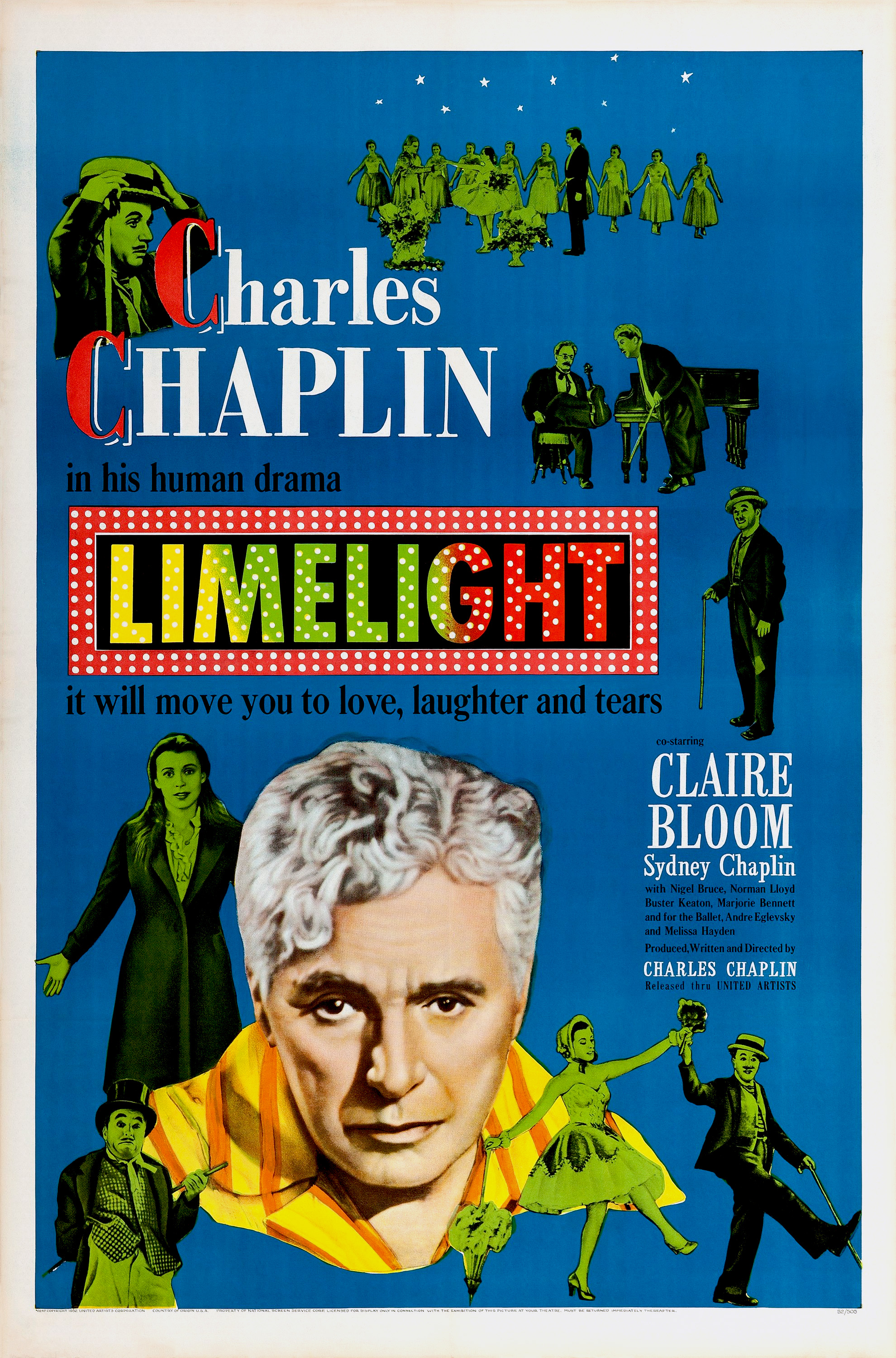
Is there any name that evokes a more passionate response than Charlie Chaplin? Arguably the most recognizable actor to ever work in the medium of film (perhaps only overtaken by Marilyn Monroe in terms of being a pure icon that is known across the world), he earned every bit of his acclaim and status as one of Hollywood’s finest performers. On both sides of the camera, he proved himself to be one of the most talented artists to ever enter into the industry – but I highly doubt anyone needs to be convinced of this fact. What many don’t realize is that the second half of his career was not nearly as positive as his happy-go-lucky Tramp persona, which has infiltrated the culture more than many characters, with his personal philosophy and slightly inadherent politics placing him in a precarious position, where he was accused of being a Communist sympathizer, and subsequently blacklisted from Hollywood in a move that would essentially end the height of his career, and rob him of over two decades of work in the industry as he had to retreat to his native Europe. The final film he made in America was Limelight, which is often considered one of his finest works – perhaps not the exuberant comedy we’d expect from Chaplin, but still an excellent comic masterpiece that carries the depth that we usually find in Chaplin’s more expansive works, the story of a former clown basking in his past glories while trying to survive life after falling out of the public eye, is a truly extraordinary achievement, and one of the most complex films Chaplin ever made. It remains one of his most cherished works, even outside of the downbeat realization that this was his American swan song, a fitting but melancholy fact that only adds to the impact made by the film.
Limelight is not a film made by the rambunctious, energetic Chaplin that we knew from the silent era, but rather one carefully constructed by an older, more weathered version of the artist, a man who is on the other side of middle-age, and is now gradually taking on more heartfelt roles that represent his newfound appreciation for stories focused on more intimate matters. Throughout the film, Chaplin seems to be reflecting on his own career – while he was far from a faded star, the character of Calvero is not too dissimilar from the actor’s most famous creation, The Tramp. They’re both eccentric and lovable buffoons that use their physicality to extract hearty laughter and genuine joy from the audience. Chaplin knows how to command the screen, so much that even when playing a relatively subdued character, he’s using every bit of charisma he had to bring him to life. Some have argued this is one of the actor’s most personal roles, particularly in how it has many parallels with his own life – I think of it as Chaplin ruminating on what his life would’ve been like had he not ventured out of Britain and taken a chance on Hollywood, and rather chose to stay at home and work on stage. As we tend to see, the most vivid performers are often those that fade into obscurity the fastest, and whatever propelled Chaplin to tell this story and create such an interesting individual was worth the effort, since Calvero is one of his most incredible creations, a complex individual who is far from any discernible archetype, all through Chaplin’s increasingly tender touch in playing the character with as much humour as he did heart.
While he did define an entire century’s worth of comedy, no one could infuse the most humorous situations with necessary pathos quite like Chaplin. In many ways, Limelight barely feels like a comedy – had it not featured a few well-placed sequences of levity, this would almost entirely be a straightforward drama, a precise and honest character study about two people trying to navigate a hostile world while attempting to break into the contemporary entertainment scene (one of them for the first time, the other in what he hopes is a comeback). Chaplin could have so easily aimed for the low-hanging fruit, since the premise of Limelight does inarguably feature some degree of comedy, which could’ve quickly descended into being entirely outrageous and idiosyncratic in the way a lot of self-referential comedies around this time tended to be. One element of the film that anchors it to reality is Claire Bloom’s performance, which is just as good as the one being given by her intimidatingly famous co-star. Bloom, who we now recognize as one of the finest actresses of stage and screen, was a young upstart by the time Limelight was made, but even though she was relatively inexperienced, she turned in a remarkable performance that is essentially the heart of the film. Her character is a ballerina trying to make a name for herself, and is on the precipice of a breakthrough – and Bloom brings so much empathy to the role, helping define the film as much more than just the dreadful tale of a young starlet interacting with an older, washed-up entertainer. There’s a sobering quality to the film that comes through in the central dynamic that is quite difficult to describe, which only proves how Chaplin was a master of his craft, even managing to use the smallest details to establish a clear and concise tone.
This film could’ve so easily turned into a bold comedy with several hilarious moments (and don’t be mistaken, it doesn’t lack a lot of strong humour), but Chaplin had broader ambitions, and in the process of telling this story, he effortlessly combined humour with the more serious fare, creating a distinct and unforgettable film that is best described as a bittersweet tragicomedy, the final hurrah for a master that must’ve already known that his peak was behind him, and that the changing nature of his industry would inevitably place him in the same position as the protagonist of this film. However, unlike Calvero, Chaplin was an artist always willing to adapt to the times, and throughout Limelight, we see him constantly pushing the boundaries of his craft and telling a story that appears simple at a cursory glance, but actually turns out to be unexpectedly complex when we break it down. This isn’t solely a story of an old man trying to regain his former glory – it’s a complex character study that looks at the entertainment industry as a constantly shifting entity, something that changes so frequently, anyone not willing to hold onto the saddle and adapt to the new standards is going to be left behind. As much as we relish in Chaplin’s self-reflective perspective on the industry he dominated for nearly half a century by this point, there is a much wider message being conveyed here – and naturally, the director does it through subversively endearing filmmaking that leads us to believe we’re watching nothing more than a delightful comedy, only to discover that it grows increasingly more serious as it goes on, but yet never fails to keep us engaged. This was the magic that Chaplin possessed and so liberally scattered throughout his long and storied career, which seemed to be leading up to this point.
It’s difficult to not be absolutely charmed by Limelight, a film that perfectly calibrates itself as a combination of both comedy and drama, occurring at the perfect intersection between the two. We are always in good hands, since Chaplin was never a filmmaker who would do anything insubstantial, with nearly every one of his films (especially those that came later) being works of incredible complexity and wholehearted candour. This film in particular is special, since it finds the director looking back on his own journey, judging the previous few decades through the lens of this tragic but uplifting story of a man finding his own self-worth through helping another young artist find her voice. Only someone as gifted as Chaplin could make a film that ends on both a sombre and uplifting note, concluding with the death of the main character, while still being a happy ending – but if there was anyone who could pull off such an anomaly of an ending (and everything that precedes it), it would be the effortlessly self-assured Chaplin, who broke boundaries in a way that none of his contemporaries could (but not for lack of trying – the director even employs one of his peers from the silent era, the equally iconic Buster Keaton, for a surprise appearance towards the end of the film). As a whole, Limelight is a special film – the kind of deeply meaningful and achingly funny comedy that carries an emotional weight that takes us by surprise, and by the end of the film, we’ve been both delighted and shattered, which is perhaps the most appropriate response for a film as layered and melancholy as this masterful excursion into the heart of the entertainment industry, and a couple of wayward souls tasked with navigating it.
 The Postmodern Pelican