
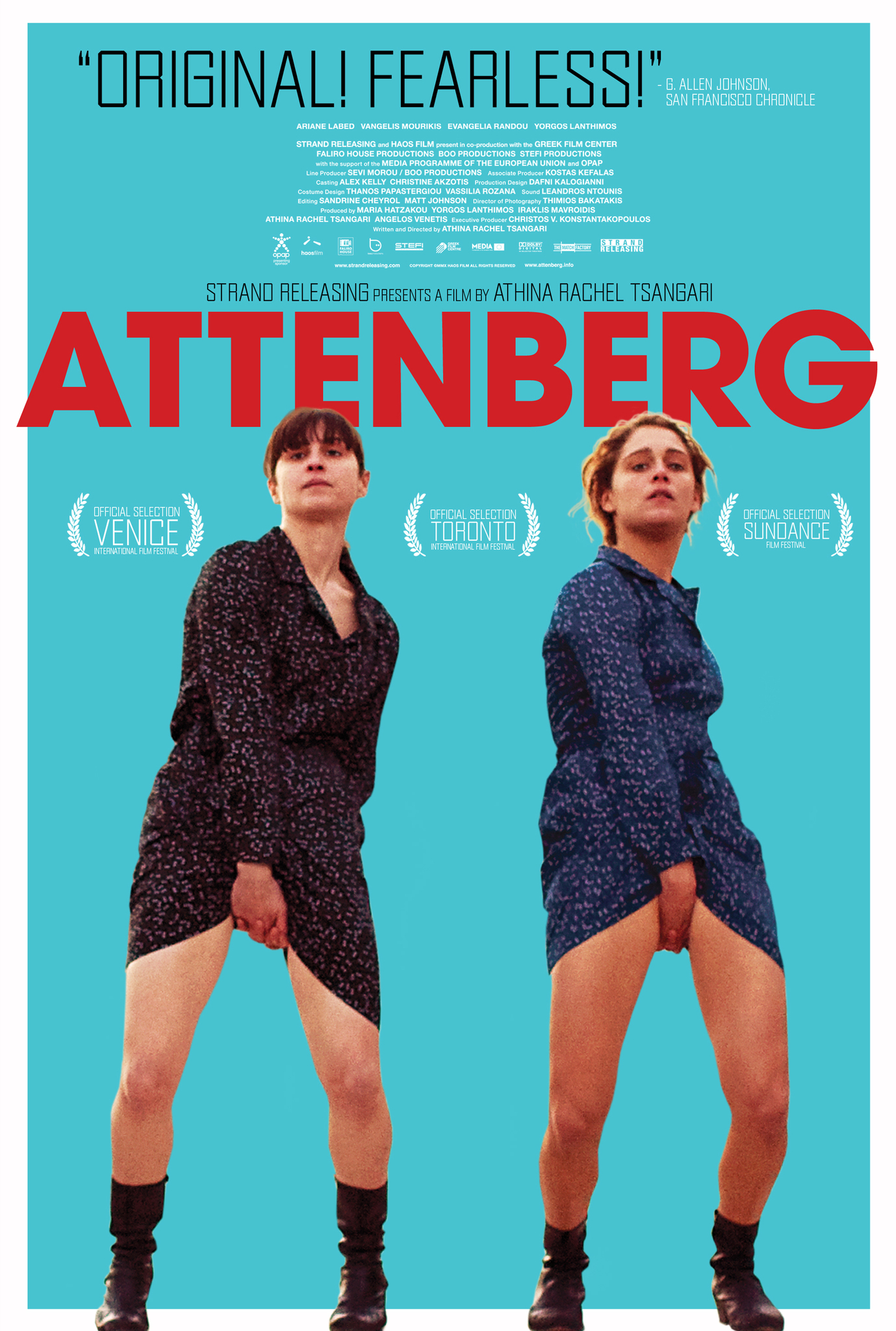
When it comes to making cinema that redefines the limits of artistic expression by filtering it through the most absurd and deranged stories imaginable, no one comes close to the work being done in Greece over the past two decades. Some of the most fascinating and provocative films have been produced by a range of native directors, to the point where they are collectively known as entries into the Greek Weird Wave, a movement dedicated to mind-bending surrealism with deeply realistic undertones. One of the most interesting filmmakers working under this loosely-defined manifesto is Athina Rachel Tsangari, who has been a close collaborator of Yorgos Lanthimos, arguably the person who brought this movement to the mainstream (or at least getting it as close to it as possible). One of her crowning achievements is Attenberg, a bizarre psychosexual dark comedy about a young woman who doesn’t crave sexual desire, but rather the ability to actually feel any emotion, her lust for physical touch contrasting sharply with her deeply anti-social personality, which causes her to live a life of significant seclusion, outside a few encounters with people that she either has a familial connection to, or is interested in pursuing them for the sake of her own self-discovery. Attenberg is a deeply strange and unsettling film, but like any work produced under the guidance of this particular era of Greek filmmaking, it is not bizarre for the sake of it, but rather as a way of commenting on deeper issues that relate to the surrounding world, something many of these characters that populate the films have never truly understood, which makes for some of the more interesting commentaries that define such stories. Attenberg is a tremendous film, a dark comedy about very serious subjects, executed with precision and earnestness that makes for a truly provocative experience.
Attenberg is not a film that is easy to decode from the outset, and it never truly seems to be particularly interested in going above and beyond what we’ve already encountered in the genre, staying with the same surreal sense of abstraction that makes this movement so endearing, but also incredibly confusing for those who aren’t versed in the demented practices of these directors. Tsangari approaches this story from several different perspectives, presenting the viewer with mainly a series of interwoven vignettes in the life of the main character, who we carefully watch in order to make sense of her activities, coming to understand who she is as an individual, and what her life actually entails. It’s never really made all that clear, but a good way to view this film is through the lens of the nature documentaries that Marina watches throughout it – much of the story is centred on the protagonist’s reverence for Sir David Attenborough (whose last name inspires the film’s title), and in many ways, the director is structuring this as less of a character study, and more as a nature documentary, where the everyday routine of this peculiar creature is shown to us, but without the “Attenberg” narration that helps us make sense of what we’re seeing on screen. Instead of being guided by some omnipotent, all-knowing entity that gives us context and clarity, Attenberg instead relies on the individual viewer’s interpretation – and there is so much wonderful discussion to be had about how the director uses this strange approach to her advantage, crafting an unforgettable portrait of an eccentric young woman trying to find her way through a world she struggles to comprehend, relying on a preconceived routine that guides her through life, but is imminently going to come to an end after radical changes force her to reconsider not only her own regular activities, but also her entire existence.
In defining the character of Marina, who is undeniably opaque for the majority of the film, Tsangari makes a good decision in casting French actress Ariane Labed in the part. Attenberg is a character-driven story, so it only makes sense that the person who played the central role would need to be someone who could handle all the challenges presented to her, especially in how the film is structured around deconstructing her – it’s more common to find stories that present us with a fragmented individual that is gradually pieced together as the film goes on, as opposed to having one where our protagonist is seemingly normal at the start, but proves herself to be far from ordinary as we get to know her more, which is an unsettling but fascinating approach to characterization. Labed warrants so much acclaim for following Tsangari’s direction and doing exactly what she asked for – this is a clearly very emotionally and physically taxing role, and Labed surrenders to the madness, putting every fibre of her body and psychological state into creating the character of Marina, who is truly quite intimidating if we don’t take the time to actually look beneath her erratic behaviour. For those who aren’t used to this style of storytelling, Attenberg may seem like it is about an unstable young woman without any direction in life – and while this is undeniably true, there is so much more nuance to how it explores a few months in her life, showing her gradual voyage into the wider world with such sincerity, which intermingles with the beautifully abstract narrative. It’s a matter of oscillating between sanity and madness, all of which comes through in Labed’s stunning and unforgettable performance, which anchors the entire film and single-handedly makes it extraordinary.
There’s a liberation in watching a film in which nearly nothing makes sense, since we don’t often get works of art so gleefully indebted to the act of simply destroying all notion of logic, while still being strung together by a layer of coherency that prevents it from being entirely derailed by absurdity. While this film may inarguably be far less bewildering in practice than it is in theory (allegations that films under this genre are impenetrable are vastly overblown), there’s very little value in expecting a film in which all the pieces of the puzzle are placed down in a convenient manner, and Tsangari consistently acknowledges that she isn’t interested in any real sense of rational thought when she was conceiving of this film. Much like her friend Lanthimos (who has a small but pivotal role in the film), she designs her films less along the lines of a consistent story, but rather a series of moments that are driven by the atmosphere rather than narrative. It’s an approach that certainly has its flaws – after all, how else do we possibly make sense of a character as bewildering as Marina, in situations as polarizing as the ones she finds herself in, and still genuinely grow to care for her? It’s a film that uses the audience’s natural curiosity to great effect, deconstructing a story that barely exists as it is, and using that time to construct a fascinating narrative about a woman working her way through a bewildering world. Surrealism is a repellent when it comes to the discussion – the more we try and make sense of it, the less we actually understand, and while Attenberg isn’t fully defined as a surrealist work, it bears many of the same traits, which becomes quite effective the more we dare to venture into the main character’s world, encounter a range of distinct personalities that make for quite an odd experience.
Provocative but captivating in ways that cannot ever be understated, Attenberg is a remarkable achievement, and a film that seems to only grow better with every passing year, since its central themes are becoming steadily universal the more our world descends into unmitigated madness. It doesn’t always make sense, but it really doesn’t need to in the first place. Instead, it has an abundance of very interesting ideas that place the audience in the position of a passive voyeur, observing the daily activities of a young woman who is seemingly normal, but who grows increasingly more unstable the more we come to understand her. The film is undeniably an acquired taste – it lacks a consistent structure, and whatever narrative cues there are that we can recognize are quickly replaced by the same overarching disdain for conventions that mainly defines the film and makes it such a peculiar but captivating work of postmodern storytelling. There is a complete lack of consistency in how the director constructs her character, and the more we come to rationalize her perspective, the less we can actually understand, a contradiction that works tremendously in this film’s favour. Dark, brooding and blisteringly funny, Attenberg is a bizarre film that proves exactly how the Greek Weird Wave is producing some of the finest works in contemporary cinema, and that as long as we have these demented filmmakers telling their stories in their own way, modern art is still in exceptionally good hands.
 The Postmodern Pelican